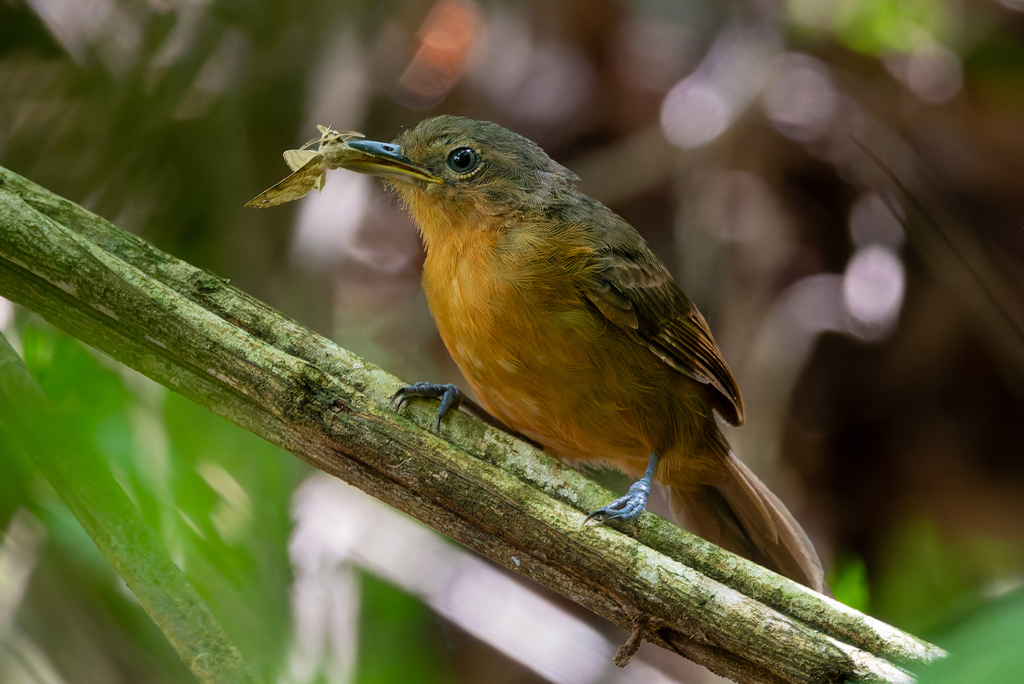
Dusky Antbird
Photo © Adam Jackson
Photo © Adam Jackson — CC0 1.0 — Source: iNaturalist photo #442194099Identification
The dusky antbird is a small passerine, measuring 13 to 15 cm long and weighing 15 to 19 grams. Sexual dimorphism is pronounced. Males of the nominate subspecies are mostly slate gray with darker wings and tail, featuring a distinctive white patch between the scapulars and narrow white tips on wing coverts and outer tail feathers. The posterior underparts show a clay-colored tinge. Females are quite different, displaying a tawny-tinged dark olive-gray crown and upperparts, with a very small white interscapular patch, cinnamon-edged wing coverts, and tawny-buff underparts with an olive tinge to the flanks. All adults possess a striking rich chocolate-brown iris. Subspecific variation exists, particularly in plumage darkness and extent of white markings.
Range & Habitat
The dusky antbird is found from southern Mexico through Central America and into South America, with different subspecies occupying distinct regions from Veracruz and Oaxaca south through the isthmus, across the Andes of Colombia and Venezuela, and throughout the Amazon basin including the Guianas and northeastern Brazil. The species inhabits the understorey of evergreen forest, strongly favoring forest edges, clearings, and the edges of watercourses. It also occurs in secondary forest when bordered by taller forest with dense understorey. Elevational range varies by region, reaching 1,250 m in Central America, 2,000 m in Colombia, 1,800 m in Venezuela, and 1,400 m in Ecuador, though mostly occurring below 1,200 m.
Behaviour & Diet
The dusky antbird is a year-round resident throughout its range. It feeds on a wide variety of insects and spiders, foraging singly, in pairs, or in family groups primarily on the ground and within 5 meters of it. The bird characteristically hops through dense vegetation, gleaning, reaching, lunging, and making short fluttery flights to capture prey. It rarely joins mixed-species feeding flocks but regularly attends army ant swarms in Panama, typically for brief periods. Breeding seasons vary geographically, spanning February to October in Central America and August to November in Amazonian Brazil. Nests are distinctive rounded or elongated pouches constructed from dead leaves, palm fronds, grasses, and fern stems, typically suspended from slender branches within 3 meters of the ground. Clutch size is usually two eggs, and both parents participate in incubation, brooding, and feeding nestlings.
Best Time & Places to See It
The dusky antbird can be found year-round throughout its range. Best viewing opportunities occur in lowland evergreen forests and at forest edges across Central and South America, particularly in Panama, Colombia, Ecuador, Venezuela, and the Guianas. The species' preference for dense understorey vegetation and forest edges makes it most readily observed in these microhabitats. Early morning hours typically offer the best chances for both visual and auditory encounters, as the birds are vocal and active during this time.
Photography Tips
Photographing dusky antbirds requires patience and attention to their favored microhabitats. Position yourself near forest edges and clearings where the birds forage close to the ground. Use a fast shutter speed to capture their quick, hopping movements through dense vegetation. The rich chocolate-brown iris and subtle plumage details reward close-focus photography. Sexual dimorphism provides excellent compositional opportunities—attempt to photograph both male and female to showcase the species' striking color differences. Early morning light filtering through the understorey can beautifully illuminate the male's slate-gray plumage and distinctive white markings. Exercise caution in dense vegetation; wear earth-toned clothing and move slowly to avoid alarming these forest birds.
Anavilhanas National Park
Arenal Volcano National Park
Barra del Colorado National Wildlife Refuge
Baru Volcano National Park
Braulio Carrillo National Park
Cahuita National Park
Caño Negro National Wildlife Refuge
Carara National Park
Chagres National Park
Nothing matches these filters.
No community photos yet. Log in to add the first one.
No community observations of this species yet.