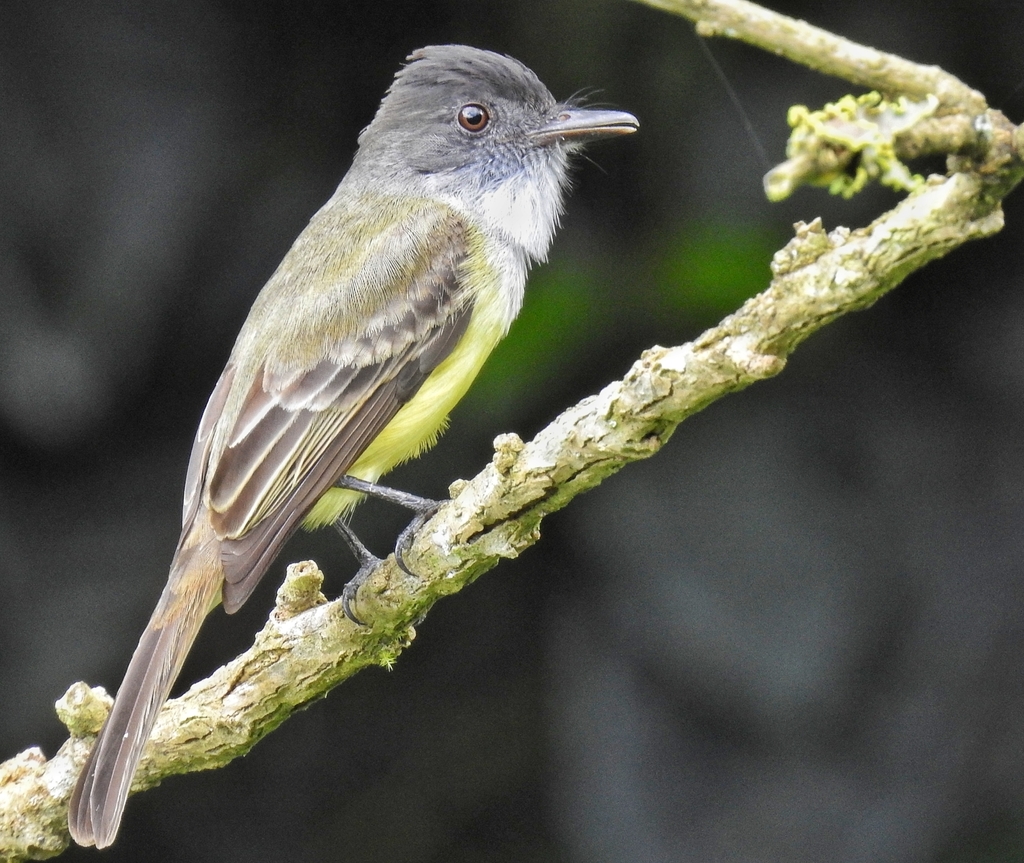
Dusky-capped Flycatcher
Photo © Esteban Poveda
Photo © Esteban Poveda — CC BY 4.0 — Source: iNaturalist photo #104931795Identification
The Dusky-capped Flycatcher is a small passerine, measuring 16 to 18.5 cm in length and weighing 14 to 27 g. Males and females are identical in plumage. The nominate subspecies, found in parts of South America, displays a distinctive sooty brown crown with a slight crest, dark greenish olive-brown upperparts, and a gray throat and breast contrasting with a yellow belly. The tail is dark grayish brown, and the wings are dusky with thin pale edges.
Subspecific variation is considerable across this species' wide range. Northern populations often show darker, more blackish crowns, while some southwestern forms display paler plumage overall. All subspecies share a dark brown iris, black bill with a lighter base, and black legs and feet. Wing coverts and flight feathers display subtle edging variations—ranging from buffy and cinnamon tones to ochre and rufous—that help distinguish populations across Central and South America.
Range & Habitat
This species is remarkably widespread, occurring from the southwestern United States (Arizona and New Mexico) south through Mexico, every Central American country, and across mainland South America, notably absent only from Chile, Paraguay, and Uruguay. Trinidad also hosts populations. The species comprises 13 recognized subspecies, each occupying distinct geographic ranges and showing subtle plumage and vocal differences. Some subspecies occupy small, specialized ranges—for instance, M. t. platyrhynchus is endemic to Cozumel Island, while coastal and island populations exist throughout Central America and northwestern South America.
The exact range limits of several subspecies remain incompletely defined, as vocal and plumage differences between adjacent populations are sometimes clinal rather than sharply delineated. Ornithologists note that additional playback experiments throughout Central and South America are needed to precisely map population boundaries and better understand subspecific distributions.
Behaviour & Diet
Like other tyrant flycatchers, the Dusky-capped Flycatcher is an insectivore that forages actively through vegetation. Its behavior and ecology are typical of the genus Myiarchus, though detailed studies on specific feeding ecology, breeding system, and social behavior are limited in the available literature. The species' complex taxonomic history—with what are now recognized as seven or more separate species once classified as subspecies of M. tuberculifer—suggests significant behavioral and vocal differentiation among populations.
Vocalizations appear to be a key characteristic distinguishing subspecific groups, with some populations showing marked differences in call structure and song patterns. These vocal variations have proven important to taxonomists and birders alike in identifying populations in the field.
Best Time & Places to See It
The Dusky-capped Flycatcher's broad distribution means it is accessible to travelers across much of the Americas. In the United States, the species reaches its northern limit in Arizona and southwestern New Mexico, making the southwestern borderlands the best location for North American birders. Throughout Mexico, Central America, and northwestern South America, the species is present and can be encountered in appropriate habitat. The diversity of subspecies means that observant travelers moving through different regions will encounter populations with noticeably different appearance and vocalizations.
Birders seeking specific subspecies should research which form occurs in their target region. For instance, the distinctive olivascens subspecies with its blackish crown and pale face is found in the southwestern United States and Mexico. Travelers exploring Central American cloud forests, lowland woodlands, and humid forests will have opportunities to observe multiple subspecies as they move south.
Photography Tips
Photographing the Dusky-capped Flycatcher requires patience and attention to subtle field marks. Focus on capturing the crown pattern and color, which varies significantly among subspecies—from sooty brown to blackish—and the facial coloration, which ranges from sooty brown to pale gray. The crest, though slight, often appears raised and makes a useful identifying feature. Good lighting is essential to render the complex plumage tones accurately, particularly the transitions between the crown, face, and upperparts.
Capture images showing the wing and tail patterns, as the edging colors on coverts and flight feathers are key identification features that vary clinally across the species' range. The contrast between the gray breast and yellow belly is striking and should be clearly recorded. Record vocalizations when possible, as subspecific differences in calls are significant. Include habitat context in some images, as this small flycatcher is often seen in or near vegetation where it forages for insects.
Amacayacu National Park
Amazônia National Park
Anavilhanas National Park
Antisana National Park
Arenal Volcano National Park
Bahuaja Sonene National Park
Barbilla National Park
Baritú National Park
Barra del Colorado National Wildlife Refuge
Nothing matches these filters.
No community photos yet. Log in to add the first one.
No community observations of this species yet.