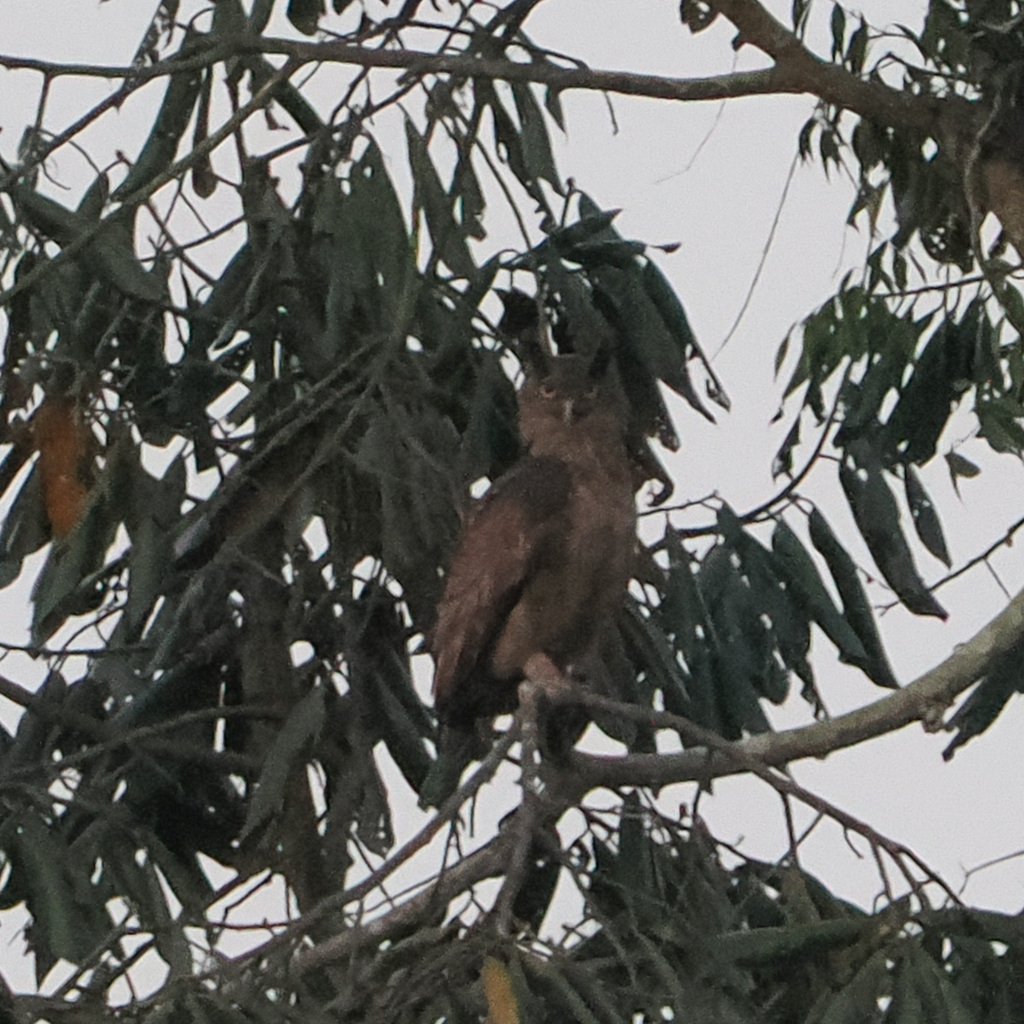
Dusky Eagle-Owl
Photo © Tero Linjama
Photo © Tero Linjama — CC0 1.0 — Source: iNaturalist #343649299Identification
The dusky eagle-owl is a large, greyish-brown owl with a distinctive appearance that makes it recognizable among Asian owl species. Its most striking features are the prominent ear tufts that give it a distinctive silhouette. The underparts are greyish white with dark brown streaking, while the dark brown wings display whitish streaks. The nominate subspecies occurring in South Asia shows these markings clearly, with wings measuring 380–435 mm and a tail of 187–224 mm. The subspecies Ketupa coromanda klossii, found in Southeast Asia, is considerably darker overall with much less obvious whitish wing markings, making regional identification an important consideration for field observers.
Range & Habitat
This widespread species is distributed across South and Southeast Asia, ranging from Pakistan, India, Nepal and Bangladesh through Myanmar and Thailand to Malaysia and into China. The dusky eagle-owl is remarkably adaptable, inhabiting diverse environments including forests, wooded wetlands, and agricultural areas with scattered groves and trees. It has even been recorded in oil palm plantations during surveys in Malaysian states such as Selangor, Perak, Pahang and Negeri Sembilan. The species shows a particular affinity for roadside avenues lined with old, large trees, making it accessible to travellers in both natural and human-modified landscapes.
Behaviour & Diet
The dusky eagle-owl is largely nocturnal, becoming active shortly before sunset, though it is not deterred by daylight and has been observed hunting during the day in cloudy conditions. The species exhibits fascinating breeding behaviour, with nesting occurring between November and April, peaking in December and January. Rather than building their own nests, these owls opportunistically reuse stick nests constructed by other large birds, particularly woolly-necked storks, on trees such as Ficus, Mitragyna and Dalbergia species. Research has shown that breeding pairs actively track stork nesting activity, preferentially selecting areas with high densities of stork nests. Unfortunately, the dusky eagle-owl remains one of the least studied owls globally, with most biological information derived from anecdotal observations rather than systematic research.
Best Time & Places to See It
The breeding season from November to April, particularly December and January, offers the best opportunity to locate this species, as pairs are more active and visible during nesting. Look for the owls in agroforestry landscapes where woolly-necked storks breed, as the owls' presence is closely linked to stork colonies. Agricultural areas with scattered old trees, wooded wetlands, and roadside avenues with mature specimens provide good habitat throughout the species's range. Malaysia's oil palm plantation regions have proven productive for recent sightings, while the broader distribution across South Asia suggests opportunities wherever suitable habitat occurs.
Photography Tips
Since the dusky eagle-owl is largely nocturnal, successful photography requires patience and nocturnal equipment. Position yourself near known breeding areas during the nesting season when owls are more active. The bird's emergence shortly before sunset offers a window for photography in twilight conditions. During cloudy weather, there is a possibility of daytime hunting activity, which can provide better lighting conditions than night photography. The prominent ear tufts and contrasting plumage patterns are distinctive photographic features worth capturing. Given that this species remains poorly studied, any quality photographs contribute valuable documentation to scientific understanding of this elusive owl.
Ranthambhore National Park
Sawai Madhopur, India
+294 birds+20 mammals
Granite ridges and ravines carved through the Aravalli Range frame this protected landscape in eastern Rajasthan, where deciduous forest mingles with open scrubland and seasonal water…
VIEW NATIONAL PARKPanna National Park
Badgadi Kalan, India
+271 birds+17 mammals
Where granite gorges slice through central India's Vindhyan plateau, a landscape of stark beauty unfolds across nearly six hundred square kilometers. The Ken River carves through…
VIEW NATIONAL PARKKaziranga National Park
Kohora, India
+422 birds+26 mammals
Dawn breaks over the floodplains of the Brahmaputra, where tall grasslands stretch endlessly beneath monsoon-heavy skies. This sprawling wilderness of northeastern Assam is a mosaic of…
VIEW NATIONAL PARKKeoladeo National Park
Shreenagar Rural, India
+326 birds+14 mammals
Where shallow wetlands shimmer beneath vast Rajasthani skies, one of Asia's finest bird sanctuaries pulses with extraordinary life. This former maharaja's hunting reserve, now spanning 29…
VIEW NATIONAL PARKNo community photos yet. Log in to add the first one.
No community observations of this species yet.