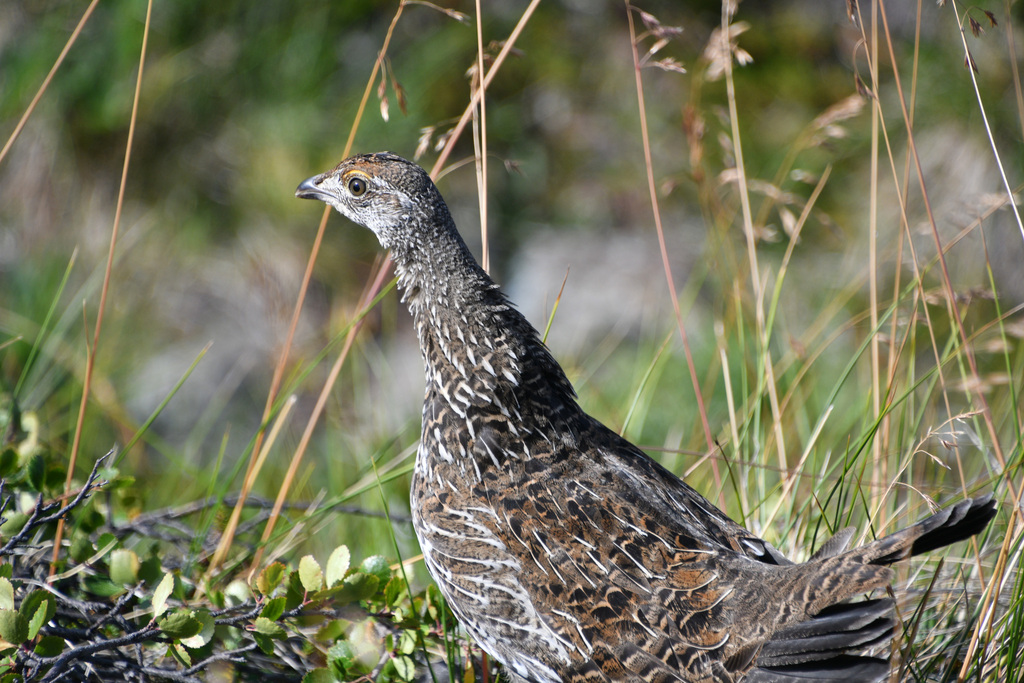
Dusky Grouse
Photo © Thompson Hyggen
Photo © Thompson Hyggen — CC0 1.0 — Source: iNaturalist photo #323909346Identification
The dusky grouse is a forest-dwelling species with distinctive plumage that differs markedly between sexes. Males are considerably larger than females, with a mean body mass of 1.21 kg compared to 0.91 kg in females. Both sexes display a characteristic long, square tail with a gray end. During the breeding season, males are mainly dark in coloration and feature a striking purplish throat air sac ringed with white feathers, along with a yellow to red wattle above the eye that becomes prominent during display. Females are more subtly patterned, with mottled brown plumage and dark brown and white marks on the underparts, providing effective camouflage in their forest habitat.
Range & Habitat
The dusky grouse is native to the Rocky Mountains of western North America, ranging from southeastern Alaska and Yukon south to New Mexico. Four recognized subspecies occupy different portions of this vast territory. These birds are closely associated with conifer and mixed forest edges in mountainous regions, showing a strong affinity for areas dominated by various conifer species. They construct their nests as simple ground scrapes concealed beneath shrubs or logs, relying on camouflage for protection during the nesting season.
Behaviour & Diet
Dusky grouse are permanent residents throughout their range, though they exhibit the unusual behavior of moving to higher altitudes during winter, seeking out denser forest areas. During breeding season, males establish territories where they perform elaborate displays, singing with deep hoots and making short flapping flights to attract females. Once mating occurs, females depart the male's territory to nest independently. Clutch sizes range from one to twelve eggs.
These birds are primarily ground foragers, consuming plant matter supplemented with invertebrates. Their diet is highly seasonal: in winter, they feed extensively on fir and Douglas-fir needles, with occasional hemlock and pine needles, while spring and summer bring consumption of fresh herbaceous growth including ferns and willow, along with berries from plants such as salal, mahonia, and vaccinium species. They also actively hunt larger invertebrates including ants, beetles, crickets, and grasshoppers. Chicks depend almost entirely on insect prey for their first weeks of life.
Best Time & Places to See It
Dusky grouse are most conspicuous during the breeding season when males vocalize from their territories. Look for them in conifer and mixed forest edges throughout the Rocky Mountain region from Alaska and Yukon south to New Mexico. In winter, they concentrate in denser forest areas at higher elevations, making them somewhat less visible but still present year-round for dedicated observers.
Photography Tips
Spring and early summer offer the best opportunities to photograph displaying males with their distinctive throat sac and eye wattle fully engorged. Focus on forest edges and openings where males are most likely to perform. The mottled brown females blend remarkably well with their surroundings, requiring patience and careful scanning of the forest floor. Early morning hours typically yield the best light and greatest activity for photography.
Glacier National Park
Glacier, Canada
+162 birds+12 mammals
Where granite peaks pierce the clouds above the Columbia River valley, Glacier National Park protects one of the most dramatic mountain wilderness areas in western Canada.…
VIEW NATIONAL PARKKootenay National Park
Area G (Forster Creek/Mount Assiniboine), Canada
+181 birds+23 mammals
Where the spine of the Canadian Rockies rises above 3,000 metres, the high alpine realm around Forster Creek and Mount Assiniboine reveals one of the continent's…
VIEW NATIONAL PARKMount Revelstoke National Park
Area B (Shelter Bay/Mica Creek), Canada
+155 birds+8 mammals
Where the Columbia River carves through the western ranges of British Columbia, Shelter Bay and Mica Creek mark the entrance to a wilderness where subalpine meadows…
VIEW NATIONAL PARKBanff National Park
Improvement District No. 9, Canada
+264 birds+33 mammals
Where the Canadian Rockies thrust skyward in a cathedral of limestone and ice, Banff National Park preserves a wilderness of astounding vertical drama. Glacier-carved valleys cradle…
VIEW NATIONAL PARKJasper National Park
Improvement District No. 12, Canada
+235 birds+34 mammals
Where the Canadian Rockies rise in dramatic succession across western Alberta, Jasper National Park spans over 11,000 square kilometres of subalpine and alpine terrain, glaciated valleys,…
VIEW NATIONAL PARKGreat Basin National Park
White Pine County, United States
+170 birds+19 mammals
Where the Great Basin's high desert plateaus rise above 10,000 feet, ancient bristlecone pines endure on moonscape ridges of limestone and quartzite, creating one of North…
VIEW NATIONAL PARKZion National Park
Washington County, United States
+244 birds+30 mammals
Towering sandstone cliffs in shades of crimson, rust, and cream rise abruptly from the Virgin River's winding canyon floor, their sculpted faces bearing witness to millions…
VIEW NATIONAL PARKMesa Verde National Park
Montezuma County, United States
+166 birds+10 mammals
Across the high desert plateau of southwestern Colorado, where sandstone mesas rise abruptly from piñon-juniper scrubland, Mesa Verde National Park preserves one of North America's most…
VIEW NATIONAL PARKGreat Sand Dunes National Park
Saguache County, United States
+193 birds+14 mammals
Where the Colorado high plains collide with one of North America's most extraordinary geological anomalies, nearly 600 square kilometres of windswept sand rise abruptly from the…
VIEW NATIONAL PARKCapitol Reef National Park
Garfield County, United States
+196 birds+22 mammals
Wrinkled ridges of crimson and gold sandstone rise from the floor of south-central Utah, their weathered faces carved by the Fremont River into one of the…
VIEW NATIONAL PARKGrand Teton National Park
Teton County, United States
+247 birds+38 mammals
Where the Teton Range tears skyward in a dramatic escarpment above the Snake River valley, nearly 2,550 square kilometers of montane wilderness unfolds across Teton County,…
VIEW NATIONAL PARKYellowstone National Park
Park County, United States
+253 birds+43 mammals
Across nearly 11,400 square kilometres of the Rocky Mountain plateau, geothermal fury and pristine wilderness converge in one of Earth's most dynamic landscapes. Hot springs, geysers…
VIEW NATIONAL PARKBlack Canyon of the Gunnison National Park
Montrose County, United States
+169 birds+13 mammals
Where the Gunnison River has carved one of North America's steepest and most dramatic canyons, ancient metamorphic rock walls plunge nearly 2,000 feet in places, creating…
VIEW NATIONAL PARKRocky Mountain National Park
Larimer County, United States
+259 birds+33 mammals
Where granite peaks rise above 12,000 feet and alpine tundra gives way to subalpine forest, Rocky Mountain National Park spans the Continental Divide across nearly 1,600…
VIEW NATIONAL PARKWaterton Lakes National Park
Improvement District No. 04, Canada
+252 birds+31 mammals
Where the Continental Divide plunges toward the prairies of Alberta, glacier-carved valleys and emerald lakes pierce a landscape where montane forest meets alpine tundra. Waterton Lakes…
VIEW NATIONAL PARKNahanni National Park
Dehcho Region, Canada
+151 birds+11 mammals
Where the South Nahanni River carves through the Mackenzie Mountains, a landscape of extraordinary wildness unfolds across more than 61,000 square kilometres of boreal forest, alpine…
VIEW NATIONAL PARKYoho National Park
Area A (Kicking Horse/Kinbasket Lake), Canada
+207 birds+19 mammals
Where the Canadian Rockies meet the Columbia River watershed, a vast wilderness of 2,211 square kilometres unfolds across Yoho National Park in British Columbia. The landscape…
VIEW NATIONAL PARKTombstone Territorial Park
Dawson City, Canada
+150 birds+17 mammals
Where granite peaks pierce the Yukon sky and tundra stretches endlessly toward the Arctic horizon, the Tombstone Range commands attention with uncompromising beauty. This subarctic wilderness…
VIEW NATURE RESERVEBryce Canyon National Park
Tropic, United States
+202 birds+20 mammals
Hoodoos rise like a forest of stone pillars from an amphitheater carved into Utah's high plateau, where the Paunsaugunt elevates the landscape to over 9,000 feet…
VIEW NATIONAL PARKGlacier National Park
United States
+246 birds+39 mammals
Where jagged peaks pierce a subarctic sky and glacial valleys carve through ancient rock, Glacier National Park spans the spine of the Northern Rockies along Montana's…
VIEW NATIONAL PARKGrand Canyon National Park
United States
+277 birds+35 mammals
A mile-deep chasm of rust-red rock and purple shadow cuts through the high desert plateau of northern Arizona, revealing nearly two billion years of geological history…
VIEW NATIONAL PARKNorth Cascades National Park
Whatcom County, United States
+120 birds+18 mammals
Jagged peaks rise abruptly from the western foothills of Washington's Cascade Range, where glaciers cling to elevations above 10,000 feet and meltwater feeds a landscape of…
VIEW NATIONAL PARKNational Elk Refuge
Jackson, United States
+230 birds+27 mammals
Where the sagebrush flats of northwestern Wyoming rise toward the Gros Ventre Mountains, winter transforms the landscape into a realm of survival and spectacle. The National…
VIEW WILDLIFE SANCTUARYRed Rock Lakes National Wildlife Refuge
Beaverhead County, United States
+216 birds+10 mammals
Where the Greater Yellowstone ecosystem's northern reaches meet the high plateaus of southwestern Montana, a network of glacial lakes and wetlands sustains one of the continent's…
VIEW WILDLIFE SANCTUARYNo community photos yet. Log in to add the first one.
No community observations of this species yet.