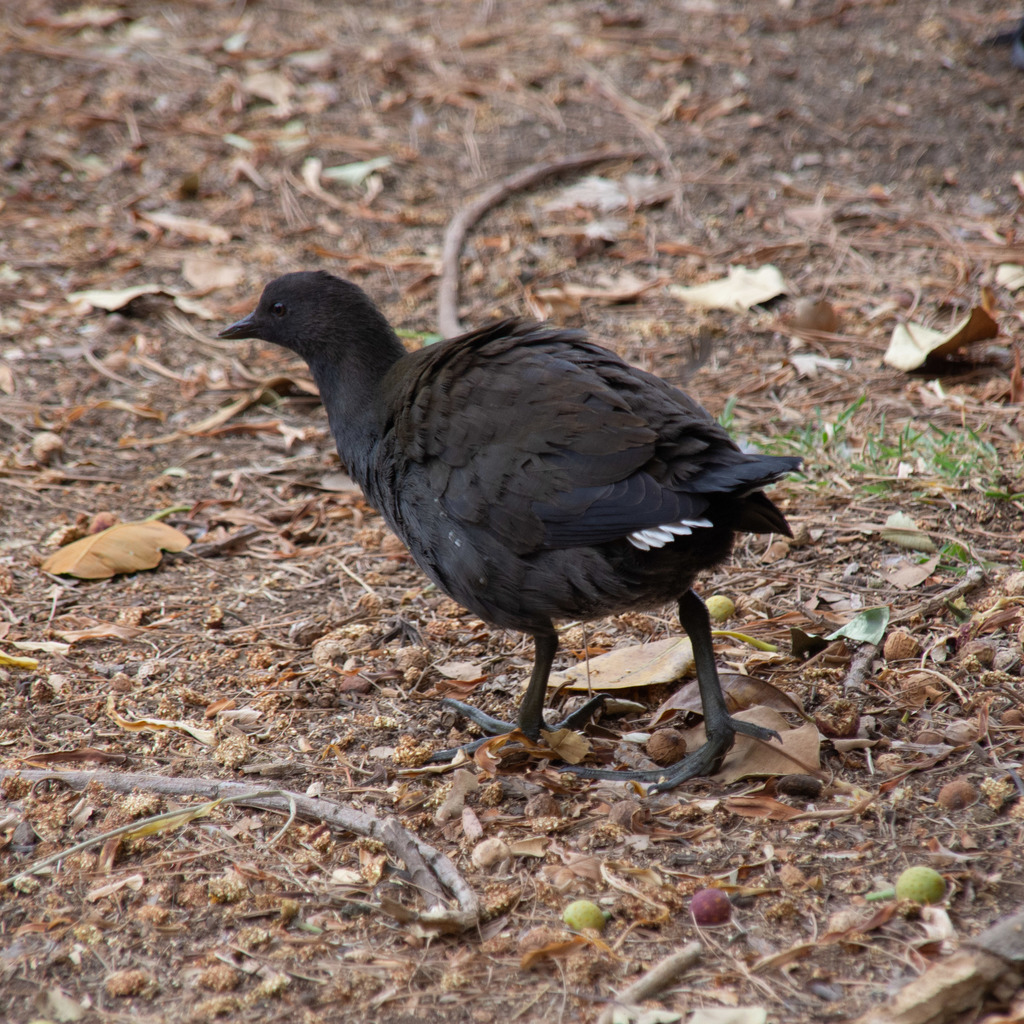
Dusky Moorhen
Photo © Terra Occ
Photo © Terra Occ — CC BY 4.0 — Source: iNaturalist #22655584Identification
The dusky moorhen is a medium-sized rail with plumage that is predominantly dark grey-black, with a browner tinge to the upper parts. Adults measure 25–38 centimetres depending on subspecies and geography, with Australian birds being noticeably larger than their New Guinea counterparts. The most distinctive features are the bright red frontal shield on the forehead and the yellow-tipped red bill, resembling the common moorhen but with a key difference: dusky moorhens lack the white flank line and instead display orange-yellow legs rather than pure yellow. During breeding season (warmer months), the frontal shield becomes particularly vivid in both sexes; in autumn and winter, especially in females and young males, this shield dulls considerably.
Range & Habitat
This species occurs across Australia, New Guinea, Borneo, and Indonesia, with occasional vagrants reaching New Zealand. In Australia, they are widespread throughout eastern Victoria, New South Wales, and Queensland as far north as Cooktown, with smaller populations in eastern South Australia, Tasmania, and south-western Western Australia. Dusky moorhens are wetland specialists, showing a strong preference for freshwater marshes and swamps. They require open water with adequate cover—grass, reeds, and emergent vegetation are essential. They thrive in urban parks, botanical gardens, river banks, and farm dams. In south-east Queensland, populations are denser in areas with taller vegetation and abundant aquatic plants. These birds are largely sedentary, often remaining in the same location for eight years or more.
Behaviour & Diet
Dusky moorhens are diurnal and gregarious outside the breeding season, though territorial when nesting. They breed from August to January in southern Australia (typically one brood) and January to June in the north (often two broods). Pairs construct bulky nests of reeds and grasses at the water's edge, typically laying 5–11 whitish eggs marked with red-brown spots. The species has a rich vocal repertoire: the territorial call is a loud, far-carrying kurk or krik that can be heard over two kilometres away; they also produce sharp alarm calls, soft mewing courtship notes, and various clicking and whistling sounds for parent-chick communication.
Their diet is omnivorous and opportunistic. Adults feed on seeds, grass and shrub tips, algae, fruits, molluscs, and invertebrates, supplemented by carrion and even droppings from gulls and ducks. Chicks are initially fed annelid worms and molluscs, with increasing plant matter as they mature.
Best Time & Places to See It
Dusky moorhens can be found year-round throughout their range, though breeding season activity (August–January in the south, January–June in the north) offers the best opportunity to observe territorial behaviour and hear their distinctive calls. Eastern Australian wetlands—particularly in Queensland, New South Wales, and Victoria—are reliable locations. Urban sites such as Currumbin Wildlife Sanctuary, Brisbane Botanic Gardens, and Gold Coast Regional Botanic Gardens offer excellent viewing opportunities. Look for them in dawn and dusk hours when they are most active, particularly around reed-fringed water bodies and marshy areas with dense aquatic vegetation.
Photography Tips
Approach wetland habitats slowly and quietly to avoid alarming roosting birds. Early morning light is ideal for capturing the subtle plumage details and the brilliant red of the frontal shield, which is most vibrant during breeding season. Position yourself low and use longer lenses (300mm+) to photograph birds foraging at the water's edge or swimming among reeds. The contrast between the dark plumage and red shield provides excellent colour saturation in natural light. Listen for their loud territorial calls to locate active birds, and be patient—dusky moorhens are relatively shy and may disappear into reed beds quickly. Capturing parent birds with chicks offers compelling compositional opportunities during breeding season.
Barrington Tops National Park
Belair National Park
Ben Boyd National Park
Blue Mountains National Park
Bogani Nani Wartabone National Park
Boodjamulla National Park
Bribie Island National Park
Budj Bim National Park
Cania Gorge National Park
Nothing matches these filters.
No community photos yet. Log in to add the first one.
No community observations of this species yet.