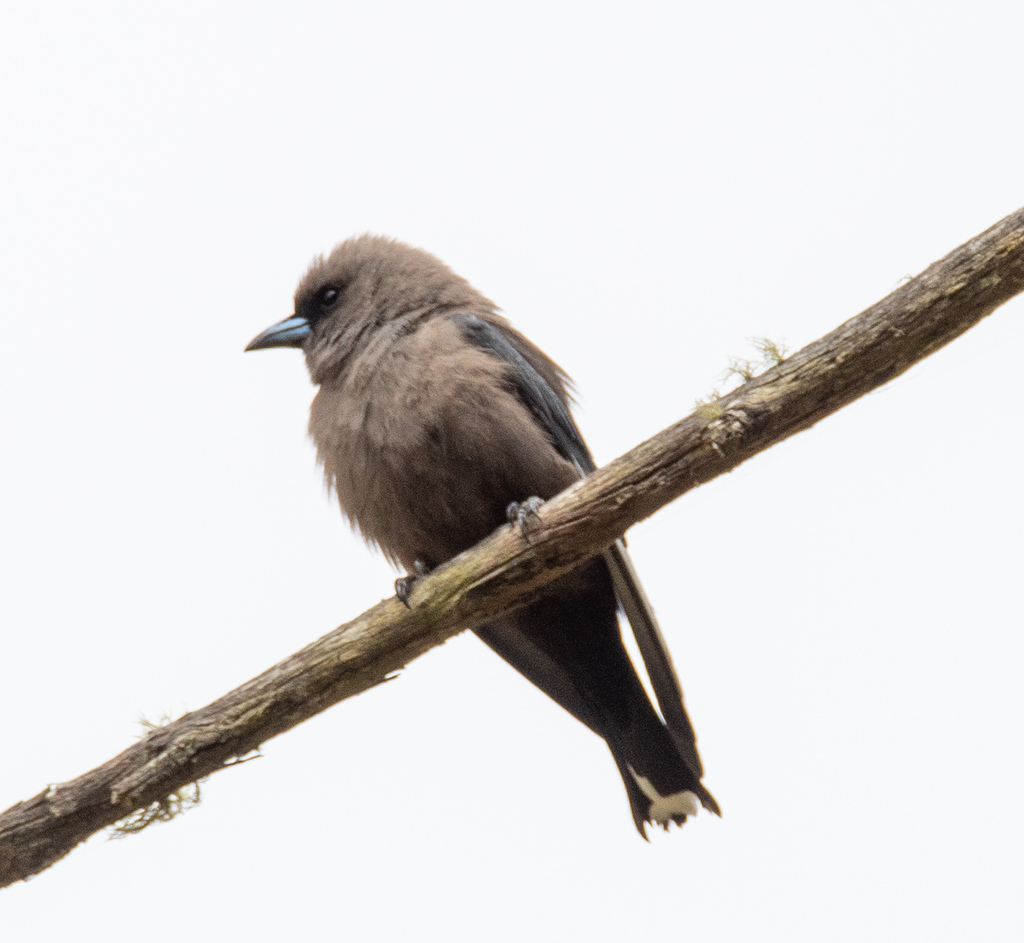
Dusky Woodswallow
Photo © Jonno Downes
Photo © Jonno Downes — CC BY 4.0 — Source: iNaturalist #144520153Identification
The dusky woodswallow is a medium-sized, swallow-like bird with a distinctive dark brown plumage, though grey individuals have been recorded. Look for a black patch in front of the eyes, grey or black wings marked with white streaks, and a characteristic white patch on the outer wing that distinguishes it from other woodswallow species. The tail is black with a white tip and silver underwing, while the blue-grey bill is capped with black. A helpful field mark is the bird's habit of spontaneously wagging or swiveling its tail with fervent, rapid movements—a trait shared with other woodswallows.
Range & Habitat
Dusky woodswallows inhabit open eucalyptus forests and woodlands across eastern and southern Australia, ranging from the Atherton Tableland in Queensland south to Tasmania and west to the Eyre Peninsula in South Australia. These are nomadic birds that undergo seasonal migrations and movements; notably, south-eastern populations migrate northward during autumn. The species roosts communally at night and breeds in large flocks of 20–30 birds, clustering together to protect young from predators. The population is considered common within its local habitat range.
Behaviour & Diet
Dusky woodswallows are vocal, communicative birds with various chattering calls; their most distinctive call is a harsh mobbing alarm used to warn the flock of approaching predators or intruders. Their diet is remarkably varied: they forage on the ground and in trees for foliage, grass, termites, butterflies, and other insects, while also feeding on flower nectar. They are agile hunters, plucking flying insects directly from the air, and they perch inconspicuously on utility lines and branches while waiting for prey. Intriguingly, they have been observed engaging in kleptoparasitism, working cooperatively as a group to steal prey from restless flycatchers.
Best Time & Places to See It
The dusky woodswallow's nomadic nature means that sightings depend on seasonal movements and local conditions, making timing somewhat unpredictable. However, breeding activity occurs from August to January, when birds are most concentrated in large communal flocks—the best opportunity to observe them. Search open eucalyptus woodlands throughout their range, watching for birds in flight or perched on exposed branches and utility lines where they hunt for insects.
Photography Tips
Capture this species in flight if possible, as their aerial insect-catching behaviour is distinctive. Look for the white outer wing patch and silver underwing in flight shots, and try to photograph the characteristic tail-wagging behaviour that identifies them in the field. Early morning or late afternoon typically provides the best light for photography. Since they roost communally and breed in flocks, locate a roosting or nesting site during the breeding season (August–January) for opportunities to photograph multiple birds and interesting social interactions.
Bald Rock National Park
Barrington Tops National Park
Belair National Park
Ben Boyd National Park
Blue Mountains National Park
Budj Bim National Park
Carnarvon National Park
Chiltern-Mt Pilot National Park
Cleland National Park
Nothing matches these filters.
No community photos yet. Log in to add the first one.
No community observations of this species yet.