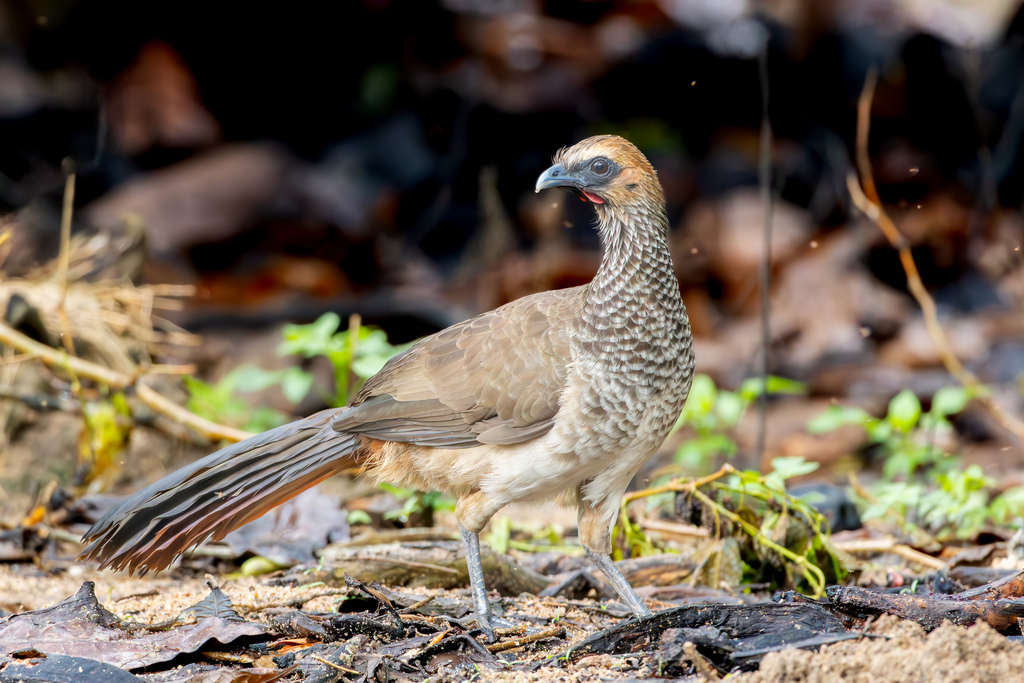
East Brazilian Chachalaca
Photo © Francisco V. Bezerra Neto
Photo © Francisco V. Bezerra Neto — CC BY-SA 4.0 — Source: iNaturalist photo #587329803Identification
The East Brazilian chachalaca is a medium-sized bird measuring about 50 cm (1.6 ft) in length. It is distinguished by its dull rufous crown and nape, brown upperparts, and distinctive reddish rump. The species has a characteristic red gular patch (throat patch), with the lower throat and breast appearing dark brownish and spotted in white (in females) or buff (in males). The remaining underparts are white, except for ochre-colored vent feathers. A striking feature is the bird's dark brown eye, which is surrounded by bare slate-blue skin that creates a distinctive facial pattern.
Range & Habitat
This species is endemic to eastern Brazil, found in a fairly narrow strip of territory from Rio Grande do Norte in the north, extending south into Espírito Santo and Minas Gerais. The East Brazilian chachalaca inhabits several forest and scrubland types, with the Atlantic Forest forming its primary habitat. The species also occurs in secondary forest, caatinga (semi-arid shrubland), and restinga (coastal scrubland) landscapes, demonstrating some flexibility in habitat use.
Behaviour & Diet
The East Brazilian chachalaca is a social bird that forages in small flocks of up to approximately seven individuals. While its diet has not been comprehensively detailed, fruits comprise the primary food source. The species is vocal, with a distinctive song consisting of a repeated "re-a-tok" call that can be easily distinguished from the five-syllable song of the closely related speckled chachalaca.
Little is known about this species' breeding ecology, though limited observations provide some insight. Nests are constructed as shallow, unlined bowls made of twigs and leaves, typically positioned in dense foliage approximately 3.2 m (10 ft) above the ground in trees. Clutches of three eggs have been documented.
Best Time & Places to See It
The East Brazilian chachalaca is generally considered common throughout its range, with stable populations. The species appears to tolerate human activity and human-altered habitats, making it accessible to nature travelers across much of eastern Brazil within its range from Rio Grande do Norte south to Espírito Santo and Minas Gerais. Its preference for secondary forest and scrubland means it is often encountered in more open or disturbed habitats, not only pristine Atlantic Forest.
Photography Tips
The bare slate-blue facial skin surrounding the eye and the red gular patch are key distinguishing features worth capturing. The bird's rufous crown, reddish rump, and spotted breast pattern provide good photographic subjects. Since the species forages in small flocks, patience may yield opportunities to photograph multiple individuals. The bird's tolerance of human-altered habitats increases accessibility for photographers, though the small flock size means shots of single birds or pairs are more typical than large group compositions.
Serra do Cipó National Park
Brazil
+379 birds+5 mammals
Where granite escarpments rise above the Atlantic Forest transition zone in southeastern Brazil, Serra do Cipó National Park unfolds across a landscape of dramatic ridges, cascading…
VIEW NATIONAL PARKPau Brasil National Park
Brazil
+211 birds
Tropical Atlantic forest cloaks the rolling terrain of northeastern Bahia, where Pau Brasil National Park protects nearly 390 square kilometers of one of Brazil's most biodiverse…
VIEW NATIONAL PARKChapada Diamantina National Park
Brazil
+346 birds+5 mammals
Where granite peaks and sandstone cliffs rise abruptly from the Brazilian interior, Chapada Diamantina National Park sprawls across 4,215 square kilometers of some of Brazil's most…
VIEW NATIONAL PARKCatimbau National Park
Brazil
+118 birds+6 mammals
Where sandstone plateaus rise from the semi-arid scrublands of northeastern Brazil, Catimbau National Park unfolds across more than 1,000 square kilometres of geological drama and surprising…
VIEW NATIONAL PARKNo community photos yet. Log in to add the first one.
No community observations of this species yet.