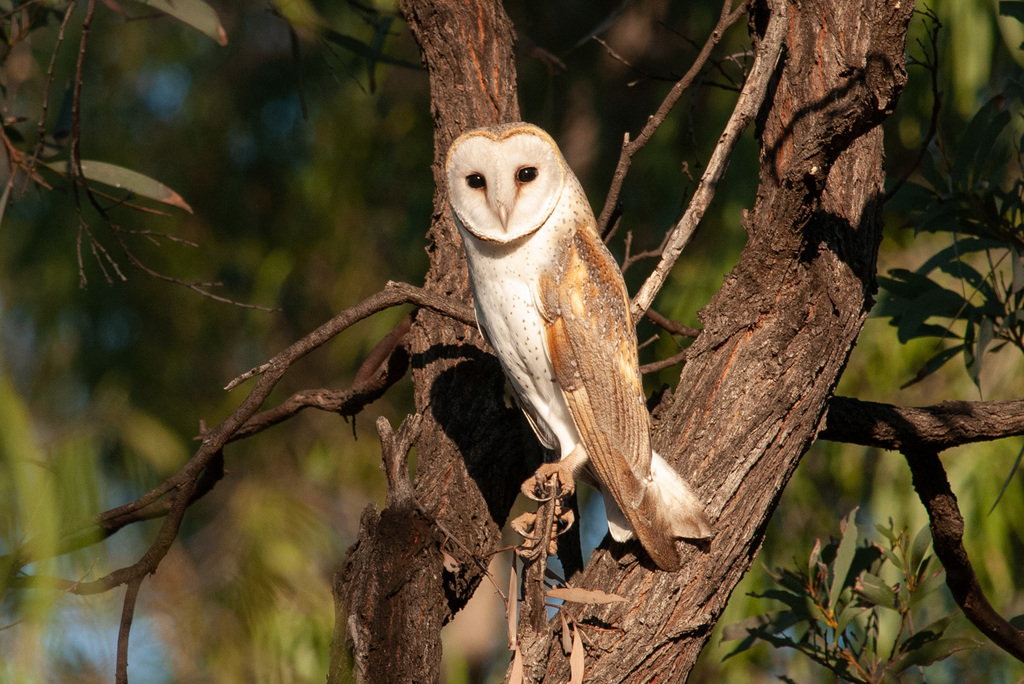
Eastern Barn Owl
Photo © Rolf Lawrenz
Photo © Rolf Lawrenz — CC BY 4.0 — Source: iNaturalist photo #162975525Identification
The Eastern Barn Owl is a distinctive nocturnal hunter with the characteristic features of the genus Tyto. Like its relatives, it displays the iconic heart-shaped facial disc and large forward-facing eyes adapted for night hunting. Its plumage and size vary across its wide range, reflecting the seven recognized subspecies that span from the Indian subcontinent through Southeast Asia to Australia and the Pacific Islands. The species is best distinguished from other barn owls by its specific range and subspecific characteristics, though field identification can be challenging without detailed knowledge of regional variation.
Range & Habitat
This owl inhabits southeastern Asia, New Zealand, and Australasia, occurring across the Indian subcontinent, Southeast Asia, Australia, and many Pacific Islands. It favours open country such as farmland and grassland with interspersed woodland, typically below 2,000 metres elevation, though it occasionally ranges as high as 3,000 metres in tropical regions. The species is generally sedentary, with individuals remaining in established territories even when better foraging areas nearby become available. In Australia, some migration occurs seasonally, with birds moving toward the northern coast in the dry season and southward in the wet season, while nomadic movements also follow rodent plagues. Remarkably, Eastern Barn Owls have demonstrated ocean-crossing capabilities, with occasional records from Norfolk Island, Lord Howe Island, and New Zealand, where breeding was first recorded in 2008.
Behaviour & Diet
The Eastern Barn Owl is nocturnal throughout most of its range, though it sometimes hunts by day on various Pacific Islands, a behaviour possibly influenced by harassment from other birds. It hunts with an effortless, wavering flight low over the ground, relying on its extraordinarily acute hearing to locate prey in complete darkness. The owl's silent flight is facilitated by specialized feather adaptations: tiny serrations on the leading edges of flight feathers and a hairlike fringe on the trailing edges break up airflow and reduce turbulence, while hairlike extensions to feather barbules further minimize noise during wingbeats.
The species specializes in hunting ground-dwelling animals, with nearly all food consisting of small mammals including mice, rats, voles, and small marsupials. In moist temperate areas, small mammals comprise over 90% of the diet, though in hot, dry regions the proportion is lower and prey variety increases, including bats, birds, lizards, amphibians, insects, and spiders. Pairs mate for life, forming new bonds only if one partner is killed. Breeding occurs at varying times depending on locality, with clutches averaging about four eggs laid in tree hollows, old buildings, or cliff fissures. The female alone incubates the eggs and relies entirely on the male to provide food for herself and the chicks during this vulnerable period. When small prey becomes abundant, barn owl populations can expand rapidly.
Best Time & Places to See It
As a nocturnal species over most of its range, the Eastern Barn Owl is most actively hunted during night hours, particularly shortly before dusk when it becomes active. In open farmland and grassland habitats, especially areas with rough grass strips adjoining pasture or woodland edges, the owl quarters the ground with its characteristic wavering flight. On some Pacific Islands, daytime observations are possible when the owl hunts in daylight. While the species is sedentary in most locations, seasonal movements in Australia may offer opportunities to observe birds in different areas during dry and wet seasons. Patient nocturnal observers in suitable open habitats across its range—from Southeast Asian farmlands to Australian grasslands—stand the best chance of encountering this elusive hunter.
Photography Tips
Photographing this nocturnal species presents significant challenges. Night photography requires specialized equipment including high-ISO capable cameras, fast lenses, and infrared or thermal imaging technology to capture images in darkness. Position yourself near open hunting grounds at dusk to capture the owl's distinctive wavering flight as it quarters the ground. The bird's silent flight demands patient waiting rather than active pursuit. If daytime observations occur on Pacific Islands, use natural light to capture the characteristic facial disc and forward-facing eyes. Listen carefully for the sounds of the owl's presence, as its acute hearing—your guide to its location—may alert you before visual confirmation. Remote camera traps placed near known roost sites or nest locations can yield remarkable images without disturbing this sensitive hunter.
Kanha Tiger Reserve
Bandhavgarh National Park
Ben Boyd National Park
Blue Mountains National Park
Bribie Island National Park
Budj Bim National Park
Cania Gorge National Park
Carnarvon National Park
Chiltern-Mt Pilot National Park
Nothing matches these filters.
No community photos yet. Log in to add the first one.
No community observations of this species yet.