Eastern Black-eared Wheatear
Photo © Christoph Moning
Photo © Christoph Moning — CC BY 4.0 — Source: iNaturalist photo #91639313Identification
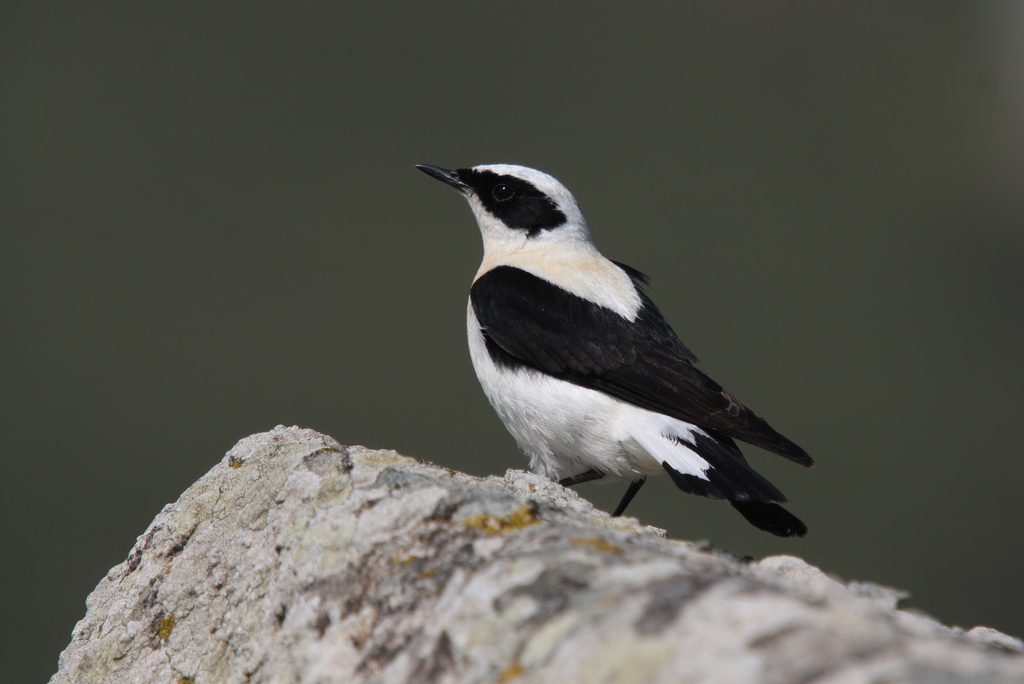
The eastern black-eared wheatear is a small, striking bird with distinctive plumage that changes seasonally. Breeding males are unmistakable, featuring a white or nearly white forehead, crown, and mantle with a buff tinge, combined with notably black wings. The underparts are white tinged with buff, while the back, upper tail coverts, and most of the tail are white. A bold black mask extends from the ear coverts to the bill, and the throat may be either black or white. The tail feathers (except the central pair) display much more white than those of the closely related northern wheatear, often extending to the tip on the inner web.
In autumn and winter, the bird's appearance transforms considerably, with the head and mantle becoming distinctly buff, as do the underparts. The buff intensity varies, but this seasonal change is far more pronounced than in females. Females are overall gray-brown birds with less marked seasonal changes, though they retain the characteristic white lower back. The eastern black-eared wheatear can be distinguished from its western counterpart by its whiter, less buff-tinted upperparts, creating a more starkly contrasting black-and-white appearance, particularly in males.
Range & Habitat
This migratory species breeds across the eastern Mediterranean, Southeast Europe, extending eastward to the Caspian Sea and Iran. It undertakes substantial seasonal migrations, traveling south to winter quarters in the Sudan. The bird favors open habitats with scattered trees, making its home in savanna, rocky slopes, and barren pastures where it can hunt and perch with relative ease.
Behaviour & Diet
As a member of the Old World flycatcher family, the eastern black-eared wheatear is an active and alert forager, characteristic of its family. Like other wheatears, it is primarily insectivorous, hunting small invertebrates in the open habitats it frequents. The bird's behavior reflects its adaptation to sparse, rocky terrain where it can be spotted moving restlessly across the ground or launching short flights to catch prey.
Best Time & Places to See It
To observe this species, visit its breeding range in the eastern Mediterranean and Southeast Europe during the breeding season. For winter sightings, travel to the Sudan where populations congregate. The bird's preference for open habitats makes it relatively visible, particularly in rocky areas, grasslands, and savanna where scattered trees provide perching opportunities. Migration periods may also offer viewing opportunities along traditional flyways between breeding and wintering grounds.
Photography Tips
The eastern black-eared wheatear's bold plumage and striking facial mask make it an attractive photographic subject, especially breeding males with their high-contrast black-and-white markings. The bird's active, ground-dwelling habits mean positioning yourself low to photograph it against sky or landscape backgrounds will be most effective. The distinct seasonal plumage changes offer opportunities to document different appearances throughout the year. Early morning light will enhance the contrast of the male's striking mask and the brightness of white plumage elements.
Javakheti National Park
Bozali, Georgia
+138 birds
Dawn breaks over a high-altitude plateau where volcanic peaks pierce the Caucasian sky, their slopes cloaked in alpine meadows that stretch toward horizons of impossible clarity.…
VIEW NATIONAL PARKPirin National Park
Bansko, Bulgaria
+124 birds+10 mammals
Where jagged limestone peaks pierce the Macedonian sky, ancient glacial valleys cradle some of Bulgaria's most pristine wilderness. This southwestern corner of the Balkans rises to…
VIEW NATIONAL PARKStrandzha Nature Park
Kondolovo, Bulgaria
+215 birds+19 mammals
Where the Rhodope Mountains descend toward the Black Sea coast, ancient forests rise above limestone plateaus in a tapestry of ecological richness rarely found elsewhere in…
VIEW NATURAL PARKCirceo National Park
Italy
+232 birds+6 mammals
Where limestone headlands plunge toward the Tyrrhenian Sea, Circeo National Park preserves a rare mosaic of Mediterranean coastal habitats that few Italian reserves can match. The…
VIEW NATIONAL PARKCilento, Vallo di Diano and Alburni National Park
Campora, Italy
+145 birds+12 mammals
Where the southern Apennines descend toward the Tyrrhenian coast, the landscape transforms into a mosaic of limestone plateaus, deep ravines, and Mediterranean scrubland that defines Cilento,…
VIEW NATIONAL PARKAbijata-Shalla Lakes National Park
Ethiopia
+438 birds+7 mammals
Two crater lakes of contrasting chemistry define this remote corner of Ethiopia's Rift Valley, where soda lakes and freshwater basins create a mosaic of distinct aquatic…
VIEW NATIONAL PARKAwash National Park
Didiga, Ethiopia
+473 birds+23 mammals
Where the Ethiopian Rift Valley carves through volcanic plateaus, a ribbon of riverine forest winds through acacia scrubland and grassland, creating a mosaic of habitats that…
VIEW NATURAL PARKSimien Mountains National Park
Debark, Ethiopia
+120 birds+9 mammals
Where granite escarpments plunge thousands of metres into misty valleys, the Ethiopian highlands reveal a landscape of almost mythical drama. These volcanic plateaus, carved by ancient…
VIEW NATIONAL PARKPindos National Park
Ioannina Regional Unit, Greece
+163 birds+12 mammals
Where limestone peaks rise abruptly from the Pindus range in northwestern Greece, a landscape of dramatic gorges, alpine meadows, and dense beech forests creates one of…
VIEW NATIONAL PARKMount Ainos National Park
Sami Municipal Unit, Greece
+118 birds+1 mammals
Where limestone and conglomerate peaks rise dramatically above the Ionian Sea, Mount Ainos commands the landscape of Kefalonia with a rugged majesty that few Mediterranean summits…
VIEW NATIONAL PARKVikos–Aoos National Park
Ioannina Regional Unit, Greece
+136 birds+4 mammals
Where limestone gorges plunge through the Pindus Mountains, the Vikos–Aoos National Park guards one of Greece's most dramatic inland wilderness areas. The park's defining feature is…
VIEW NATIONAL PARKMount Parnitha National Park
Municipal Unit of Acharnes, Greece
+137 birds+4 mammals
Where pine-clad ridges rise abruptly from the Attica plains, Mount Parnitha National Park unfolds across nearly 4,000 hectares of Mediterranean mountain wilderness. The park's defining character…
VIEW NATIONAL PARKSounio National Park
Municipal Unit of Ayios Konstantinos, Greece
+103 birds
Where rocky headlands plunge into the Aegean Sea along Attica's southeastern coast, Sounio National Park preserves a landscape shaped by millennia of human presence yet alive…
VIEW NATIONAL PARKButrint National Park
Vagalat, Albania
+140 birds+3 mammals
Where the Ionian coast meets ancient alluvial plains, Butrint National Park spans a landscape of extraordinary ecological complexity that has shaped human settlement for three millennia.…
VIEW NATIONAL PARKOlympos National Park
Pieria Regional Unit, Greece
+137 birds+3 mammals
Where the Thessalian plains give way to soaring limestone massifs, Olympos National Park rises as one of the Aegean's most dramatic mountain wilderness areas. This IUCN…
VIEW NATIONAL PARKSamaria National Park
Chania Regional Unit, Greece
+103 birds+1 mammals
Vertical walls of pale limestone rise nearly a kilometre from the Cretan seabed, their flanks carved by the Samaria Gorge into one of Europe's most dramatic…
VIEW NATIONAL PARKKerkini Lake National Park
Serres, Greece
+291 birds+18 mammals
Where the Strymon River widens into a sprawling freshwater lake hemmed by the Rhodope Mountains, Kerkini National Park unfolds across northern Greece as one of southeastern…
VIEW NATIONAL PARKAlta Murgia National Park
Bari, Italy
+168 birds+6 mammals
Across the limestone plateaux of Apulia's interior, where the Adriatic's influence fades into continental warmth, lies a landscape sculpted by millennia of human pastoralism and Mediterranean…
VIEW NATIONAL PARKNo community photos yet. Log in to add the first one.
No community observations of this species yet.