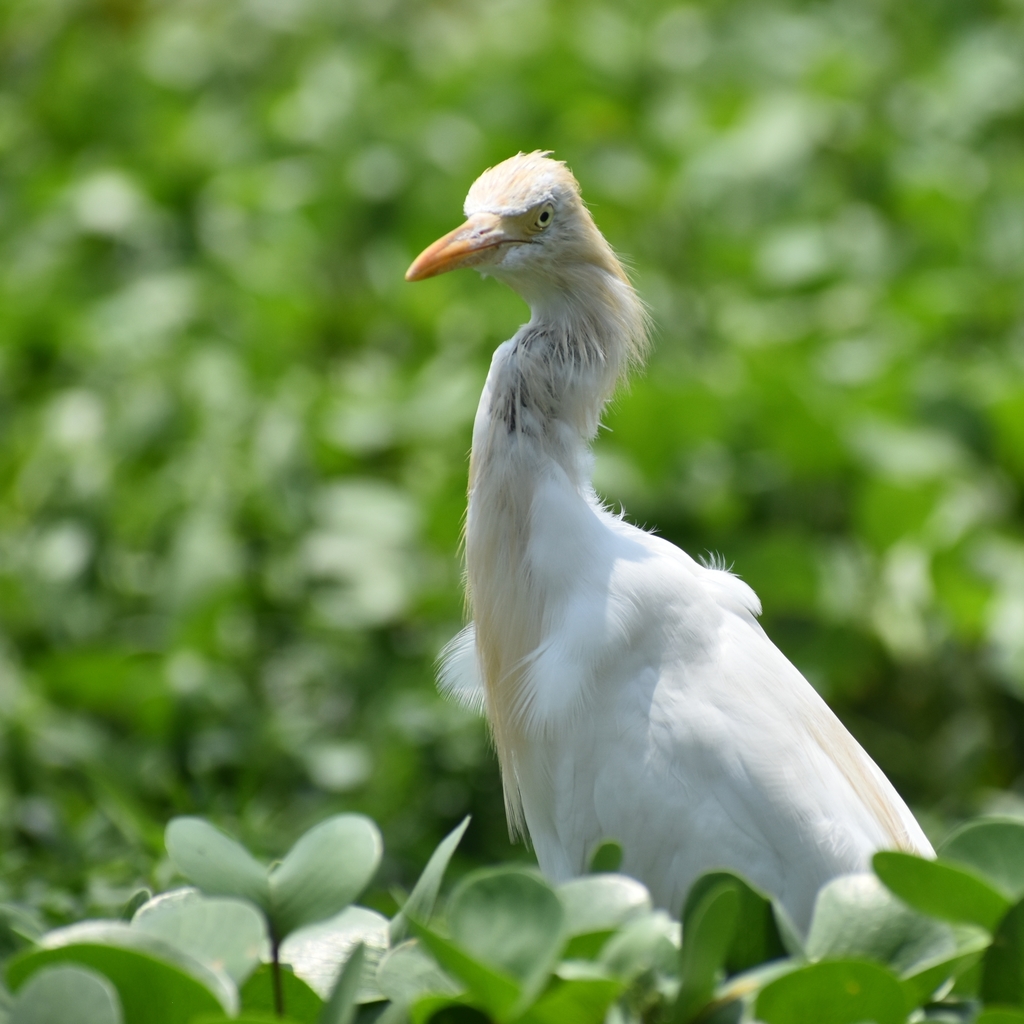
Eastern Cattle Egret
Photo © Devika M B
Photo © Devika M B — CC BY 4.0 — Source: iNaturalist #109656608Identification
The eastern cattle egret is a stocky heron measuring 46–56 cm in length with a wingspan of 88–96 cm. It has a relatively short thick neck, sturdy bill, and characteristically hunched posture. Non-breeding adults are predominantly white with a yellow bill and greyish-yellow legs. During breeding season, adults develop distinctive orange-buff plumes on the throat, head, and lower back. The eastern cattle egret differs from its western counterpart in breeding plumage, with buff coloration extending to the cheeks and throat and more golden-hued plumes. The bird's eye positioning provides binocular vision during feeding, an adaptation to its terrestrial foraging lifestyle.
Range & Habitat
Native to southern and eastern Asia and Australasia, the eastern cattle egret has experienced a remarkable range expansion, beginning colonisation of Australia in the 1940s and regularly visiting New Zealand from the 1960s onwards. This expansion is largely attributed to the species' ability to exploit human livestock farming. Unlike most herons, eastern cattle egrets favour drier, open habitats over wetlands, typically found in fields and grasslands rather than shallow water.
Their feeding habitats include seasonally inundated grasslands, pastures, farmlands, wetlands, and rice paddies. They nest in colonies, usually near bodies of water in woodlands, swamps, or on islands, often sharing these spaces with other wading birds such as herons, egrets, ibises, and cormorants.
Behaviour & Diet
Eastern cattle egrets exploit a unique ecological niche by closely associating with large grazing mammals, particularly cattle and horses. They feed on insects and small vertebrates disturbed by these animals, and notably remove ticks and flies directly from the animals' bodies—a mutually beneficial relationship. Their greater dietary reliance on terrestrial insects rather than aquatic prey sets them apart from most heron species.
These egrets are largely silent birds, though they produce quiet, throaty rick-rack calls at breeding colonies. Some populations are highly migratory or show post-breeding dispersal, while others remain sedentary. In the northern hemisphere, migration typically follows cooler-to-warmer patterns, whereas Australian populations migrate to cooler Tasmania and New Zealand during winter.
Best Time & Places to See It
The best locations for observing eastern cattle egrets are open grasslands, pastures, and agricultural areas where cattle and other livestock graze, particularly in tropical, subtropical, and warm temperate zones across southern and eastern Asia and Australasia. Look for them in seasonally inundated grasslands and rice paddies, especially during breeding season when they gather in colonies.
Breeding seasons vary by region: in northern India, nesting begins with the onset of monsoons in May, while in Australia the breeding season runs from November to early January. For viewing in Australia, the 1940s onward marked their establishment in the north and east, making these regions reliable locations. Populations in India show local migrations in response to monsoons, moving northward from Kerala after September.
Photography Tips
Photograph eastern cattle egrets in open grassland and pasture habitats where they forage alongside livestock—these settings provide excellent opportunities to capture their characteristic feeding behaviour and interaction with grazing animals. The contrast between their white plumage and golden grassland backgrounds creates striking images.
During breeding season, visit nesting colonies for shots of birds displaying with their distinctive buff and golden plumes. Early morning and late afternoon light will best highlight their breeding plumage colouration. Since these egrets often gather in flocks during migration, particularly at night in coastal areas, daytime observations at traditional roosting and feeding sites offer the most reliable photography opportunities.
Minneriya National Park
Sri Lanka
+158 birds+9 mammals
Across the dry zone of Sri Lanka's North Central Province spreads a landscape of shallow tanks, grassland margins, and scattered dry forest—a mosaic of water and…
VIEW NATIONAL PARKRanthambhore National Park
Sawai Madhopur, India
+294 birds+20 mammals
Granite ridges and ravines carved through the Aravalli Range frame this protected landscape in eastern Rajasthan, where deciduous forest mingles with open scrubland and seasonal water…
VIEW NATIONAL PARKHat Noppharat Thara-Mu Ko Phi Phi National Park
Ao Nang, Thailand
+253 birds+9 mammals
Where limestone karsts rise dramatically from turquoise waters, Hat Noppharat Thara-Mu Ko Phi Phi National Park unfolds across a mosaic of beach, mangrove forest, and island…
VIEW NATIONAL PARKKhao Yai National Park
Prachantakham District, Thailand
+377 birds+46 mammals
Evergreen dipterocarp forest blankets the rolling terrain of this national park in eastern Thailand, where limestone hills rise abruptly from the forest floor and seasonal streams…
VIEW NATIONAL PARKKakadu National Park
Kakadu, Australia
+273 birds+46 mammals
Kakadu National Park is Australia’s largest national park and one of the world’s most remarkable protected areas, covering nearly 20,000 square kilometres in the tropical north…
VIEW NATIONAL PARKDaintree National Park
Dedin, Australia
+362 birds+37 mammals
Daintree National Park is one of the world’s oldest and most biologically diverse tropical rainforests, protecting an extraordinary landscape where ancient forests meet the Great Barrier…
VIEW NATIONAL PARKRoyal National Park
Sydney, Australia
+296 birds+46 mammals
Where sandstone ridges plunge toward the Tasman Sea, Royal National Park unfolds across 343 square kilometres of southeastern Australian coastal wilderness. The park's defining character emerges…
VIEW NATIONAL PARKRinyirru National Park
Lakefield, Australia
+258 birds+7 mammals
Where the savanna grasslands of far north Queensland meet seasonal wetlands and eucalypt woodlands, Rinyirru National Park sprawls across more than 12,500 square kilometres of rugged,…
VIEW NATIONAL PARKMorton National Park
Australia
+253 birds+57 mammals
Across nearly 4,800 square kilometers of New South Wales's Southern Tablelands, rugged sandstone plateaus rise above sheltered valleys where cool-climate eucalypt woodland meets grassy heath and…
VIEW NATIONAL PARKBribie Island National Park
Brisbane, Australia
+284 birds+20 mammals
Across tidal flats and shallow waterways north of Brisbane, Bribie Island National Park spreads across nearly four hundred square kilometres of subtropical coastal wilderness—a patchwork of…
VIEW NATIONAL PARKWilsons Promontory National Park
Australia
+210 birds+21 mammals
Where granite headlands plunge toward Bass Strait, Wilson's Promontory National Park sprawls across nearly 1,300 square kilometers of southeastern Victoria's most rugged coastal wilderness. The park's…
VIEW NATIONAL PARKKanha Tiger Reserve
Kanha Kisli F.V., India
+321 birds+23 mammals
Where sal forests give way to emerald meadows and crystalline streams carve through ancient valleys, one of India's finest wilderness reserves unfolds across the Maikal Range.…
VIEW NATIONAL PARKTadoba National Park
Palasgaon Singru, India
+270 birds+20 mammals
Where sal forests meet open grasslands and rocky outcrops rise from red laterite soil, central India's landscape unfolds in raw, untamed beauty. Ancient teak woodlands and…
VIEW NATIONAL PARKBandhavgarh National Park
Garhpuri, India
+285 birds+17 mammals
Where granite ridges rise dramatically above sal and bamboo forests, one of India's most pristine tiger reserves unfolds across the Vindhyan plateau. Ancient rock formations tower…
VIEW NATIONAL PARKKaziranga National Park
Kohora, India
+422 birds+26 mammals
Dawn breaks over the floodplains of the Brahmaputra, where tall grasslands stretch endlessly beneath monsoon-heavy skies. This sprawling wilderness of northeastern Assam is a mosaic of…
VIEW NATIONAL PARKKeoladeo National Park
Shreenagar Rural, India
+326 birds+14 mammals
Where shallow wetlands shimmer beneath vast Rajasthani skies, one of Asia's finest bird sanctuaries pulses with extraordinary life. This former maharaja's hunting reserve, now spanning 29…
VIEW NATIONAL PARKWay Kambas National Park
Lampung Timur, Indonesia
+237 birds+20 mammals
Across the low swamplands of eastern Lampung, where freshwater wetlands merge into tidal mangrove forests along the Sunda Strait, sprawls one of Sumatra's most vital sanctuaries.…
VIEW NATIONAL PARKGir National Park
Asundrali, India
+258 birds+13 mammals
Dry deciduous forests cloak the rolling hills of western Gujarat where the Gir landscape rises as a final sanctuary for one of the world's rarest felids:…
VIEW NATIONAL PARKGirringun National Park
Australia
+231 birds+10 mammals
Where granite gorges cleave through subtropical woodland in North Queensland, Girringun National Park unfolds across rugged terrain shaped by millions of years of weathering and erosion.…
VIEW NATIONAL PARKNo community photos yet. Log in to add the first one.
No community observations of this species yet.