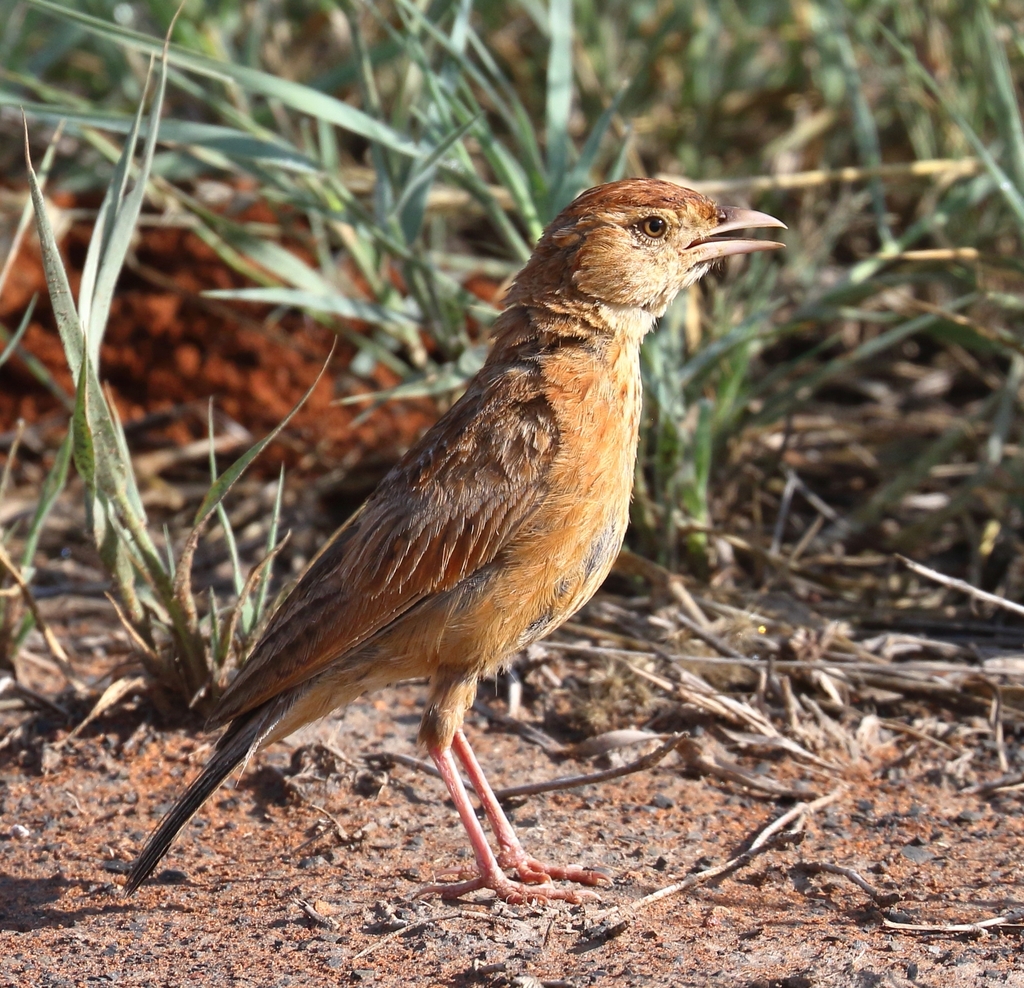
Eastern Clapper Lark
Photo © Alan Manson
Photo © Alan Manson — CC BY 4.0 — Source: iNaturalist #268524565Identification
The eastern clapper lark is a small passerine measuring 15 cm in length, easily recognised by its distinctive plumage. Look for a brown crown, rich rufous underparts, and strong, sturdy bill. The upperparts are brown, becoming greyer towards the northern extent of its range. Its ascending call—a distinctive "pooooeeeee"—often betrays its presence before you spot the bird itself.
Range & Habitat
This species is endemic to the drier regions of southern Africa, with its range spanning Zambia, Namibia, Botswana, Lesotho, and South Africa. Five subspecies are recognised across this distribution, each adapted to local conditions. The eastern clapper lark favours open grasslands and savannah habitats, typically in arid and semi-arid environments where vegetation remains sparse.
Behaviour & Diet
A skulking species by nature, the eastern clapper lark can prove frustratingly difficult to locate except during its spectacular display flight. It is solitary rather than gregarious, spending much of its time foraging inconspicuously on the ground in dry habitats. Its diet consists primarily of seeds and insects gleaned from the ground. The bird's name derives from its remarkable display flight: it launches into an ascending flight with vigorous wing clapping, then descends in a dramatic parachute motion with trailing legs extended.
Best Time & Places to See It
Search for the eastern clapper lark in open grasslands and savannah across southern Africa, particularly in Botswana, Namibia, and South Africa. The bird is most conspicuous during its display season, when males perform their characteristic wing-clapping flights. Scanning open habitats and listening for the ascending "pooooeeeee" call will aid your search, though patience and persistence are essential given the species' generally secretive behaviour when not displaying.
Photography Tips
Photographing this species demands patience and timing. During non-display periods, the bird's skulking habits make close approach challenging. Your best opportunity comes during the display flight, when the male becomes more conspicuous and predictable. Position yourself with the sun at your back in open terrain where you can track the ascending and parachuting flight sequence. Early morning light often produces the best results, and a telephoto lens (at least 500 mm) will be necessary to capture detail as the bird performs its aerial display.
Addo Elephant National Park
Etosha National Park
Mountain Zebra National Park
Nothing matches these filters.
No community photos yet. Log in to add the first one.
No community observations of this species yet.