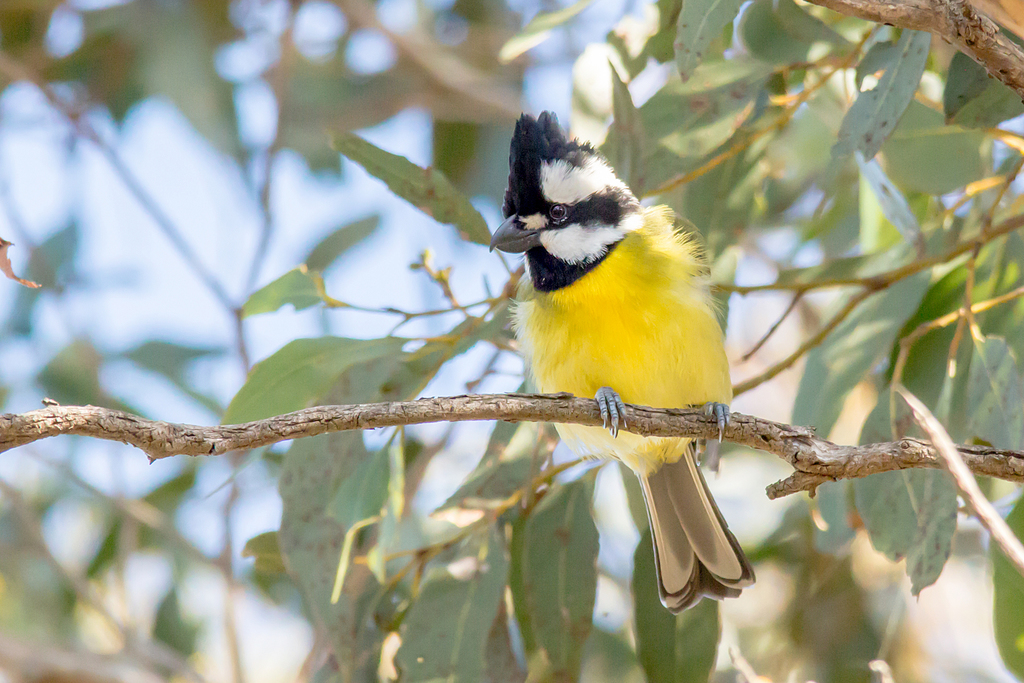
Eastern Shriketit
Photo © Andrew Allen
Photo © Andrew Allen — CC BY 4.0 — Source: iNaturalist photo #49939130Identification
The eastern shriketit is a small passerine, measuring 15–19 cm in length with a wingspan of 24–29 cm. Males weigh 26.5–40 g, while females are slightly lighter at 23–33 g. The species is readily identified by its distinctive head pattern: broad white patches separated by a thick black eyeline, with another black band running from the bill over the crown to the nape. Males possess an erectable crest and have a black throat, while females show an olive-brown throat instead. The back is olive-brown to olive-green, and the underparts are yellow. The large, powerful bill is specially adapted for levering and stripping bark. Juveniles resemble adults in head pattern but have buffy-white throats, breasts and bellies with browner wings.
The eastern shriketit differs from its congeners: the northern shriketit has broad yellow wing-margins and brownish-grey wing coverts, while the western shriketit displays a white belly, olive-grey wing-coverts and yellow-edged flight feathers. The golden whistler, which shares similar habitat, is distinguished by its mostly black head, white throat with black breast-band, and narrower bill.
Range & Habitat
This species is endemic to south-eastern Australia, found from the Mount Lofty Ranges and Fleurieu Peninsula of South Australia, through Victoria and New South Wales east of the Great Dividing Range, northward to the Atherton Tablelands of tropical Queensland. The species is most common in north-central and coastal Victoria and eastern New South Wales, with more scattered occurrences throughout Queensland. The eastern shriketit is sedentary or locally nomadic.
The preferred habitat consists of eucalypt forest and open woodland canopies, with secondary use of mallee, cypress-pine, coastal tea-tree and banksia stands. It also frequents trees along rivers and occasionally ventures into rainforests, always foraging in the upper canopy strata where it is most active.
Behaviour & Diet
The eastern shriketit forages unobtrusively in pairs or small groups, using its powerful bill to lever up and tear bark in search of spiders, beetles and insect larvae. Remarkably, this species demonstrates tool-use behaviour, having been observed holding a twig in its bill and poking it into crevices to extract concealed insects.
Breeding occurs from late August to early January, with double broods typical in the northern part of its range and single broods more common in the cooler south. The nest is a deep cup constructed from bark fibre bound with spider-web and lined with fine grass and lichen, typically positioned among the highest twigs of a eucalypt sapling 5–30 m above ground. Clutches of 2–3 whitish eggs with brown or slate-grey spots are incubated for 15–16 days, primarily by the female. Young fledge after 14–17 days and receive parental care for 3–6 months thereafter.
Best Time & Places to See It
The eastern shriketit is generally uncommon to rare, though widely distributed across its range. The species is sedentary or locally nomadic, making year-round observation possible, though breeding activity from late August to early January offers the best opportunity for sightings as birds are more vocal and active. North-central and coastal Victoria, and areas east of the Great Dividing Range in New South Wales, offer the most reliable viewing prospects due to higher densities in these regions.
Search for this species in the canopy of eucalypt forests and open woodlands, scanning tall saplings and mature trees carefully. Early morning visits during calm weather will increase your chances of locating birds, as they forage unobtrusively and can be easily overlooked despite their striking appearance.
Photography Tips
The eastern shriketit's small size and preference for the upper canopy present significant photographic challenges. Position yourself with backlighting to illuminate the distinctive white head patches and catch the erectable crest of males. A telephoto lens of at least 300–400 mm is essential. Focus on birds during early morning when light is directional and they are most active in foraging behaviour.
During breeding season, patient observation of nest sites in tall eucalypt saplings may reward photographers with behavioural sequences of bark-stripping and feeding. Avoid approaching nests closely, as this may disturb breeding birds and attract predators. Capturing the bird's characteristic posture while levering bark will best showcase its adapted bill and feeding ecology.
Bunya Mountains National Park
Australia
+149 birds+11 mammals
Where subtropical rainforest meets open eucalyptus woodland on the elevated plateau of southeastern Queensland, Bunya Mountains National Park unfolds across 483 square kilometres of some of…
VIEW NATIONAL PARKHerberton Range National Park
Australia
+115 birds+10 mammals
Rainforest-clad ridges and rocky outcrops define this 324-square-kilometre reserve in far north Queensland, where the mountainous terrain of the Herberton Range rises through layered eucalypt woodland…
VIEW NATIONAL PARKGreater Bendigo National Park
Whipstick, Australia
+202 birds+8 mammals
Across the red volcanic plains of inland Victoria, Greater Bendigo National Park sprawls across more than 1,000 square kilometres of eucalyptus woodland, open grassland, and scattered…
VIEW NATIONAL PARKChiltern-Mt Pilot National Park
Australia
+229 birds+12 mammals
Granite ridges and eucalyptus woodlands define this 869-square-kilometre park straddling the border between Victoria and New South Wales, where rugged terrain rises sharply from gentler foothill…
VIEW NATIONAL PARKKinglake National Park
Australia
+164 birds+11 mammals
Where the volcanic plains of central Victoria rise into forested ridges, Kinglake National Park encompasses roughly 844 square kilometres of diverse habitat that represents one of…
VIEW NATIONAL PARKLower Glenelg National Park
Australia
+161 birds+12 mammals
Where the Glenelg River carves through southeastern Victoria's limestone country, Lower Glenelg National Park unfolds across nearly 800 square kilometres of river gorge, eucalypt woodland, and…
VIEW NATIONAL PARKBudj Bim National Park
Australia
+137 birds+7 mammals
Across southwestern Victoria's volcanic plains, Budj Bim National Park preserves a landscape shaped by ancient lava flows and Indigenous land stewardship spanning millennia. The park's 184…
VIEW NATIONAL PARKSpringbrook National Park
Australia
+195 birds+25 mammals
Subtropical rainforest meets open eucalypt woodland across a mountainous terrain where the McPherson Range rises sharply from the Queensland coast, creating a patchwork of microclimates and…
VIEW NATIONAL PARKLamington National Park
Australia
+227 birds+24 mammals
Where subtropical rainforest rises steeply from the Queensland coast, Lamington National Park spreads across 541 square kilometres of one of Australia's most biodiverse mountain landscapes. The…
VIEW NATIONAL PARKRoyal National Park
Sydney, Australia
+296 birds+46 mammals
Where sandstone ridges plunge toward the Tasman Sea, Royal National Park unfolds across 343 square kilometres of southeastern Australian coastal wilderness. The park's defining character emerges…
VIEW NATIONAL PARKLittle Desert National Park
Australia
+200 birds+11 mammals
Across northwestern Victoria's semi-arid interior, sandstone ridges and heathland plateaus rise from red earth in a landscape sculpted by fire and drought rather than water. Little…
VIEW NATIONAL PARKNaracoorte Caves National Park
Australia
+116 birds+12 mammals
Beneath the grassy limestone plains of southeastern South Australia lies one of the Southern Hemisphere's most significant underground landscapes. Naracoorte Caves National Park encompasses a mosaic…
VIEW NATIONAL PARKSundown National Park
Australia
+211 birds+9 mammals
Granite ridges and eucalypt woodlands define this 305-square-kilometre expanse of southeastern Queensland, where the landscape descends from sandstone plateaus into open forests and grassy clearings that…
VIEW NATIONAL PARKBald Rock National Park
Australia
+122 birds+15 mammals
Granite peaks and weathered stone dominate the landscape of this 202-square-kilometre national park in inland New South Wales, where rugged tors and rocky outcrops rise dramatically…
VIEW NATIONAL PARKGirraween National Park
Australia
+193 birds+21 mammals
Granite boulders rise like the bones of the earth across these 278 square kilometres of southeastern Queensland, where the Great Dividing Range descends towards the coastal…
VIEW NATIONAL PARKMorton National Park
Australia
+253 birds+57 mammals
Across nearly 4,800 square kilometers of New South Wales's Southern Tablelands, rugged sandstone plateaus rise above sheltered valleys where cool-climate eucalypt woodland meets grassy heath and…
VIEW NATIONAL PARKLake Eildon National Park
Australia
+119 birds+8 mammals
Across the rippled waters and wooded shorelines of central Victoria's sprawling reservoir system, Lake Eildon National Park encompasses nearly 870 square kilometres of transformed landscape where…
VIEW NATIONAL PARKBribie Island National Park
Brisbane, Australia
+284 birds+20 mammals
Across tidal flats and shallow waterways north of Brisbane, Bribie Island National Park spreads across nearly four hundred square kilometres of subtropical coastal wilderness—a patchwork of…
VIEW NATIONAL PARKWilsons Promontory National Park
Australia
+210 birds+21 mammals
Where granite headlands plunge toward Bass Strait, Wilson's Promontory National Park sprawls across nearly 1,300 square kilometers of southeastern Victoria's most rugged coastal wilderness. The park's…
VIEW NATIONAL PARKGreat Sandy National Park
Australia
+306 birds+40 mammals
Where coastal dunes rise inland from the Queensland coastline, Great Sandy National Park encompasses a landscape of remarkable ecological diversity shaped by subtropical humid conditions year-round.…
VIEW NATIONAL PARKGirringun National Park
Australia
+231 birds+10 mammals
Where granite gorges cleave through subtropical woodland in North Queensland, Girringun National Park unfolds across rugged terrain shaped by millions of years of weathering and erosion.…
VIEW NATIONAL PARKBlue Mountains National Park
Australia
+220 birds+43 mammals
Dramatic sandstone cliffs rise in tiers across this mountainous plateau west of Sydney, their rust-coloured faces weathered into amphitheatres and gorges where eucalyptus forest clings to…
VIEW NATIONAL PARKKosciuszko National Park
Australia
+211 birds+52 mammals
Where the Great Dividing Range reaches its highest peaks in southeastern Australia, Kosciuszko National Park encompasses a landscape of windswept plateaus, rocky ridges, and deep river…
VIEW NATIONAL PARKKu-ring-gai Chase National Park
Sydney, Australia
+216 birds+39 mammals
Where Hawkesbury sandstone cliffs plunge toward sheltered bays and creeks, Ku-ring-gai Chase National Park unfolds across rugged terrain just north of Sydney, a mosaic of eucalyptus…
VIEW NATIONAL PARKBarrington Tops National Park
Australia
+175 birds+47 mammals
Where the New England Plateau rises above the Hunter Valley, temperate rainforest cloaks the highest reaches of Barrington Tops, its dense canopy fed by year-round precipitation…
VIEW NATIONAL PARKDorrigo National Park
Gleniffer, Australia
+172 birds+17 mammals
Where subtropical rainforest transitions into cool temperate woodland, Dorrigo National Park rises across the volcanic tablelands of far northern New South Wales, cloaked in the perpetually…
VIEW NATIONAL PARKWarrumbungle National Park
Coonabarabran, Australia
+183 birds+22 mammals
Volcanic peaks and weathered ridges rise abruptly from the inland tablelands of central New South Wales, their exposed rock faces glowing ochre and rust in the…
VIEW NATIONAL PARKOxley Wild Rivers National Park
Australia
+202 birds+45 mammals
Where the New England Tablelands descend toward the coast, river gorges carve through temperate forests in a landscape of dramatic geological contrast. Oxley Wild Rivers National…
VIEW NATIONAL PARKNew England National Park
Australia
+169 birds+35 mammals
Temperate eucalypt woodlands and cool rainforest pockets define this upland reserve where granite peaks rise above the New England Plateau in northeastern New South Wales. Here,…
VIEW NATIONAL PARKBudawang National Park
Australia
+80 birds+17 mammals
Rugged sandstone ridges rise dramatically across the New South Wales Southern Tablelands, their weathered faces sculpted by millennia of wind and water into a landscape of…
VIEW NATIONAL PARKBen Boyd National Park
Eden, Australia
+255 birds+47 mammals
Where the temperate forests of the far south coast meet towering sea cliffs, Ben Boyd National Park unveils one of New South Wales' most dramatic coastal…
VIEW NATIONAL PARKGrampians National Park
Australia
+214 birds+18 mammals
Where sandstone ridges rise above the Western District of Victoria, Grampians National Park unfolds across rolling terrain sculpted by ancient geology and sustained by a temperate…
VIEW NATIONAL PARKGreat Otway National Park
Australia
+255 birds+42 mammals
Temperate rainforest and wet eucalyptus woodland cloak the ridges and gullies of Victoria's Great Otway National Park, where persistent moisture and mild year-round temperatures sustain a…
VIEW NATIONAL PARKMount Buffalo National Park
Myrtleford, Australia
+124 birds+7 mammals
Granite peaks rise abruptly from the volcanic plains of northeastern Victoria, their exposed rock faces and windswept ridges defining Mount Buffalo National Park's rugged character. The…
VIEW NATIONAL PARKCoorong National Park
Australia
+217 birds+15 mammals
Where the Murray River meets the Southern Ocean, a chain of shallow lagoons stretches across the South Australian coast, separated from the sea by a ribbon…
VIEW NATIONAL PARKStirling Range National Park
Australia
+149 birds+7 mammals
Where ancient quartzite ranges rise abruptly from the southwestern Australian plateau, Stirling Range National Park unfolds as a realm of dramatic escarpments, deep valleys, and surprising…
VIEW NATIONAL PARKNo community photos yet. Log in to add the first one.
No community observations of this species yet.