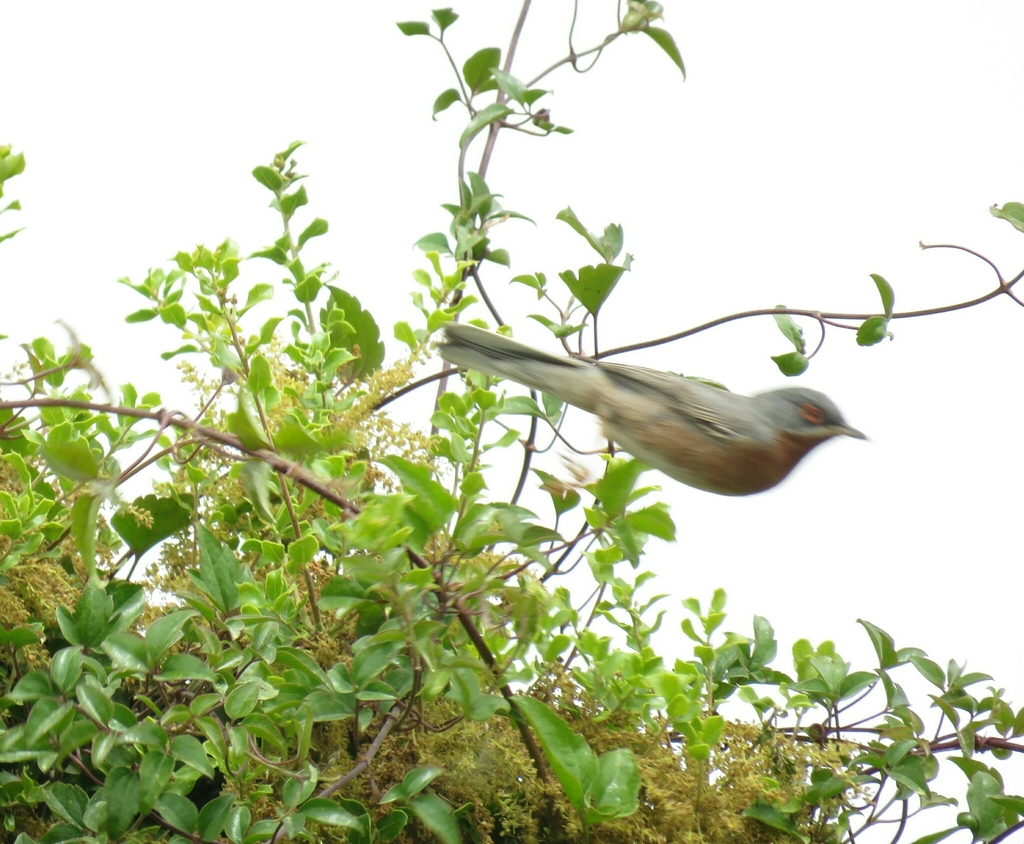
Eastern Subalpine Warbler
Photo © Juan Carlos Caicedo Hernández
Photo © Juan Carlos Caicedo Hernández — CC BY 4.0 — Source: iNaturalist #24536630Identification
The eastern subalpine warbler is a small, sexually dimorphic sylviid warbler with striking plumage differences between males and females. Adult males are particularly distinctive, featuring a deep blue-grey back and head, brick-reddish-brown coloration on the throat and breast that is sharply demarcated from a largely white belly, and characteristic white malar streaks or "moustaches" framing the face. A blackish mask on the lores and ear-coverts adds further contrast. Females are less boldly marked, with mainly brown upperparts and a greyer head, whitish underparts with a subtle pink flush, and paler flanks. The species differs from its western counterpart by its deeper blue-grey upperparts, more pronounced facial mask, and the restriction of brick-red coloration to the throat and breast with paler flanks and a wider white submoustachial stripe.
Range & Habitat
The eastern subalpine warbler breeds in the southernmost areas of Europe, inhabiting dry Mediterranean regions where it favors tall, dense heterogeneous maquis with sparse tree cover. It shows particular preference for maquis dominated by holm oak, strawberry tree, and tree-heath, as well as young cork oak forests and dense bushy areas. The bird also utilizes bushy formations dominated by brambles along sunny ravines and valley bottoms, and shows an interesting affinity for intermediate stages of post-wildfire succession, where regenerating vegetation provides ideal habitat.
Behaviour & Diet
The eastern subalpine warbler is monogamous, with the breeding season extending from late March to late June. Males construct several "cock nests" before the pair builds the actual breeding nest—a deep, robust cup of grasses, thin roots, and leaves, lined with finer materials and hair, typically placed 30–130 centimeters above the ground in low scrub or small trees. Clutches consist of three to five eggs. The species is primarily insectivorous, feeding on small insects and their larvae during the breeding season. Outside this period, it supplements its diet with berries and fruits. Its song is fast and rattling, similar to the lesser whitethroat.
Best Time & Places to See It
The breeding season from late March to late June is the best time to observe eastern subalpine warblers, when males are actively singing and pairs are engaged in nesting activities. They should be sought in dry Mediterranean hill slopes and scrubland habitats, particularly in areas with the characteristic maquis vegetation mentioned above. Look in regions where post-wildfire succession has created suitable bushy habitats interspersed with open ground.
Photography Tips
Photographing this species can be rewarding but challenging, as these warblers often remain hidden within dense scrub. Males are more visually striking than females due to their bold coloration and distinctive white malar streaks, making them preferable subjects. Early morning during the breeding season offers the best opportunities, as males are more vocal and active. Position yourself near suitable habitat and wait patiently, listening for the fast, rattling song that will help locate individuals. The white malar markings and facial mask of males are key features to capture, as they distinguish this species from related warblers. Back-lit or side-lit conditions can help emphasize the male's blue-grey upperparts and reddish-brown breast coloration.
North York Moors National Park
North Yorkshire, United Kingdom
+234 birds+32 mammals
Across the high moorlands of North Yorkshire, where heather and bilberry sprawl beneath vast skies, the landscape rises and falls in gentle undulation—a patchwork of open…
VIEW NATIONAL PARKSouth Downs National Park
Chichester, United Kingdom
+298 birds+45 mammals
Chalk downland ridges rise and fall across the South Downs, their open grasslands and beech hangers creating a mosaic of habitats that has shaped human settlement…
VIEW NATIONAL PARKCirceo National Park
Italy
+232 birds+6 mammals
Where limestone headlands plunge toward the Tyrrhenian Sea, Circeo National Park preserves a rare mosaic of Mediterranean coastal habitats that few Italian reserves can match. The…
VIEW NATIONAL PARKTuscan Archipelago National Park
Rio, Italy
+174 birds+8 mammals
Where the Tyrrhenian Sea fragments into granite and schist islands, the Arcipelago Toscano National Park protects one of the Mediterranean's most biodiverse maritime realms. Scattered across…
VIEW NATIONAL PARKForeste Casentinesi, Monte Falterona and Campigna National Park
Santa Sofia, Italy
+92 birds+13 mammals
Where the northern Apennines rise above the Tuscan-Emilian divide, beech and fir forests cloak the slopes of Monte Falterona in a mantle of temperate woodland that…
VIEW NATIONAL PARKMaiella National Park
Pacentro, Italy
+131 birds+11 mammals
Limestone scarps rise abruptly from the valleys around Pacentro, their pale faces scored by millennia of water and wind into a landscape of canyons, karst features,…
VIEW NATIONAL PARKGran Sasso and Monti della Laga National Park
Pietracamela, Italy
+155 birds+12 mammals
Where the Apennines rise in their most dramatic form, the Gran Sasso e Monti della Laga National Park unfolds across nearly 70,000 hectares of limestone peaks,…
VIEW NATIONAL PARKMonti Sibillini National Park
Castelsantangelo sul Nera, Italy
+113 birds+11 mammals
Where the Apennines rear their limestone spine across central Italy, the Sibillini Mountains National Park reveals a landscape of dramatic vertical relief, high plateaus, and deeply…
VIEW NATIONAL PARKGargano National Park
Cagnano Varano, Italy
+219 birds+7 mammals
Where the Gargano Peninsula's limestone plateaus descend toward the Adriatic, Cagnano Varano sits at the threshold of one of southern Italy's most ecologically vital landscapes. The…
VIEW NATIONAL PARKCilento, Vallo di Diano and Alburni National Park
Campora, Italy
+145 birds+12 mammals
Where the southern Apennines descend toward the Tyrrhenian coast, the landscape transforms into a mosaic of limestone plateaus, deep ravines, and Mediterranean scrubland that defines Cilento,…
VIEW NATIONAL PARKPindos National Park
Ioannina Regional Unit, Greece
+163 birds+12 mammals
Where limestone peaks rise abruptly from the Pindus range in northwestern Greece, a landscape of dramatic gorges, alpine meadows, and dense beech forests creates one of…
VIEW NATIONAL PARKMount Ainos National Park
Sami Municipal Unit, Greece
+118 birds+1 mammals
Where limestone and conglomerate peaks rise dramatically above the Ionian Sea, Mount Ainos commands the landscape of Kefalonia with a rugged majesty that few Mediterranean summits…
VIEW NATIONAL PARKVikos–Aoos National Park
Ioannina Regional Unit, Greece
+136 birds+4 mammals
Where limestone gorges plunge through the Pindus Mountains, the Vikos–Aoos National Park guards one of Greece's most dramatic inland wilderness areas. The park's defining feature is…
VIEW NATIONAL PARKMount Parnitha National Park
Municipal Unit of Acharnes, Greece
+137 birds+4 mammals
Where pine-clad ridges rise abruptly from the Attica plains, Mount Parnitha National Park unfolds across nearly 4,000 hectares of Mediterranean mountain wilderness. The park's defining character…
VIEW NATIONAL PARKSounio National Park
Municipal Unit of Ayios Konstantinos, Greece
+103 birds
Where rocky headlands plunge into the Aegean Sea along Attica's southeastern coast, Sounio National Park preserves a landscape shaped by millennia of human presence yet alive…
VIEW NATIONAL PARKOlympos National Park
Pieria Regional Unit, Greece
+137 birds+3 mammals
Where the Thessalian plains give way to soaring limestone massifs, Olympos National Park rises as one of the Aegean's most dramatic mountain wilderness areas. This IUCN…
VIEW NATIONAL PARKKerkini Lake National Park
Serres, Greece
+291 birds+18 mammals
Where the Strymon River widens into a sprawling freshwater lake hemmed by the Rhodope Mountains, Kerkini National Park unfolds across northern Greece as one of southeastern…
VIEW NATIONAL PARKAlta Murgia National Park
Bari, Italy
+168 birds+6 mammals
Across the limestone plateaux of Apulia's interior, where the Adriatic's influence fades into continental warmth, lies a landscape sculpted by millennia of human pastoralism and Mediterranean…
VIEW NATIONAL PARKCinque Terre National Park
Riomaggiore, Italy
+135 birds+1 mammals
Steep terraced cliffs plunge toward the Ligurian Sea where five villages cling to a Csb-climate coastline shaped by centuries of viticulture and stone masonry. Riomaggiore, the…
VIEW NATIONAL PARKSeven Sisters National Nature Reserve
Eastbourne, United Kingdom
+190 birds+15 mammals
Where the South Downs meet the English Channel, the chalk cliffs of Seven Sisters rise in a dramatic sequence of white promontories that have shaped both…
VIEW NATURE RESERVENo community photos yet. Log in to add the first one.
No community observations of this species yet.