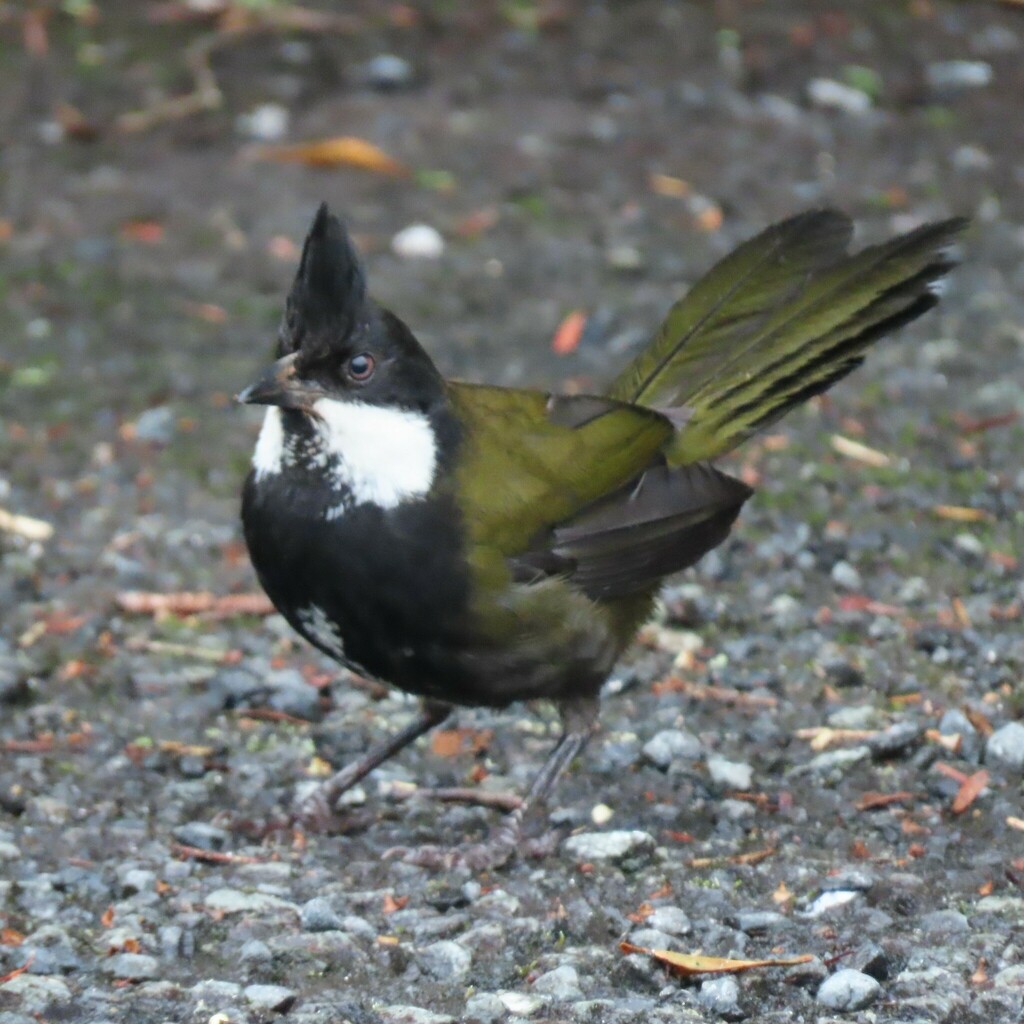
Eastern Whipbird
Photo © pimelea
Photo © pimelea — CC BY 4.0 — Source: iNaturalist #190057929Identification
The Eastern Whipbird is a slim, 26–30 cm passerine weighing 47–72 grams, easily recognised by its distinctive plumage: olive-green upperparts contrasting with a black head and breast, a small black crest, and a striking white cheek patch. The abdomen is paler, and the long tail is dark olive-green with white tips. Males are slightly larger than females, though plumage is similar between the sexes. Juveniles are duller olive-brown and lack the white cheek stripes and dark throat markings of adults.
Range & Habitat
This species is endemic to the east coast of Australia, occurring from eastern Victoria northward through to central Queensland. Two subspecies are recognised: the nominate P. o. olivaceus ranges across the broader eastern distribution, while P. o. lateralis, found on the Atherton Tableland in North Queensland between Cooktown and Townsville, is smaller and browner. The Eastern Whipbird inhabits wet temperate forests, including both rainforests and wet sclerophyll forests, typically near water sources. It is considered a habitat specialist and is threatened by urbanisation.
Behaviour & Diet
The Eastern Whipbird is insectivorous, foraging for insects in leaf litter on the forest floor. It is notoriously shy and elusive, heard far more often than seen. The species is monogamous, breeding from late winter through spring, constructing loosely built bowl nests of twigs and sticks lined with softer materials in shrubs or trees less than 3–4 m above ground. Females typically lay clutches of two pale blue eggs with blackish splotches, incubate them, and brood nestlings, while males assist with feeding and more actively care for fledglings for approximately 6 weeks after they leave the nest. Several broods may occur within an extended breeding season.
Best Time & Places to See It
Although difficult to observe directly, the Eastern Whipbird is best located by listening for its distinctive and far-carrying call—a characteristic sequence of a long note, sharp whip-crack sound, and follow-on notes, typically delivered as a duet between male and female. Calls are most frequent in early morning and may occur throughout the day with peaks at noon and sunset. Seek out wet forests in eastern Victoria, New South Wales, and Queensland; the northern subspecies can be found in the wet tropics of North Queensland.
Photography Tips
Photographing the Eastern Whipbird presents a significant challenge due to its shy, secretive nature. Patience and careful stalking through dense forest understorey are essential. Early morning visits to suitable wet forest habitats offer the best chances. Use the bird's distinctive call as a guide: learning to recognise and locate the sound will greatly improve your opportunities. When attempting to photograph, move slowly and deliberately to avoid flushing the bird deeper into cover. A longer focal length lens (300–400 mm) will be advantageous for capturing distant subjects in the shadowy forest environment.
Alpine National Park
Bald Rock National Park
Barrington Tops National Park
Ben Boyd National Park
Blue Mountains National Park
Bouddi National Park
Bribie Island National Park
Budawang National Park
Bunya Mountains National Park
Nothing matches these filters.
No community photos yet. Log in to add the first one.
No community observations of this species yet.