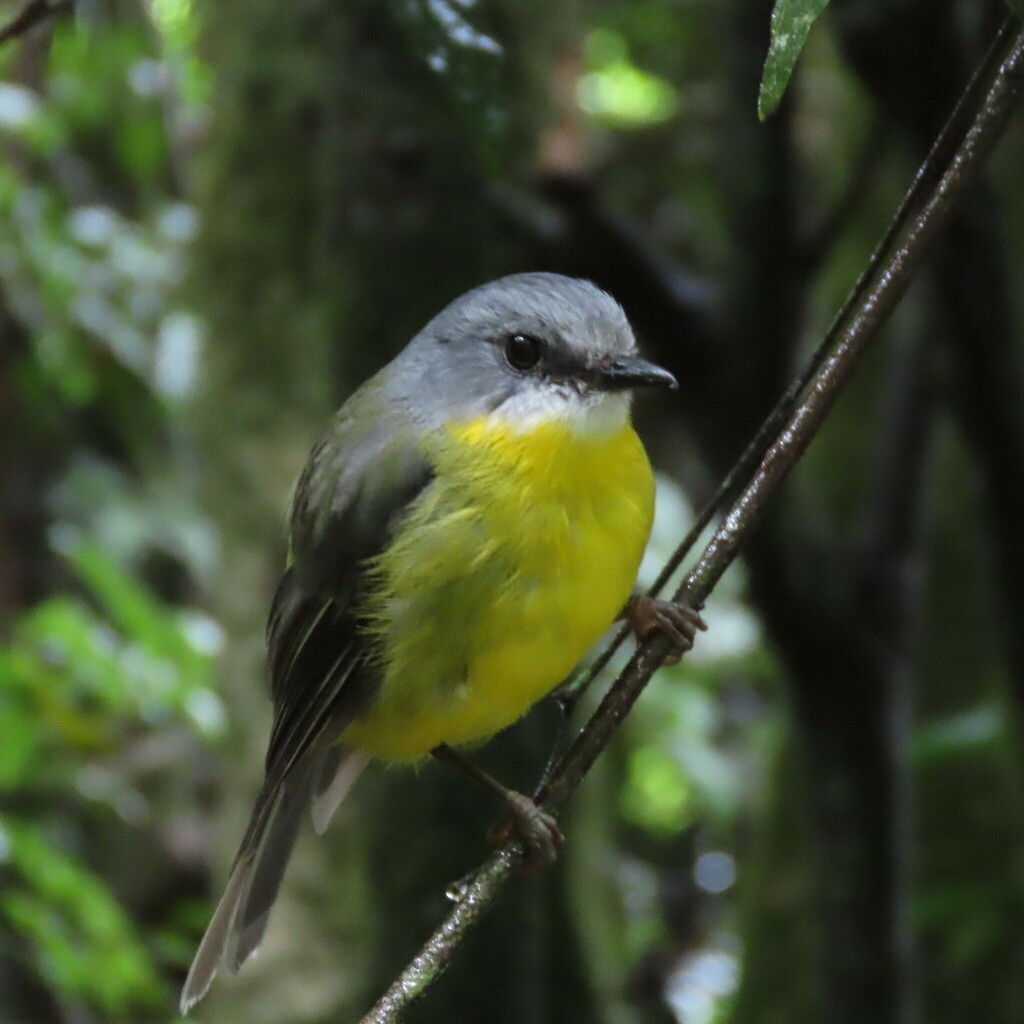
Eastern Yellow Robin
Photo © pimelea
Photo © pimelea — CC BY 4.0 — Source: iNaturalist #190056783Identification
The Eastern Yellow Robin is one of the larger Australasian robins, measuring 15 to 16 cm in length and weighing 15 to 28 g. Despite its common name, this species belongs to the genus Eopsaltria, whose Australian members are known colloquially as "yellow robins" to distinguish them from the "red robins" of the genus Petroica. Like all Australian robins, it is not closely related to either the European robin or the American robin. The species' distinctive appearance and relatively larger size make it one of the most easily observed members of its family.
Range & Habitat
The Eastern Yellow Robin inhabits coastal and sub-coastal eastern Australia, extending from the extreme southeast corner of South Australia through most of Victoria and the western half of New South Wales, with populations reaching as far north as Cooktown. In tropical Northern Queensland, birds are mainly restricted to the warm heights of the Great Dividing Range.
This species occupies a wide range of habitats including heaths, mallee, acacia scrub, woodlands, and sclerophyll forests, though it is most often found in damper places or near water. Like all Australian robins, the Eastern Yellow Robin tends to inhabit fairly dark, shaded locations. Pairs and small family parties establish territories—sometimes year-round, sometimes for a season—and appear little disturbed by human presence. They do not migrate any great distance but will make local movements with the seasons, particularly to higher and lower ground.
Behaviour & Diet
The Eastern Yellow Robin is a perch and pounce hunter, typically launching from a tree trunk, wire, or low branch to capture prey. Its diet includes a wide range of small creatures, mostly insects. Breeding takes place in the spring and, as with many Australian birds, is often communal. The species constructs a neat cup-shaped nest from fine plant material and spider web, usually placed in a fork and expertly disguised with lichen, moss, bark, or leaves.
Best Time & Places to See It
Spring is the best season to observe breeding activity and increased territorial behaviour. The species is year-round, so it can be seen throughout the year across its range. Look for them in damper woodlands and forests near water sources throughout eastern Australia, from the far southeast through to Far North Queensland.
Photography Tips
The Eastern Yellow Robin's tendency to perch prominently on tree trunks, wires, and low branches makes it relatively approachable and rewarding to photograph. Its lack of concern for human presence allows photographers to get reasonably close. Favour shaded forest habitats where the species naturally occurs, and watch for hunting behaviour from exposed perches, which can produce dynamic action shots.
Alpine National Park
Bald Rock National Park
Barrington Tops National Park
Ben Boyd National Park
Blue Mountains National Park
Bouddi National Park
Bribie Island National Park
Budawang National Park
Budj Bim National Park
Nothing matches these filters.
No community photos yet. Log in to add the first one.
No community observations of this species yet.