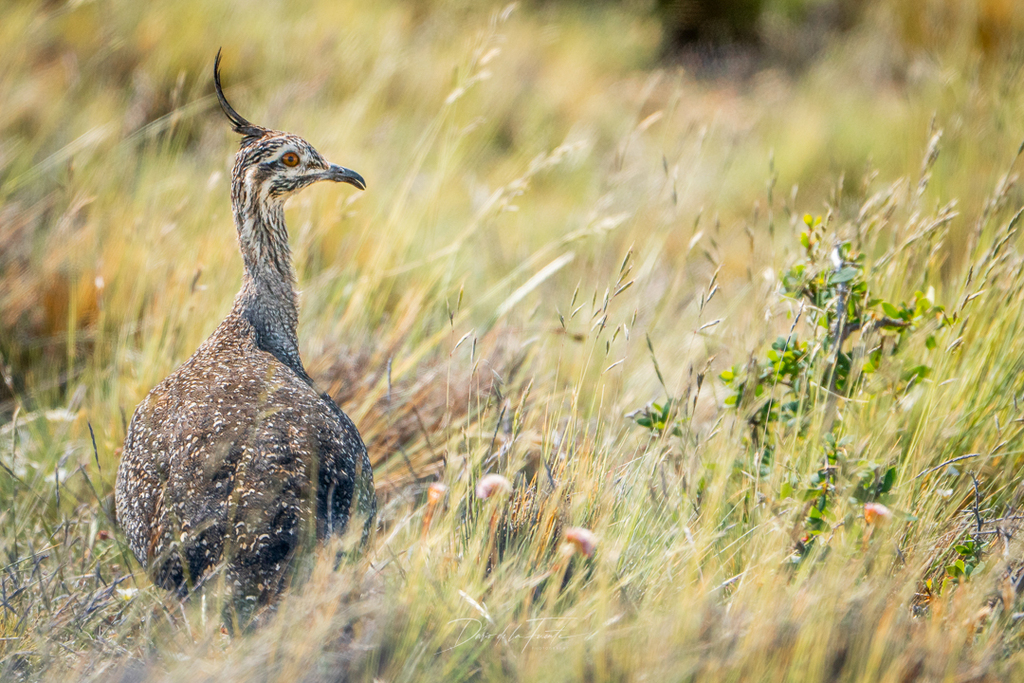
Elegant Crested Tinamou
Photo © Darío De la Fuente
Photo © Darío De la Fuente — CC BY 4.0 — Source: iNaturalist photo #547798958Identification
The elegant crested tinamou is a medium-sized, partridge-like bird averaging 39 to 41 cm in length. Its plumage is olive-brown with distinctive black and white vermiculations, and it sports a striking long off-white stripe running above the eye and down the side of the neck—the feature that inspired its "elegant" name. The bird has a short, sharp, upright beak and relatively short, strong legs and feet with whitish-grey coloring, perfectly adapted for running rather than flying. Its rounded wings and overall compact build make it instantly recognizable once spotted, though you're more likely to hear it first: these birds are often detected by their loud, mournful whistle calls.
Range & Habitat
The elegant crested tinamou is found throughout southern Chile and Argentina, ranging from sea level to elevations of 2,500 metres. This species inhabits dry arid grasslands, open thickets, dry savanna, exposed hills with scattered bushes, and cultivated farmlands—essentially any open or semi-open terrain. Notably, it avoids tall dense grasses and very thick brush, preferring environments where it can move freely on the ground. Multiple subspecies occur across different regions, from northwestern Argentina's Andes down through Patagonia and into southern Chile.
Behaviour & Diet
The elegant crested tinamou is highly terrestrial, spending most of its time running and walking on the ground. It is strongly gregarious, regularly forming flocks of 5 to 10 birds, particularly during winter when groups cover large territories in search of food. The bird returns to regular roost-sites at night and performs frequent dust-bathing to maintain plumage health and remove parasites.
Its omnivorous diet is seasonal: in winter, birds consume plant grains, fruits, leaves, and buds, while summer brings an abundance of insects. When food is scarce, the birds travel considerable distances; when resources are plentiful, they remain in one area. The species is extremely wary when hunted, standing tall to scan for danger before either retreating to cover or flattening itself against the ground with its head lowered.
Best Time & Places to See It
Winter is the best season to observe elegant crested tinamous, as birds form larger flocks and are more active in search of food across their range. Look for them in open grasslands and scrubland habitats across southern Argentina and Chile. The birds' loud, distinctive whistles make them easier to locate by ear, particularly in early morning. Subspecies vary by region: the nominate race occurs in central Argentina's Neuquén and Río Negro provinces, while the southern patagonica subspecies extends into Chile from Biobío Province southward, making it accessible to visitors to Patagonian regions.
Photography Tips
Photographing this species requires patience and early starts, when birds are most vocal and active. Look for them in open habitats where they cannot hide easily, and listen for their characteristic sad whistle to locate flocks. The off-white facial stripe and olive-brown plumage photograph well in natural light, so aim for clear morning conditions. Remember that these birds are extremely wary and will either bolt on foot or press themselves flat to the ground when alarmed—approach slowly and use cover. Given their poor flying ability and tendency to stay terrestrial, expect to photograph them on the ground rather than in flight, which actually works to your advantage for capturing their characteristic running posture and strong legs.
Patagonia National Park
Cochrane, Chile
+133 birds+8 mammals
Where the Andes meet the Patagonian steppe, vast grasslands and shrublands sweep across rolling terrain carved by ancient glaciation, their contours softened by distance and dramatic…
VIEW NATIONAL PARKMonte León National Park
Argentina
+100 birds+4 mammals
Where the Patagonian steppe meets the Atlantic, Monte León National Park protects a landscape of windswept coastal cliffs, rocky outcrops, and semi-arid grassland spanning over 1,200…
VIEW NATIONAL PARKLos Cardones National Park
Argentina
+193 birds+6 mammals
Where the Andes descend into northwestern Argentina, Los Cardones National Park sprawls across nearly 1,200 square kilometres of one of South America's most distinctive high-altitude desert…
VIEW NATIONAL PARKSierra de las Quijadas National Park
Argentina
+168 birds+5 mammals
Sandstone cliffs and deeply incised canyons define this 1,137-square-kilometre expanse in San Luis Province, where the dry Chacoan landscape of central Argentina reveals an unexpected ecological…
VIEW NATIONAL PARKNo community photos yet. Log in to add the first one.
No community observations of this species yet.