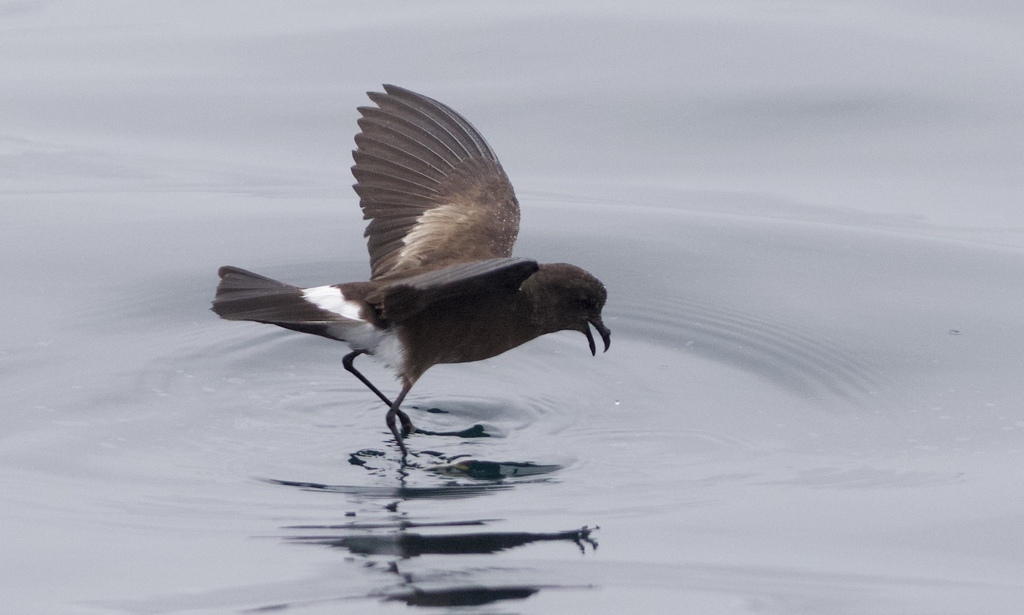
Elliot’s Storm Petrel
Photo © RJ Baltierra
Photo © RJ Baltierra — CC BY 4.0 — Source: iNaturalist photo #352528527Identification
Elliot's storm petrel is a small seabird with distinctive plumage that makes it recognizable at sea. The bird is predominantly sooty-black, but features a conspicuous white rump and a striking white band that crosses the lower belly and extends up the midline of the belly. One of its most notable features is its relatively long legs, which extend noticeably beyond the body during flight—an unusual trait that sets it apart from many other storm petrels and aids in identification for attentive observers.
Range & Habitat
Elliot's storm petrel inhabits two geographically distinct regions. The nominate subspecies, O. g. gracilis, occurs in the cold waters of the Humboldt Current off the coasts of Peru and Chile, while the subspecies O. g. galapagoensis is found in the waters surrounding the Galápagos Islands. Despite being frequently sighted at sea, the species remains poorly understood, particularly regarding its breeding habits and exact breeding locations. The only confirmed nesting site prior to 2003 was on Isla Chungungo off the Chilean coast, where approximately eleven nests were discovered in three crevices, though these sites were also used by breeding Humboldt penguins. Evidence suggests breeding colonies likely exist in Peru, given how common the species is observed offshore, though no nests have been confirmed there. The Galápagos population appears to be resident year-round and probably breeds in the region, but breeding sites remain undiscovered. An intriguing possibility exists that some birds may breed inland in the Atacama Desert, supported by the discovery of a mummified chick verified through DNA analysis in a desert crevice.
Behaviour & Diet
Like other members of the storm-petrel family, Elliot's storm petrel is primarily a seabird that feeds at sea. However, the Galápagos subspecies exhibits unusual foraging behavior for its family, as it hunts close to shore rather than far out at sea. In contrast, all other storm-petrels are exclusively pelagic foragers, hunting only in open ocean waters. This behavioral difference makes the Galápagos population particularly interesting from an ecological perspective.
Best Time & Places to See It
The best opportunities to observe Elliot's storm petrel are from pelagic boat trips in the Humboldt Current waters off Peru and Chile, where the species is quite common offshore, and around the Galápagos Islands. The Galápagos population's tendency to forage closer to shore than other storm-petrels may make them somewhat more accessible to observers than their pelagic cousins. However, given how little is known about this species' breeding patterns and seasonal movements, specific timing recommendations based on current scientific knowledge are limited.
Photography Tips
Photographing Elliot's storm petrel presents the challenges typical of seabird photography at sea: the birds are small, fast-moving, and often encountered in difficult lighting conditions on the open ocean. Focus on capturing the bird's distinctive white rump and belly markings, which are key identification features. The extended legs in flight are also worth documenting, as this trait is one of the species' most characteristic features. Patience and a good telephoto lens are essential for obtaining clear images of this small petrel.
No community photos yet. Log in to add the first one.
No community observations of this species yet.