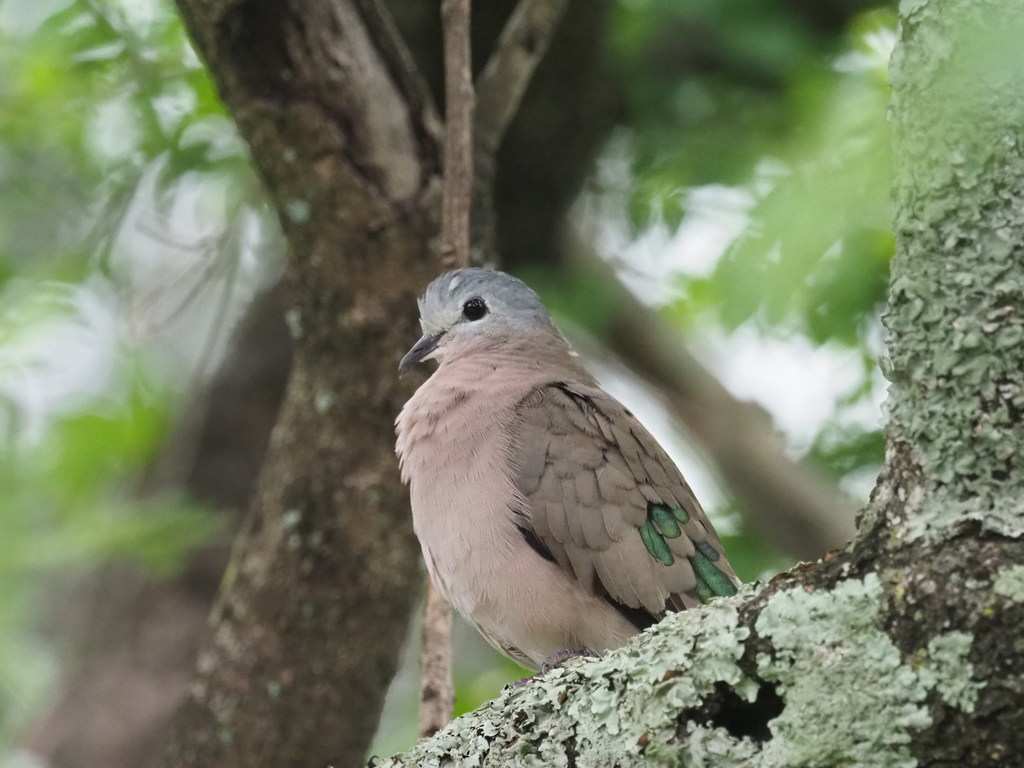
Emerald-spotted Wood Dove
Photo © Nathan Earley
Photo © Nathan Earley — CC BY 4.0 — Source: iNaturalist photo #62142273Identification
The Emerald-spotted Wood Dove is a small, plump pigeon measuring approximately 20 cm in length. Its most distinctive feature is the striking green metallic patches on its folded wings, which give the species its common name. The back, hindneck, wings, and tail are pale grey-brown, with blackish bands marking the lower back and tail. The head is bluish-grey on the forehead, crown, and nape, fading to pinkish-grey on the throat, while the underparts are mauve-pink, becoming whiter toward the belly. The bill is blackish with a red base.
Males and females are similar in appearance, though females may be slightly duller. Immature birds display duller green spots and buff fringes to their feathers. When in flight, this species can be distinguished from the Black-billed Wood Dove by the absence of bright chestnut underwings. The three-part call is quite distinctive: it begins with two soft long coos, continues with a series of slow descending coos lasting about 10 seconds, and concludes with 4 seconds of rapid coos that decrease in volume.
Range & Habitat
The Emerald-spotted Wood Dove is a resident species found across eastern and southern Africa. It inhabits open, drier deciduous woodlands and second-growth areas, preferring these habitats over evergreen rainforests and semidesert regions, which it notably avoids.
Behaviour & Diet
This dove is not particularly gregarious, though small flocks may congregate at waterholes. It typically forages on the ground, feeding on grass seeds and other small seeds. The species builds a characteristically flimsy stick nest constructed in a tree or shrub, where the female lays two cream-coloured eggs. Both parents share incubation duties for 13–17 days until hatching, and both subsequently feed the young squabs for another 13–17 days until fledging. Young birds face significant predation pressure, with mongooses and shrikes accounting for many losses.
Best Time & Places to See It
Look for the Emerald-spotted Wood Dove in open deciduous woodlands and second-growth habitats throughout eastern and southern Africa. Waterholes are particularly productive locations, as birds congregate there to drink. The species' preference for ground foraging makes it relatively accessible to observers willing to scan open woodland floors carefully.
Photography Tips
The dove's small size and subtle colouration require patience and attention to detail. Position yourself near waterholes during early morning or late afternoon when birds are most active. Focus on capturing the distinctive green metallic wing patches—these iridescent feathers are the species' defining feature and make for compelling images. The bird's plump silhouette and pale grey-brown plumage blend well with dry woodland environments, so look carefully among leaf litter and sparse vegetation on the ground where it forages.
Bwindi Impenetrable National Park
Lake Mburo National Park
Murchison Falls National Park
Queen Elizabeth National Park
Aberdare National Park
Abijata-Shalla Lakes National Park
Addo Elephant National Park
Amboseli National Park
Arabuko Sokoke Forest Reserve
Nothing matches these filters.
No community photos yet. Log in to add the first one.
No community observations of this species yet.