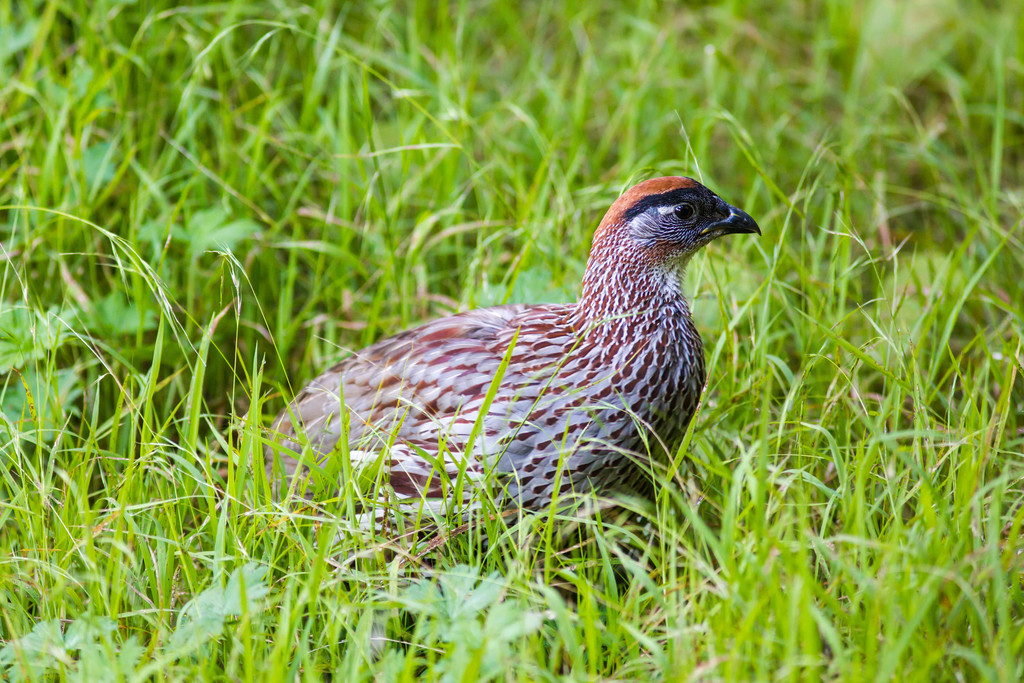
Erckel’s Spurfowl
Photo © Melissa McMasters
Photo © Melissa McMasters — CC BY 4.0 — Source: iNaturalist photo #5381457Identification
Erckel's spurfowl is the largest African spurfowl, measuring 38–43 cm in length. Males are noticeably larger than females, weighing 1.05–1.59 kg compared to females at around 1.14 kg. Both sexes share similar plumage that is distinctive and striking: the body is covered with bold chestnut-colored stripes on both the upperside and underside. The face and bill are black, contrasting sharply with the chestnut-colored crown and back of the neck. Yellow legs are a key field mark, along with white ear coverts and a single white streak running behind each eye.
Range & Habitat
This species is native to the mountainous regions of the Horn of Africa, occurring in northern Eritrea, Ethiopia, and northeast Sudan. Erckel's spurfowl inhabits high-altitude terrain between 2,000 and 3,500 metres above sea level, favoring mountainous districts with suitable vegetation. Although native to Africa, the species was introduced to Hawaii in 1957 as a gamebird and has also been established in Italy. Despite uncertainty about exact population figures, it remains common throughout its range, with an estimated distribution covering approximately 580,000 square kilometers, earning it a conservation status of least concern.
Behaviour & Diet
Erckel's spurfowl typically forages alone or in pairs in scrublands and at forest edges. The species is largely inactive for much of the day but is swift to respond to threats, running uphill when disturbed. Its diet is omnivorous, comprising plant matter such as berries, seeds, and shoots, supplemented by insects.
Vocally, this spurfowl is highly territorial and produces distinctive calls consisting of 15–20 notes delivered from clifftops and large rocks. The vocalizations, which are frequently repeated over extended periods, have been memorably described as "an insane cackled laughter, speeding towards the end with a bouncing ball pattern." Breeding occurs seasonally, with eggs laid during the rainy season; in Ethiopia, egg-laying occurs in May and again in September to November, while in Sudan it takes place in April and May.
Best Time & Places to See It
The mountainous highlands of Ethiopia, particularly in districts such as Degua Tembien, offer the most reliable opportunities to encounter this species. The rainy season (April to November in Ethiopia) is when birds are most active during breeding. Early morning is often the best time to locate them by their distinctive territorial calls, which ring out from rocky outcrops and clifftops across the highland plateaus.
Photography Tips
The bold pattern of chestnut stripes and contrasting black face make Erckel's spurfowl visually striking in photographs. Position yourself near rocky outcrops and clifftops where birds deliver their territorial calls, as these are reliable vantage points. Early morning light will best highlight the rich chestnut tones and yellow legs. The bird's habit of running uphill when threatened means approaching from lower elevations may yield better photographic opportunities before it flushes.
Hawaiʻi Volcanoes National Park
Hawaiʻi County, United States
+84 birds+2 mammals
Where volcanic slopes descend toward the Pacific across more than five thousand square kilometers, Hawaiʻi Volcanoes National Park presents one of Earth's most dynamic laboratories of…
VIEW NATIONAL PARKAwash National Park
Didiga, Ethiopia
+473 birds+23 mammals
Where the Ethiopian Rift Valley carves through volcanic plateaus, a ribbon of riverine forest winds through acacia scrubland and grassland, creating a mosaic of habitats that…
VIEW NATURAL PARKSimien Mountains National Park
Debark, Ethiopia
+120 birds+9 mammals
Where granite escarpments plunge thousands of metres into misty valleys, the Ethiopian highlands reveal a landscape of almost mythical drama. These volcanic plateaus, carved by ancient…
VIEW NATIONAL PARKHaleakalā National Park
Maui County, United States
+66 birds+4 mammals
Ascending from sea level to over 10,000 feet across a mere thirty miles, Haleakalā National Park commands one of the Pacific's most dramatic elevation gradients, where…
VIEW NATIONAL PARKKīlauea Point National Wildlife Refuge
Kilauea, United States
+79 birds+1 mammals
At the northernmost tip of Kauai, where the Pacific trades collide with volcanic rock, Kīlauea Point National Wildlife Sanctuary crowns a dramatic headland overlooking one of…
VIEW WILDLIFE SANCTUARYNo community photos yet. Log in to add the first one.
No community observations of this species yet.