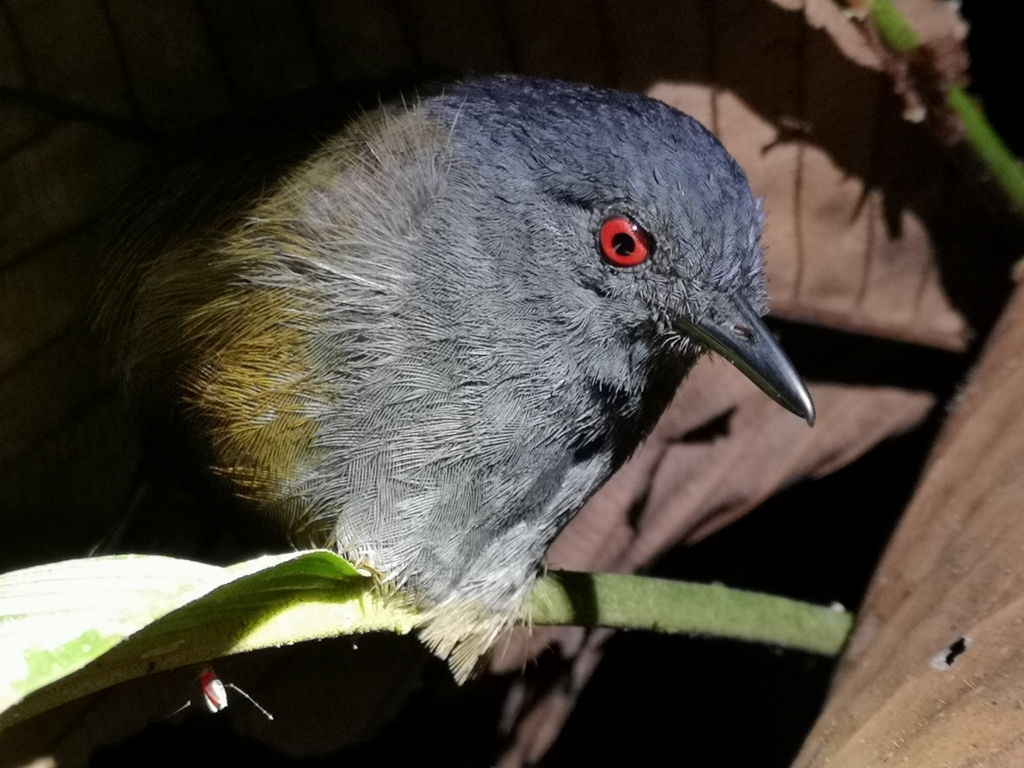
Esmeraldas Antbird
Photo © Santiago Ron
Photo © Santiago Ron — CC BY 4.0 — Source: iNaturalist #19156180The Esmeraldas antbird (Sipia nigricauda) is a species of bird in subfamily Thamnophilinae of family Thamnophilidae, the "typical antbirds". It is found in Colombia and Ecuador. == Taxonomy and systematics == The Esmeraldas antbird has a complicated taxonomic history. It was described by the naturalists Osbert Salvin and Frederick DuCane Godman in 1892 and given the binomial name Myrmeciza nigricauda. It was later reassigned as a subspecies of Myrmeciza laemosticta. At about the same time, M. laemosticta was moved into a new genus, Sipia. The original description was of a female bird and this was later the source of taxonomic confusion. The male bird was considered a different species (Sipia rosenbergi) until in 1991 it was realized that the two taxa were simply the male and female forms of the same species. The authors of the 1991 paper promoted nigricauda to species rank and by the principle of priority the specific epithet rosenbergi disappeared. In addition, the authors merged Sipia back into Myrmeciza. A molecular phylogenetic study published in 2013 found that the genus Myrmeciza, as then defined, was polyphyletic. In the resulting rearrangement to create monophyletic genera, genus Sipia was resurrected, and the Esmeraldas antbird and several other species…
Natural Farallones de Cali National Park
Buenaventura, Colombia
+733 birds+27 mammals
Where the Pacific coastal plain meets the western slopes of the Andes, Farallones de Cali National Park sprawls across nearly 3,500 square kilometers of dramatic topography…
VIEW NATIONAL PARKNatural Uramba Bahía Málaga National Park
Buenaventura, Colombia
+308 birds+15 mammals
Where the Pacific coastal rainforest descends to mangrove estuaries and rocky headlands, Uramba Bahía Málaga National Park unfolds across nearly 1,000 square kilometres of Colombia's Valle…
VIEW NATIONAL PARKNo community photos yet. Log in to add the first one.
No community observations of this species yet.