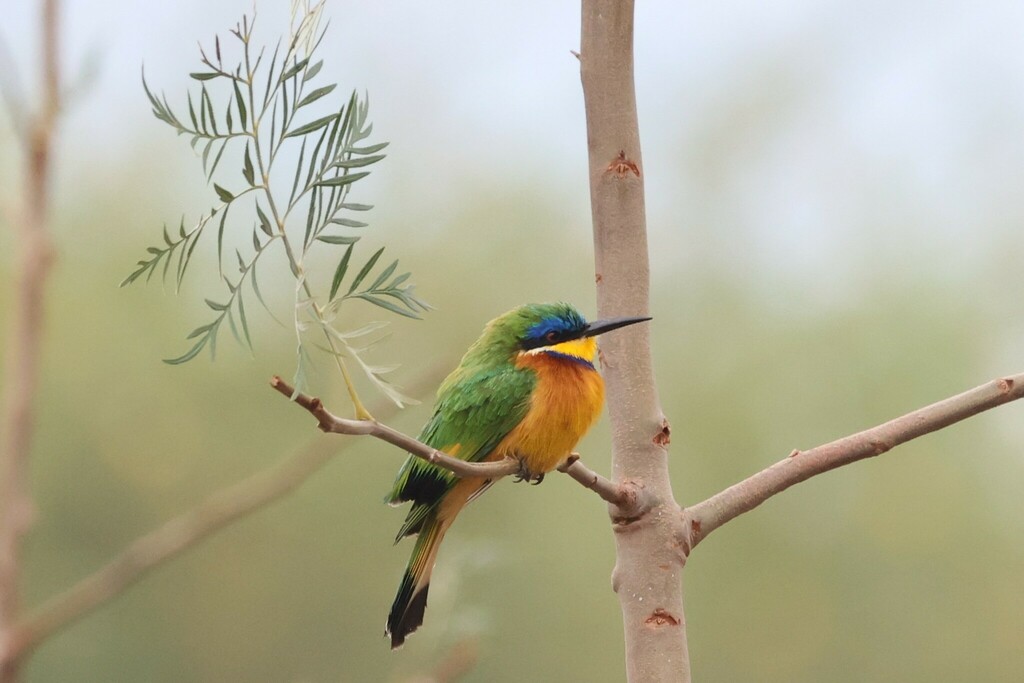
Ethiopian Bee-eater
Photo © Tommy Andriollo
Photo © Tommy Andriollo — CC BY 4.0 — Source: iNaturalist photo #441668029Identification
The Ethiopian bee-eater is a compact bird measuring around 21 cm long, slightly larger than its close relative the blue-breasted bee-eater. It displays distinctive plumage with olive-green feathers on the back and crown contrasting with russet-orange underparts. The throat is bright yellow with a narrow white border, while a dark blue band runs across the chest just below the throat. A second, narrower blue band sits above the bill and extends behind the eyes, positioned above a broad black eyestripe that is particularly diagnostic. The tail is square-ended—lacking the elongated central feathers typical of many bee-eaters—with olive-green central feathers and yellow-orange outer tail feathers tipped blackish, all narrowly edged pale. In flight, distinctive black stripes mark the back of the wings, with russet coloring visible along the underwing.
Range & Habitat
Endemic to the highlands of Ethiopia and Sudan, the Ethiopian bee-eater inhabits open montane woodland between 1,000 and 3,200 metres altitude. It favors areas of steep slopes as well as flatter terrain on the Ethiopian plateau, and has adapted to human-modified landscapes including coffee and eucalyptus plantations. The species requires regions of medium to high humidity where rainfall is persistent year-round, particularly in the rainforests of southwestern Ethiopia and parts of Sudan.
Behaviour & Diet
Unlike many gregarious bee-eater species, the Ethiopian bee-eater is typically solitary or found in pairs. It hunts from exposed perches on branches in the canopy beside tracks and clearings, using two primary foraging techniques: swift darting sorties through shrubs and low branches to snatch insects, or deliberate descents from its roost with momentary hovering before striking prey. Its diet consists of flying insects including butterflies, dragonflies, moths, large beetles, and bees, which it captures with characteristic precision before returning to its perch.
Best Time & Places to See It
The Ethiopian bee-eater is best sought in the montane woodlands of southwestern Ethiopia and Sudan within its specific elevation range. While its habitat consists of regions with year-round rainfall and high humidity, the species' solitary and perch-dependent hunting behavior makes it relatively sedentary and predictable once located. Scanning open woodland canopies and plantation edges during daylight hours offers the best chances of observation.
Photography Tips
The Ethiopian bee-eater's habit of returning to favorite perches makes it a relatively cooperative subject for patient photographers. Position yourself to capture the striking plumage details: the contrasting blue chest band and yellow throat are key field marks worth highlighting. The square-ended tail and wing pattern are diagnostic features best recorded in flight. Early morning light will enhance the vivid colors of the olive-green, russet, and yellow plumage. Since the bird hunts from exposed perches, a moderate telephoto lens combined with careful approach will yield the most rewarding images of this charming highland endemic.
Abijata-Shalla Lakes National Park
Ethiopia
+438 birds+7 mammals
Two crater lakes of contrasting chemistry define this remote corner of Ethiopia's Rift Valley, where soda lakes and freshwater basins create a mosaic of distinct aquatic…
VIEW NATIONAL PARKBale Mountains National Park
Ethiopia
+397 birds+20 mammals
Where the Ethiopian highlands rise above 4,000 metres, the Bale Mountains create a landscape of stunning ecological extremes—from afroalpine grasslands swept by wind and mist to…
VIEW NATIONAL PARKMago National Park
Ethiopia
+128 birds+3 mammals
Where the Omo River cuts through southern Ethiopia's arid borderlands, Mago National Park sprawls across a landscape of dramatic escarpments, riverine forests, and semi-arid savanna that…
VIEW NATIONAL PARKAwash National Park
Didiga, Ethiopia
+473 birds+23 mammals
Where the Ethiopian Rift Valley carves through volcanic plateaus, a ribbon of riverine forest winds through acacia scrubland and grassland, creating a mosaic of habitats that…
VIEW NATURAL PARKSimien Mountains National Park
Debark, Ethiopia
+120 birds+9 mammals
Where granite escarpments plunge thousands of metres into misty valleys, the Ethiopian highlands reveal a landscape of almost mythical drama. These volcanic plateaus, carved by ancient…
VIEW NATIONAL PARKNech Sar National Park
Arba Minch, Ethiopia
+191 birds+10 mammals
Where the East African Rift Valley plateaus drop dramatically toward the shore of Lake Abaya, a mosaic of habitats unfolds across sun-scorched savanna and acacia woodland.…
VIEW NATIONAL PARKNo community photos yet. Log in to add the first one.
No community observations of this species yet.