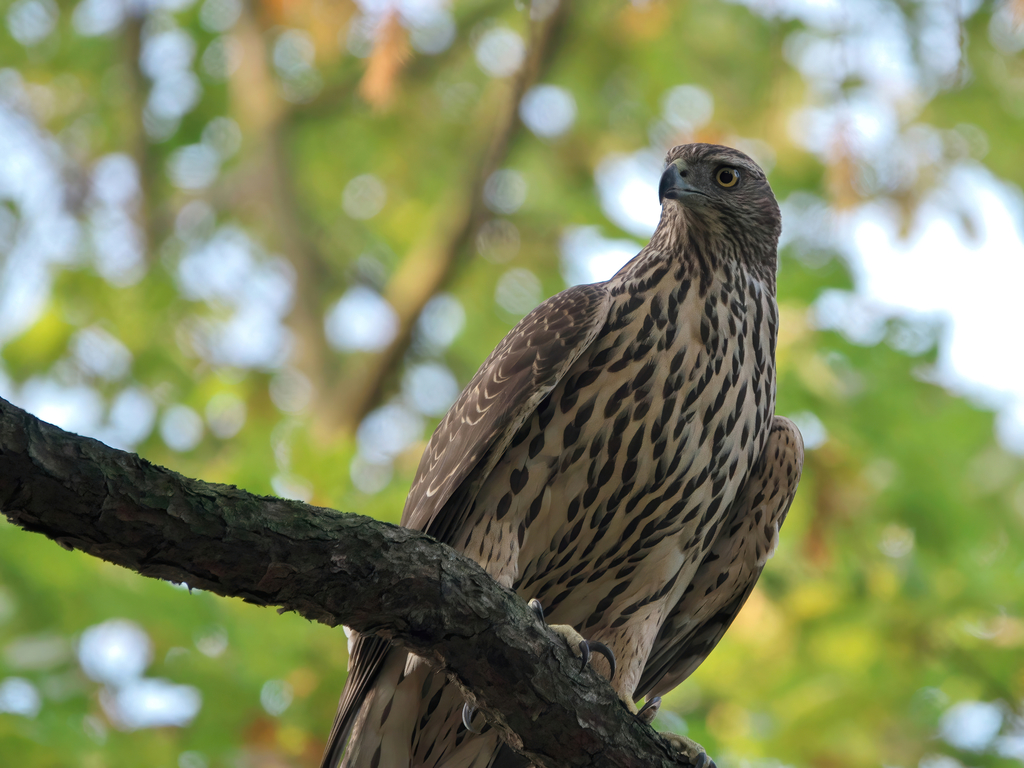
Eurasian Goshawk
Photo © Andrey Gulivanov
Photo © Andrey Gulivanov — CC BY 4.0 — Source: iNaturalist photo #97501445Identification
The Eurasian goshawk is a medium-large bird of prey belonging to the family Accipitridae, which includes eagles, buzzards, and harriers. It is the only goshawk species across most of its range, making identification straightforward in many regions. The nominate subspecies, found across most of Europe, displays a dark slaty-brown back and wing coverts with a blackish-brown head. A thin supercilium (eyebrow stripe) is visible, and the underside is creamy-white with heavy dark barring. Sexual dimorphism is pronounced, with females significantly larger than males—in some cases, the largest females can be up to four times heavier than the smallest males, though this is exceptional. Wing chord measurements reflect this size difference: males range from 300 to 342 mm, while females span 336 to 385 mm.
Body mass varies considerably across the species' range. In central Fennoscandia, males average 865 g and females 1,414 g, while in Spain the medians are notably lower at 690 g and 1,050 g respectively. Birds from southern populations tend to have thinner supercilia and broader, denser barring than their northern counterparts. Seven weakly differentiated subspecies are currently recognized, reflecting clinal variation in plumage and size across the species' vast range.
Range & Habitat
The Eurasian goshawk is a widespread species inhabiting many temperate regions of Eurasia. The nominate subspecies ranges throughout most of Europe—excluding northern Fennoscandia and northwestern Russia—and extends south to northwestern Africa, including Algeria, Tunisia, and Morocco. Eastward, its range stretches to the Urals, the Caucasus, and Asia Minor. The species is mainly resident throughout its range, though birds from colder northern regions migrate south for the winter, following the availability of prey. As forest-dwelling hunters, these agile raptors have adapted to woodland habitats across the temperate zone, exploiting ecological niches created by the abundance of small birds in forested landscapes.
Behaviour & Diet
The Eurasian goshawk belongs to the genus Astur, a group of agile, forest-dwelling hawks specialized for hunting small birds. This genus has existed for possibly tens of millions of years, having evolved as an adaptation to the explosive diversification of small birds in the world's forests. These diurnal raptors are highly maneuverable hunters, perfectly adapted to pursuit through woodland cover. The pronounced sexual dimorphism in size reflects ecological partitioning, with females capable of taking larger prey than males, thereby reducing direct competition within the pair.
Best Time & Places to See It
The Eurasian goshawk can be encountered year-round throughout its range in temperate Eurasia, though winter months may bring additional birds from northern populations migrating southward. Look for them in forested habitats across Europe, from the Mediterranean regions to Fennoscandia, and eastward through the Caucasus to Asia Minor. Resident populations are present throughout their range, but seasonal movements of northern birds mean that winter may offer increased sighting opportunities in southern and central European locations.
Photography Tips
Photographing Eurasian goshawks presents a rewarding challenge for wildlife photographers. These forest raptors are often observed perched in woodland settings where dappled light and dense vegetation can complicate exposure. Use a fast shutter speed to freeze motion, as these agile hawks are quick and active hunters. The pronounced sexual dimorphism means that pairs offer excellent compositional opportunities, though females' larger size makes them appear more impressive in photographs. Early morning and late afternoon light can enhance the detail of their dark slaty-brown plumage and highlight the distinctive barring on their underparts. Patience is essential—wait for them to perch openly rather than attempting to photograph them in dense cover, where their coloration provides effective camouflage.
No community photos yet. Log in to add the first one.
No community observations of this species yet.