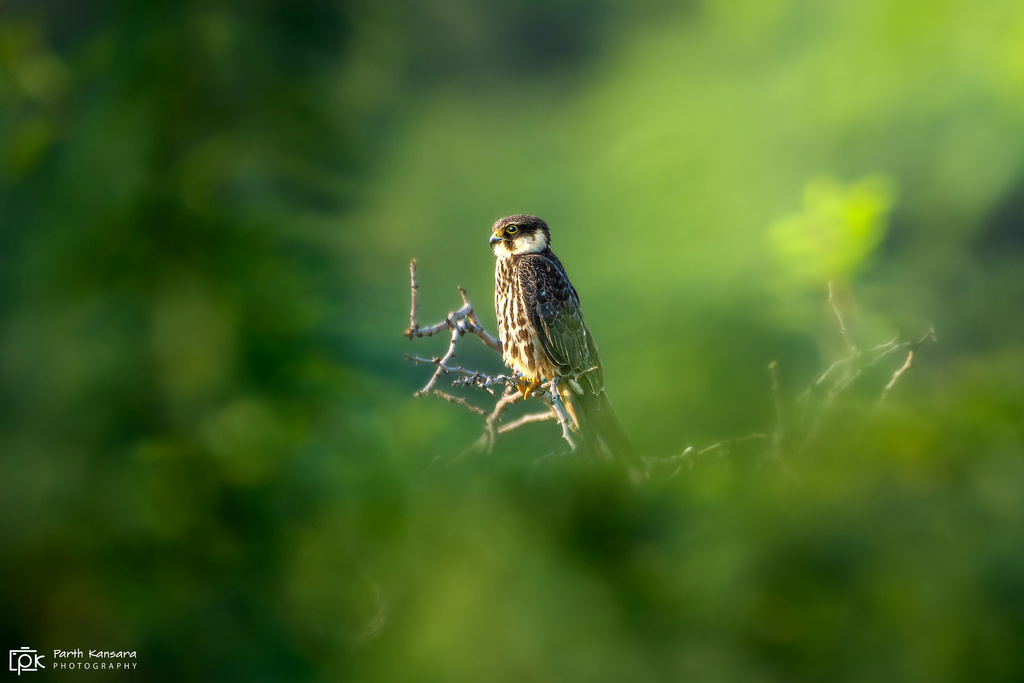
Eurasian Hobby
Photo © Parth Kansara
Photo © Parth Kansara — CC BY 4.0 — Source: iNaturalist photo #237607531Identification
The Eurasian hobby is a small, slim falcon measuring 29–36 cm in length with a wingspan of 74–84 cm and weighing 175–285 g. Adults are slate-grey above with a distinctive dark crown and two short black moustache stripes. The throat is unstreaked white, while the thighs and undertail coverts display characteristic unstreaked rufous plumage—the striking red "trousers" and vent visible at close range. The rest of the underparts are whitish with black streaks. Sexes are similar in appearance. Juveniles are considerably browner, with scaled upper parts and streaked buffy thighs and undertail coverts, and the species shows a distinct first-summer plumage.
Range & Habitat
This species breeds across the Palearctic realm. The nominate subspecies F. s. subbuteo is a long-distance migrant, wintering in Central and South Africa and South Asia, while the smaller subspecies F. s. streichi is mainly resident across Myanmar, southern China, and northern Indochina. The hobby is a bird of open country including farmland, marshes, taiga, and savannah, and is widespread in lowlands with scattered small woods. It is a rare vagrant to North America and has been recorded in Australia and Brazil.
Behaviour & Diet
The hobby is an elegant and swift bird of prey, appearing sickle-like in flight with its long pointed wings and square tail, often resembling a swift when gliding with folded wings. It is fast and powerful, taking large insects such as dragonflies, which it transfers from talons to beak and consumes while soaring in slow circles. It also captures small bats and small birds in flight, with exceptional speed and aerobatic skills enabling it to take swallows and even swifts on the wing. When not breeding, it is crepuscular, hawking principally in mornings and evenings, and may move in small groups during migration. Hobbies nest in old nests of crows and rooks, typically laying 2–3 eggs from June to August, with an incubation period of 28 days shared by both parents. They are bold and courageous birds, historically valued in falconry for hawking quails, larks, hoopoes, and drongos.
Best Time & Places to See It
The hobby is best observed in open lowland habitats with scattered woodlands during the breeding season from June to August in the Palearctic. In Africa and South Asia, look for migrant populations during winter months. Early morning and evening hours are optimal for viewing, when the species is most active during non-breeding periods. Observers in appropriate habitats should listen for the characteristic alarm calls of swallows and house martins, which often alert watchers to the presence of hunting hobbies.
Photography Tips
Capturing the hobby in flight requires fast shutter speeds and continuous autofocus to freeze its rapid, agile movements. The bird's sickle-shaped silhouette is most apparent when photographed against clear sky during soaring sequences. Early morning and evening light is ideal for bringing out the subtle slate-grey and rufous tones of the plumage. Patience is essential—position yourself near open water or open country where insects are abundant, and watch for the characteristic slow, circling soar as the bird feeds on captured dragonflies and other prey in flight.
Bwindi Impenetrable National Park
Kanha Tiger Reserve
Lake Mburo National Park
Mabamba Swamp
Murchison Falls National Park
Queen Elizabeth National Park
Aberdare National Park
Abijata-Shalla Lakes National Park
Abruzzo, Lazio and Molise National Park
Nothing matches these filters.
No community photos yet. Log in to add the first one.
No community observations of this species yet.