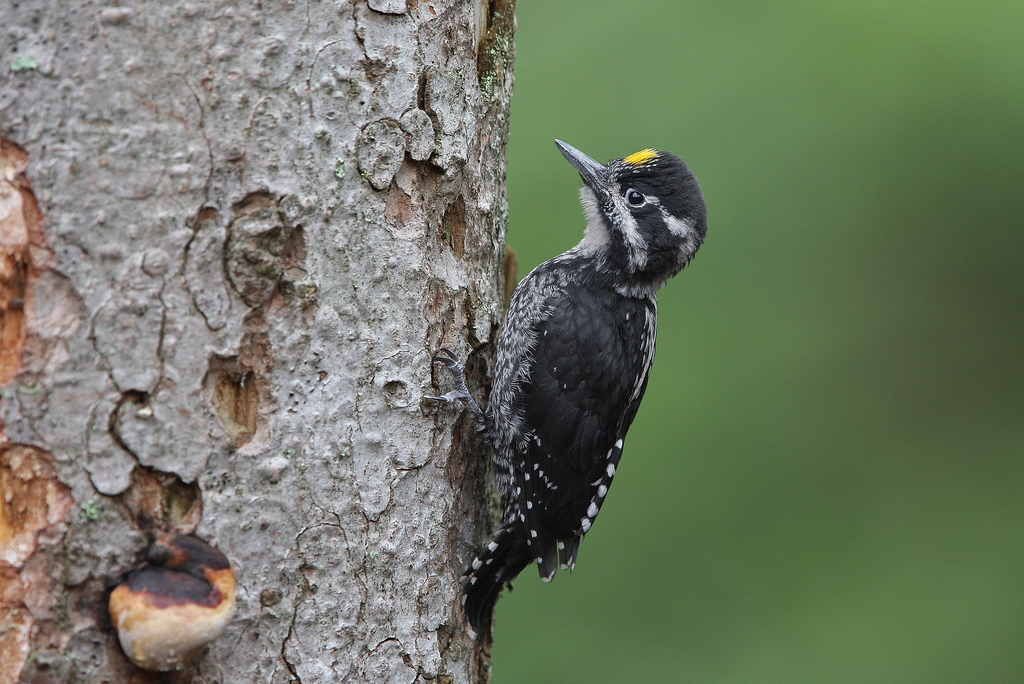
Eurasian Three-toed Woodpecker
Photo © Christoph Moning
Photo © Christoph Moning — CC BY 4.0 — Source: iNaturalist photo #91785165Identification
The Eurasian three-toed woodpecker is a medium-sized woodpecker measuring 21–22 cm in length, making it slightly smaller than the great spotted woodpecker. Adults display striking black and white plumage, with the male distinguished by a bright yellow crown—a feature notably absent in red in this species, unlike many other woodpeckers. The bird has black wings and rump contrasting with white underparts from throat to belly, while the flanks are white with black barring. The back is white with black bars, and the tail is black with white outer feathers barred in black. Juveniles of both sexes sport a yellow crown. The bird's voice is a sharp kik or chik call.
Range & Habitat
Found across a vast territory from northern Europe through northern Asia to Japan, the Eurasian three-toed woodpecker is primarily a bird of coniferous forests throughout the Palearctic region, ranging from Norway to Korea. Significant populations also inhabit the Alps and Carpathian Mountains. The species shows considerable geographic variation, with eight recognized subspecies occupying different regions across this enormous range. Most birds are permanent residents, though northern populations may migrate southward in winter, and high-elevation birds often descend to lower altitudes during the colder months.
Behaviour & Diet
These woodpeckers are specialist foragers that search coniferous trees for wood-boring beetle larvae and other insects, supplementing their diet with fruit and tree sap. A notable behavioral characteristic is their attraction to areas with large concentrations of insect-infested trees—particularly regions affected by forest fires or flooding, where beetle populations explode following environmental disturbance. For breeding, three-toed woodpeckers excavate cavity nests in dead conifers, though they occasionally use live trees or poles. Pairs excavate a new nest cavity each breeding season rather than reusing previous nests.
Best Time & Places to See It
The species' vast range and stable population make it a realistic target for travelers visiting boreal and montane coniferous forests across Europe and Asia. Year-round residency in most regions means the bird can be encountered throughout the year, though winter may bring northern populations to more accessible lower elevations. Recent surveys indicate a healthy global population estimated at 6–14.5 million adults, with particularly robust populations in Europe. Travelers exploring coniferous forests in Scandinavia, Russia, the Alps, Carpathians, and across Siberia have good chances of encounter, especially in areas showing signs of beetle infestation or recent natural disturbance.
Photography Tips
The three-toed woodpecker's striking black-and-white plumage and distinctive yellow crown provide excellent photographic subjects against coniferous foliage. The male's yellow crown is the most visually distinctive feature and should be a priority for portrait shots. Look for birds foraging on dead or dying conifers, where they may remain active for extended periods while gleaning insects. Early morning visits to areas with beetle-infested forest, particularly post-fire zones, increase encounter probability. The bird's relatively quiet nature and focus on foraging can allow patient photographers to approach reasonably close for detailed shots of plumage pattern and feeding behavior.
Baikal National Park
Bavarian Forest National Park
Bieszczady National Park
Chartreuse Regional Nature Park
Dovrefjell-Sunndalsfjella National Park
Färnebofjärden National Park
Gorce National Park
Gorkhi-Terelj National Park
Haut-Jura Regional Nature Park
Nothing matches these filters.
No community photos yet. Log in to add the first one.
No community observations of this species yet.