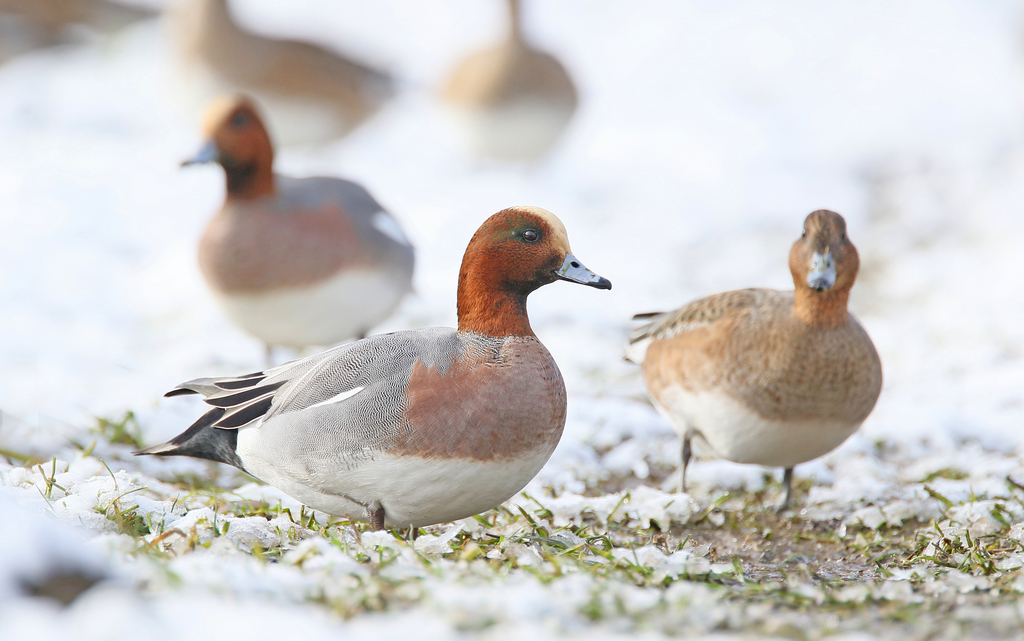
Eurasian Wigeon
Photo © Christoph Moning
Photo © Christoph Moning — CC BY 4.0 — Source: iNaturalist photo #111780119Identification
The Eurasian wigeon is a medium-sized dabbling duck measuring 42–52 cm in length with a wingspan of 71–80 cm. Breeding males are unmistakable with their chestnut head crowned in creamy yellow, pink breast, grey flanks and back, and white belly. In flight or at rest, they display a brilliant white patch on the upper wings and a dark green speculum, with a black rear end. Non-breeding males resemble females, making them trickier to identify during eclipse plumage. Females are predominantly light brown and can appear in either a rufous morph with a redder head or a grey morph with a greyer head. The species can be distinguished from the similar American wigeon by its shape, though American wigeons have paler heads and white axillaries visible on their underwings.
Range & Habitat
The Eurasian wigeon breeds across the northernmost areas of Europe and the Palearctic, making it the Old World counterpart to North America's American wigeon. Being strongly migratory, populations move considerably with the seasons, wintering much further south than their breeding range. Winter visitors venture to southern Asia and Africa, while populations also reach Great Britain and Ireland during winter months. The species is common as a winter visitor to Britain and Ireland, though it is scarce as a breeding bird, with only scattered pairs found in Scotland, the Lake District, and the Pennines. In North America, it appears as an uncommon winter visitor along the mid-Atlantic and Pacific coasts.
Behaviour & Diet
Eurasian wigeons favour open wetlands such as wet grasslands and marshes interspersed with taller vegetation. They feed primarily by dabbling for plant material or by grazing—a behaviour they readily engage in. Outside the breeding season, they are highly gregarious, forming large flocks that may include American wigeons, with which they occasionally hybridize. Breeding birds nest on the ground near water and under protective cover. This is a vocal species with distinctive calls: males produce a characteristic whistle likened to "pjiew pjiew," while females make a low growling sound transcribed as "rawr."
Best Time & Places to See It
In Britain and Ireland, winter is the prime season for observing Eurasian wigeons, when they arrive as common visitors. For North American observers, winter visits to the mid-Atlantic and Pacific coasts offer the best chance of encounters. Those seeking breeding birds should focus on northern Palearctic regions during the breeding season, particularly in Scotland where small populations persist. The species' preference for open wetlands makes it relatively visible compared to more secretive duck species, and their gregarious nature means that when present, they often gather in observable flocks.
Photography Tips
The striking plumage of breeding males makes them highly photogenic subjects. Capture the brilliant white wing patches and chestnut-and-cream head colouration in good light to showcase their distinctive markings. Females and eclipse males require careful attention to subtle plumage details and the characteristic head shape to distinguish them from American wigeons. Early morning or late afternoon light will enhance the iridescence of the dark green specula. Photographing them in their preferred open wetland habitats provides attractive background context, while flock images can convey their gregarious nature and social behaviour.
Nothing matches these filters.
Kanha Tiger Reserve
Tombstone Territorial Park
Abijata-Shalla Lakes National Park
Abruzzo, Lazio and Molise National Park
Acadia National Park
Alaska Maritime National Wildlife Refuge
Alligator River National Wildlife Refuge
Alta Murgia National Park
Appennino Lucano Val d’Agri Lagonegrese National Park
Nothing matches these filters.
No community photos yet. Log in to add the first one.
No community observations of this species yet.