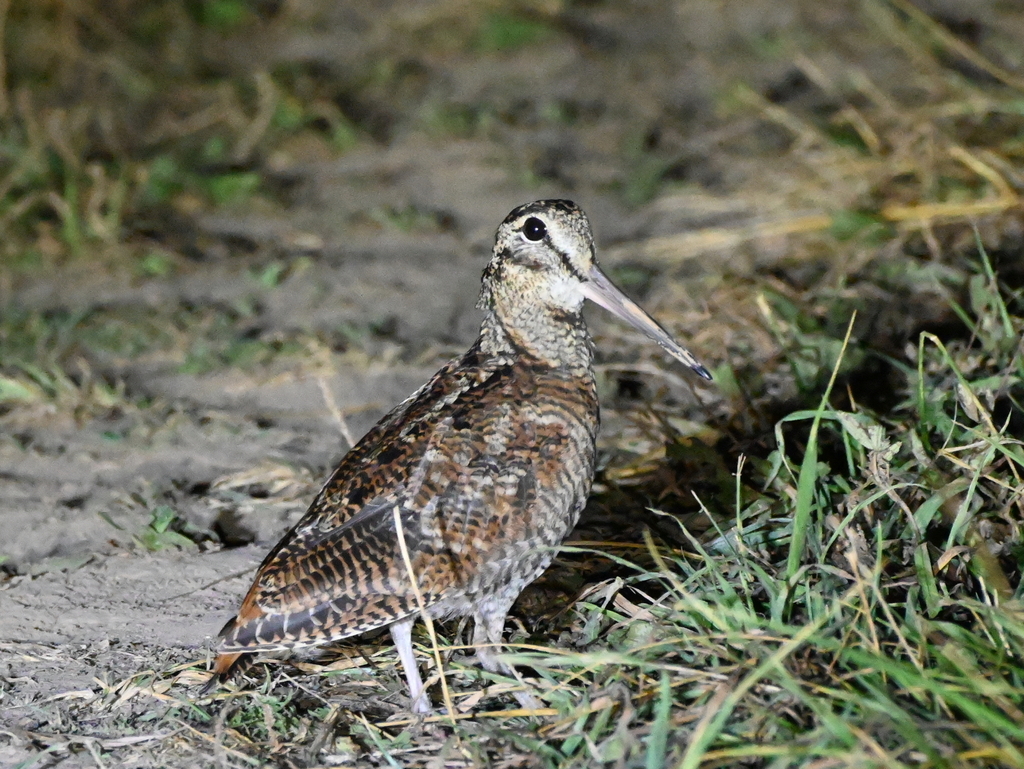
Eurasian Woodcock
Photo © Лариса Артемьева
Photo © Лариса Артемьева — CC0 1.0 — Source: iNaturalist photo #151859132Identification
The Eurasian woodcock is a medium-small wading bird measuring 33–38 cm in length, with a notably long straight bill of 6–8 cm and a wingspan of 55–65 cm. Its most distinctive feature is its cryptic camouflage: intricately patterned reddish-brown upperparts blend seamlessly with buff-coloured underparts, making it exceptionally difficult to spot in woodland settings. The head is barred with black rather than striped, distinguishing it from closely related snipes. Large eyes positioned high on the sides of the head provide the remarkable advantage of 360-degree monocular vision. The wings are rounded, and the bill has a flesh-coloured base with a dark tip, while legs range from grey to pinkish in colour. Although males are considerably larger than females, the sexes cannot be reliably separated in the field.
Range & habitat
The Eurasian woodcock is found throughout temperate and subarctic Eurasia, with approximately one-third of the global population breeding in Europe—predominantly in Russia and Fennoscandia. The breeding range extends from Fennoscandia to the Mediterranean Sea and Canary Islands, and from western Europe across to Russia. Northern and Asian populations migrate seasonally to southern Europe or the Indian subcontinent respectively, while birds in milder western European countries and Atlantic islands remain resident year-round. The world population is estimated at 14–16 million birds. This species requires large, unfragmented areas of broadleaved deciduous or mixed broadleaved and coniferous forest with dense undergrowth including brambles, holly, hazel, and bracken. Ideal territories include a mix of dry resting places, damp feeding areas, and forest clearings or wide rides essential for flight.
Behaviour & diet
Eurasian woodcocks are crepuscular, most active at dawn and dusk, and rarely seen during daylight unless flushed—when they produce a distinctive whirring wing noise. Their flight is owl- or bat-like: fast and direct during migration or over open country, but erratic with twisting and fluttering once within woodland. These birds are typically solitary migrants but may congregate under unfavourable weather or geographical conditions. They forage by probing the ground with their long, sensitive bill in search of invertebrates, making them particularly vulnerable when the ground freezes during cold weather. The male performs an extraordinary courtship display flight called "roding" at dusk between April and June, uttering a mating call of "orr, orr, orr, pist." Intriguingly, it is widely believed—though based only on anecdotal evidence—that females sometimes carry chicks between their legs whilst flying.
Best time & places to see it
Spring migration commences in February, with birds reaching breeding territories between March and May, making this an excellent period for observation. The roding display in April through June offers the best opportunity to observe males, particularly at dusk in suitable woodland habitat. Russia and Fennoscandia hold the highest concentrations during breeding season. In winter, birds favour scrubland and, during freezing weather, intertidal mud. Spring migration movements are influenced by weather conditions, so timing observations around favourable conditions increases chances of sightings.
Photography tips
Photographing Eurasian woodcocks presents a significant challenge due to their cryptic camouflage and crepuscular habits. Focus efforts on dawn and dusk when birds are most active. During spring, position yourself in suitable breeding habitat—unfragmented woodland with clearings—to witness the distinctive roding flight display, which offers dynamic photographic opportunities. Use high shutter speeds to freeze the erratic, twisting flight once birds enter woodland. The bird's exceptional 360-degree vision means approach must be extremely cautious and slow. Exercise patience, as these woodland birds remain solitary and elusive outside their aerial courtship displays.
Alpilles Regional Nature Park
Alta Murgia National Park
Altai Tavan Bogd National Park
Appennino Lucano Val d’Agri Lagonegrese National Park
Åsnens National Park
Aspromonte National Park
Avesnois Regional Nature Park
Bannau Brycheiniog National Park
Bardenas Reales
Nothing matches these filters.
No community photos yet. Log in to add the first one.
No community observations of this species yet.