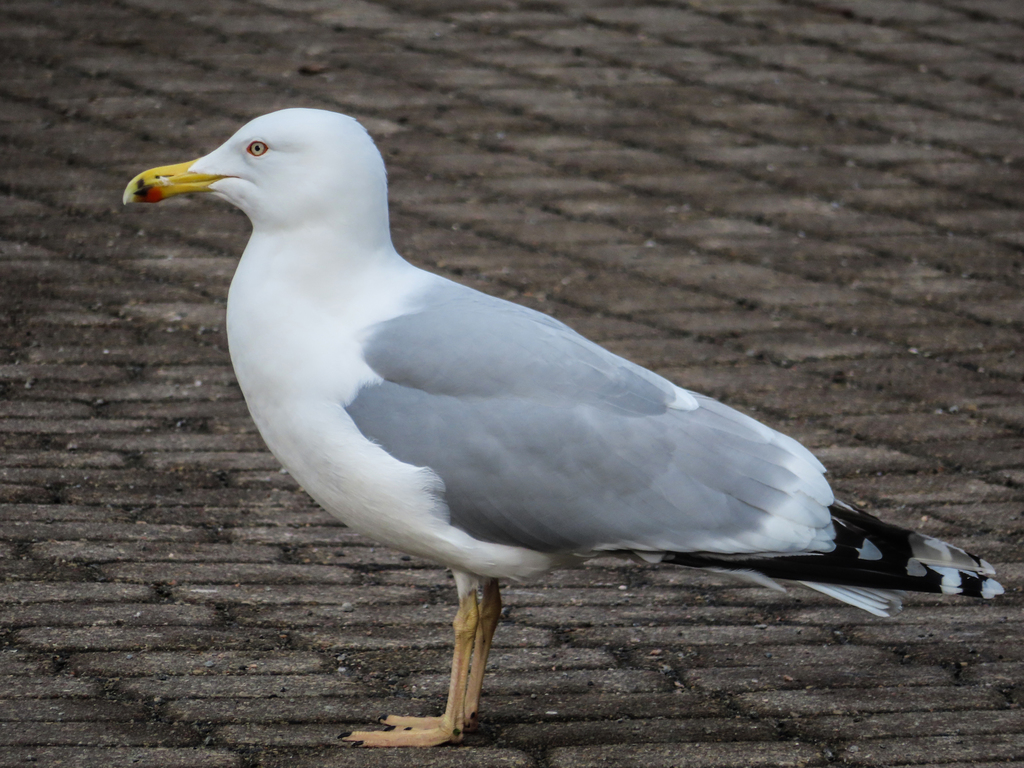
European Herring Gull
Photo © Timur Kalininsky
Photo © Timur Kalininsky — CC BY 4.0 — Source: iNaturalist photo #97052556Identification
The European herring gull is a large gull, up to 66 cm long, with males noticeably larger than females. Adults in breeding plumage are striking birds: they display a light grey back and upper wings contrasting with a white head and underparts. The wingtips are black with distinctive white spots called "mirrors," and the bill is bright yellow with a red spot. A ring of bare yellow skin surrounds the pale eye, and the legs are typically pink, though some birds in Baltic populations show yellow legs. Non-breeding adults develop brown streaks on the head and neck.
Immature birds are considerably different and can be challenging to identify. Juveniles and first-winter birds are mainly brown with darker streaks, dark bills, and dark eyes. Second-winter birds show a whiter head and underparts with less streaking and a grey back. Third-winter individuals closely resemble adults but retain some brown feathers in the wings and dark markings on the bill. The species reaches adult plumage and sexual maturity at an average age of four years. European herring gulls are larger than ring-billed gulls and can be distinguished from the lesser black-backed gull by that species' darker back and yellow legs.
Range & Habitat
The European herring gull breeds throughout the northern and western coasts of Europe. The nominate subspecies, the Scandinavian herring gull, breeds in Scandinavia and northwestern Russia. The Western European herring gull breeds in Iceland, the Faroes, Britain, Ireland, France, Belgium, the Netherlands, and Germany. Migration patterns vary considerably across their range: some European herring gulls, particularly those resident in colder areas, migrate farther south in winter, while many populations are permanent residents, including those in Ireland, Britain, Iceland, and along the North Sea shores.
Behaviour & Diet
European herring gulls are noisy, gregarious birds known for their distinctive vocalizations, particularly their loud, laughing call. They are opportunistic and adaptable feeders with a varied diet that includes fish and crustaceans as well as some plant material. The species is also an accomplished scavenger, readily consuming carrion and food left by or stolen from humans, behaviour that has allowed them to thrive in coastal towns and cities across their range.
Best Time & Places to See It
Year-round residents can be found in Ireland, Britain, Iceland, and along the North Sea shores. For travellers visiting northern and western European coasts, herring gulls are abundant and easily observed. Those visiting Scandinavian and northwestern Russian coasts during breeding season will encounter the larger Scandinavian subspecies, while winter visitors to these regions may observe migrating populations. The species' adaptability and gregarious nature mean they are readily seen around harbours, beaches, coastal towns, and food sources throughout their range.
Photography Tips
Photographing European herring gulls offers rewarding opportunities due to their large size and bold plumage patterns. Adults in breeding plumage provide the most striking images with their crisp white heads and bodies contrasting against grey backs and black wingtips with white mirrors. The bright yellow bill with its red spot and pale eye are distinctive features worth capturing. Coastal habitats—harbours, beaches, and clifftops—provide excellent settings for photography.
Be aware that immature birds require careful identification; their progression through four years of plumage development offers diverse photographic subjects but can be confusing without experience. Behavioural shots of these gregarious, vocal birds engaged in interaction with each other or their environment can be particularly engaging. Early morning light on coastal cliffs or harbours will best illuminate the subtle grey tones of the back and upper wings while highlighting the striking black and white wingtip pattern.
Delta de l’Ebre Natural Park
Acadia National Park
Alaska Maritime National Wildlife Refuge
Alta Murgia National Park
Åsnens National Park
Avesnois Regional Nature Park
Bannau Brycheiniog National Park
Beinn Eighe National Nature Reserve
Białowieża National Park
Nothing matches these filters.
No community photos yet. Log in to add the first one.