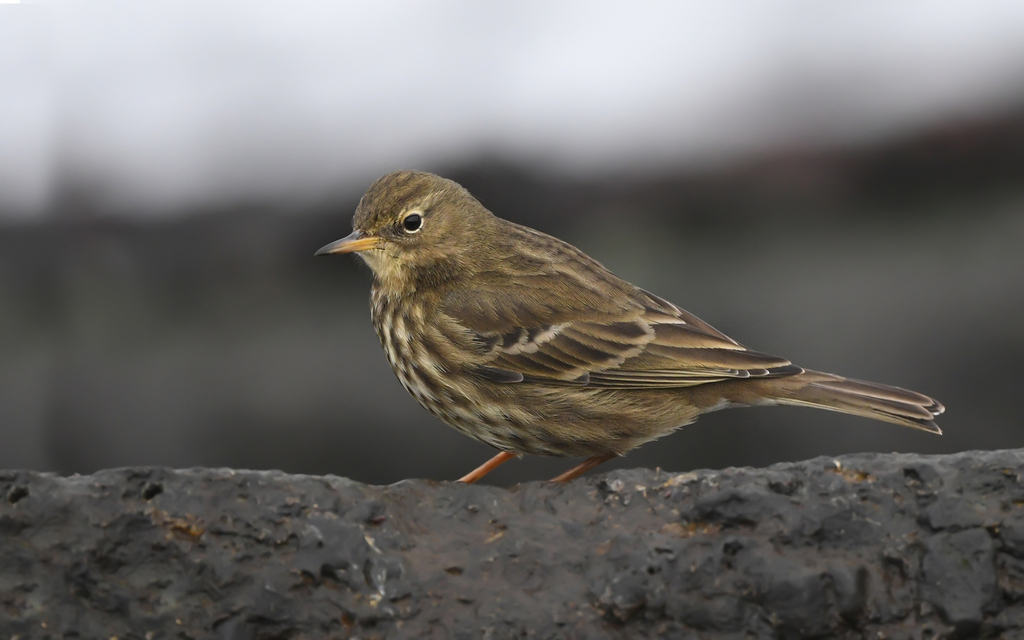
European Rock Pipit
Photo © Christoph Moning
Photo © Christoph Moning — CC BY 4.0 — Source: iNaturalist photo #344253078Identification
The European rock pipit is a small passerine measuring 16.5–17 centimetres long, with streaked greyish-brown upperparts and buff underparts heavily marked with brown streaks. Dark brown or blackish legs, bill, and iris, together with a pale eye-ring, are useful identifying features. The sexes are alike, though males average slightly brighter than females. Immature birds resemble adults but may appear browner and more streaked above, creating superficial similarity to meadow pipits.
The nominate western subspecies has smoky-olive upperparts weakly streaked with darker brown. The eastern subspecies A. p. littoralis is best distinguished in summer plumage, when it may show pinkish underparts and a pale eyebrow stripe, resembling the water pipit. In winter, European rock pipits are readily distinguishable from water pipits by their greyer, less contrastingly marked appearance and shorter supercilium. Compared to the meadow pipit, the rock pipit is darker, larger, longer-winged, and has dark rather than pinkish-red legs.
Range & Habitat
The European rock pipit breeds in western Europe on rocky coasts. Two subspecies occur: the nominate A. p. petrosus, which is non-migratory and resident year-round in western populations, and the Fennoscandian A. p. littoralis, which is migratory. The eastern subspecies winters in shoreline habitats further west and south in Europe, with ringing results showing that Scandinavian birds winter widely throughout the breeding range of the western subspecies in Britain and further south across western Europe.
There is a geographical cline in appearance across the range, with longer-billed, darker birds found at the western end and shorter-billed, paler individuals in the east. The migratory littoralis populations tend to use more sheltered and muddier, less stony coasts during winter, sometimes occupying different ecological niches from the resident nominate form.
Behaviour & Diet
The European rock pipit is territorial at least during the breeding season and year-round in resident populations. Males exhibit remarkable cooperative behaviour, sometimes entering an adjacent territory to assist the resident male in repelling an intruder—a behaviour otherwise known only from the African fiddler crab among vertebrates.
European rock pipits construct cup nests under coastal vegetation or in cliff crevices, laying four to six speckled pale grey eggs that hatch in approximately two weeks, with a further 16 days to fledging. Although they occasionally catch insects in flight, they feed mainly on small invertebrates picked from the rocks or shallow water. The species undergoes a complete moult in August–September and a partial moult from late January to early March.
Best Time & Places to See It
The nominate western subspecies is resident year-round and non-migratory, making it a reliable sight throughout the year in its rocky coastal breeding range in western Europe. The migratory eastern subspecies is present in breeding areas during breeding season and can be encountered in wider coastal regions of western Europe during winter months, when birds from Scandinavia disperse southward.
Rocky coastlines are the primary habitat to search, with birds also favoring cliff crevices and areas with coastal vegetation. Winter offers opportunities to encounter both resident and migratory populations, particularly in sheltered bays and muddier coasts where the eastern subspecies tends to concentrate.
Photography Tips
Photographing European rock pipits requires patience and careful approach, as they are wary birds of open rocky coastlines. Early morning light on coastal cliffs will showcase their subtle plumage details—the streaked greyish-brown upperparts and buff underparts with brown markings. Focus on capturing the pale eye-ring and dark legs, which are useful identification features for field guides and documentation.
During breeding season, territorial males may be more conspicuous and predictable in their movements around nesting sites in cliff crevices and coastal vegetation. Winter birds, particularly the eastern subspecies on muddier shores, may be slightly less wary than breeding birds. The rocky substrate provides good contrast for photography, and capturing birds picking invertebrates from rocks or shallow water illustrates their characteristic feeding behaviour.
Picos de Europa National Park
Posada de Valdeón, Spain
+166 birds+26 mammals
Where limestone massifs rise abruptly from the Castilian plateau, the Picos de Europa create one of Spain's most dramatic mountain wilderness areas. The park's jagged peaks,…
VIEW NATIONAL PARKStenshuvuds National Park
Skåne län, Sweden
+224 birds+19 mammals
Where limestone cliffs rise sharply above the Øresund Strait, Stenshuvuds National Park commands the southeastern tip of Skåne, a landscape carved by glaciation into rolling beech…
VIEW NATIONAL PARKKosterhavets National Park
Västra Götalands län, Sweden
+211 birds+9 mammals
Where the west coast of Sweden dissolves into an archipelago of granite skerries and pine-clad islands, Kosterhavets National Park emerges as one of northern Europe's most…
VIEW NATIONAL PARKDovrefjell-Sunndalsfjella National Park
Trøndelag, Norway
+127 birds+17 mammals
Granite peaks and deep valleys carved by ancient glaciers define this vast mountain wilderness straddling the spine of central Norway. Dovrefjell-Sunndalsfjella National Park rises where subalpine…
VIEW NATIONAL PARKLower Saxon Wadden Sea National Park
Norderney, Germany
+193 birds+12 mammals
Where the North Sea meets the German coast, a vast expanse of tidal mudflats, salt marshes, and shallow waters creates one of Europe's most dynamic estuarine…
VIEW NATIONAL PARKHamburgisches Wattenmeer National Park
Hamburg, Germany
+206 birds+6 mammals
Where the North Sea exhales across the Elbe estuary, the tidal mudflats of Hamburgisches Wattenmeer National Park emerge twice daily in a landscape of extraordinary ecological…
VIEW NATIONAL PARKJasmund National Park
Sassnitz, Germany
+136 birds+7 mammals
Towering chalk cliffs rise abruptly from the Baltic shoreline, their luminous white faces sculpted by millennia of wind, frost, and wave action into one of northern…
VIEW NATIONAL PARKVorpommersche Boddenlandschaft National Park
Küstengewässer einschließlich Anteil am Festlandso, Germany
+230 birds+19 mammals
Where the Baltic coast dissolves into a labyrinth of shallow lagoons and coastal wetlands, Vorpommersche Boddenlandschaft National Park protects one of northern Europe's most dynamic and…
VIEW NATIONAL PARKSchleswig-Holsteinisches Wattenmeer National Park
Germany
+378 birds+49 mammals
Where the North Sea ebbs and flows across a vast expanse of exposed mud and sand, the Schleswig-Holsteinisches Wattenmeer National Park reveals one of Europe's most…
VIEW NATIONAL PARKExmoor National Park
Somerset, United Kingdom
+159 birds+32 mammals
Where the Bristol Channel wind scours windswept moorland into rolling open heath, Exmoor rises from the Somerset coast as one of England's most rugged upland landscapes.…
VIEW NATIONAL PARKPembrokeshire Coast National Park
Pembrokeshire, United Kingdom
+250 birds+41 mammals
Where the Cambrian coastline meets the Celtic Sea, cliff-top moorland and hidden coves define a landscape carved by 300 million years of geological drama. Pembrokeshire Coast…
VIEW NATIONAL PARKEryri National Park
Gwynedd, United Kingdom
+199 birds+36 mammals
Where granite peaks rise abruptly from the Snowdonia landscape, Eryri National Park encompasses one of Britain's most dramatic mountain terrain. The park's rugged plateaus, deep glacial…
VIEW NATIONAL PARKLake District National Park
Westmorland and Furness, United Kingdom
+209 birds+36 mammals
Where slate fells rise steeply from mirror-still waters, the Lake District unfolds as one of Britain's most ecologically intricate mountain landscapes. The park's patchwork of deep…
VIEW NATIONAL PARKYorkshire Dales National Park
North Yorkshire, United Kingdom
+169 birds+25 mammals
Limestone pavements and deep limestone gorges carved by glaciation dominate the landscape of the Yorkshire Dales, creating a landscape of exceptional geological drama where moorland plateaus…
VIEW NATIONAL PARKBannau Brycheiniog National Park
Powys, United Kingdom
+178 birds+36 mammals
Where sandstone ridges rise above the rolling moorlands of mid-Wales, Bannau Brycheiniog National Park protects one of Britain's most compelling upland landscapes. The park's dramatic peaks,…
VIEW NATIONAL PARKNorth York Moors National Park
North Yorkshire, United Kingdom
+234 birds+32 mammals
Across the high moorlands of North Yorkshire, where heather and bilberry sprawl beneath vast skies, the landscape rises and falls in gentle undulation—a patchwork of open…
VIEW NATIONAL PARKNorthumberland National Park
Northumberland, United Kingdom
+133 birds+20 mammals
Granite ridges and moorland sweep across the Cheviot Hills in northern England, where windswept uplands give way to deep river valleys carved through ancient bedrock. Northumberland…
VIEW NATIONAL PARKSouth Downs National Park
Chichester, United Kingdom
+298 birds+45 mammals
Chalk downland ridges rise and fall across the South Downs, their open grasslands and beech hangers creating a mosaic of habitats that has shaped human settlement…
VIEW NATIONAL PARKDartmoor National Park
West Devon, United Kingdom
+162 birds+33 mammals
Across the high moorlands of Devon, where granite tors pierce through rolling heather and acid grassland, Dartmoor rises as one of Britain's most expansive upland wilderness…
VIEW NATIONAL PARKDelta de l’Ebre Natural Park
Eucaliptus, Spain
+341 birds+18 mammals
Where the Ebro River spreads into a vast labyrinth of shallow lagoons, reed beds, and brackish marshes before surrendering to the Mediterranean, one of southern Europe's…
VIEW NATURAL PARKStora Sjöfallet
Norrbotten County, Sweden
+150 birds+10 mammals
Where granite plateaus rise above boreal forest and ice-carved valleys plunge toward rushing rivers, Stora Sjöfallet unfolds across nearly 3,300 square kilometres of pristine subarctic wilderness…
VIEW NATIONAL PARKUrdaibai Biosphere Reserve
Txatxarramendi, Spain
+268 birds+8 mammals
Where the Pyrenean foothills surrender to the Bay of Biscay, tidal estuaries carve through Basque limestone, creating one of Europe's most ecologically vital wetland complexes. Salt…
VIEW BIOSPHERE RESERVECairngorms National Park
Muir, United Kingdom
+192 birds+31 mammals
Where ancient granite massifs rise above the Scottish Highlands, a subarctic wilderness unfolds across 1,748 square kilometres of raw, elemental terrain. Windswept plateaus give way to…
VIEW NATIONAL PARKLoch Lomond & the Trossachs National Park
Duchray, United Kingdom
+188 birds+40 mammals
Where ancient woodlands rise from glassy lochs and rugged Highland peaks pierce the lowland horizon, Scotland's most biodiverse landscape unfolds across 720 square kilometres of wild…
VIEW NATIONAL PARKWolin National Park
Kamień County, Poland
+232 birds+21 mammals
Where the Baltic shoreline meets vast wetland complexes and Pleistocene woodlands, Wolin National Park unfolds across nearly 440 square kilometres of northwestern Poland's most biodiverse terrain.…
VIEW NATIONAL PARKSkomer Island
Haverfordwest, United Kingdom
+177 birds+5 mammals
Where the Irish Sea crashes against the Welsh coast, wind-scoured cliffs rise dramatically from churning waters, creating one of Britain's most pristine island sanctuaries. Skomer Island's…
VIEW ISLAND & ARCHIPELAGOCabo Peñas
Susacasa, Spain
+303 birds+21 mammals
Where sea cliffs rise sheer from the Bay of Biscay, Susacasa's observation point commands one of Asturias's most dramatic coastal vistas. The landscape here is defined…
VIEW OBSERVATION POINTPort-Cros National Park
Hyères, France
+271 birds+29 mammals
Where Mediterranean granite islands rise from crystalline waters off the Provençal coast, Port-Cros National Park protects one of Europe's most intact marine and terrestrial ecosystems. The…
VIEW NATIONAL PARKLindisfarne National Nature Reserve
Holy Island, United Kingdom
+240 birds+13 mammals
Windswept tidal flats and rocky outcrops define this reserve on Holy Island, where the North Sea's relentless rhythm shapes both landscape and wildlife. The terrain shifts…
VIEW NATURE RESERVEHolkham National Nature Reserve
North Norfolk, United Kingdom
+235 birds+11 mammals
Where Norfolk's coastal flatlands meet the North Sea, Holkham National Nature Reserve unfolds across nearly 4,000 hectares of some of England's most dynamic and least predictable…
VIEW NATURE RESERVEThe Lizard National Nature Reserve
Garras, United Kingdom
+120 birds+2 mammals
Where windswept moorlands meet rocky outcrops along Cornwall's dramatic southern coast, the Lizard National Nature Reserve unfolds as one of southwest England's most ecologically distinctive landscapes.…
VIEW NATURE RESERVEForsinard Flows National Nature Reserve
Highland, United Kingdom
+35 birds+7 mammals
Across the Flow Country of northern Scotland, vast blankets of blanket bog stretch toward the horizon in seemingly endless waves of heather, cotton grass, and sphagnum…
VIEW NATURE RESERVERum National Nature Reserve
Isle Of Rum, United Kingdom
+112 birds+8 mammals
Where the Inner Hebrides rise from the Atlantic, Rum's landscape embodies the raw drama of Scotland's northwest. Steep ridges and volcanic plateaus dominate this island nature…
VIEW NATURE RESERVEHermaness National Nature Reserve
Shetland, United Kingdom
+86 birds+3 mammals
At the northern tip of Unst, the northernmost inhabited island of Shetland, sea cliffs of weathered sandstone and basalt rise dramatically from the North Sea, their…
VIEW NATURE RESERVENewport Wetlands National Nature Reserve
Goldcliff, United Kingdom
+153 birds+7 mammals
Across the Severn Estuary's southern reaches, where the Gwent Levels meet tidal mud and reedbed in a mosaic of wet grassland and shallow pools, lies one…
VIEW NATURE RESERVEDyfi National Nature Reserve
Aberdyfi, United Kingdom
+148 birds+25 mammals
Where the River Dyfi widens into a broad coastal basin, a 2,400-hectare mosaic of saltmarsh, reedbed, mudflat and freshwater wetland spreads across the Cardigan Bay estuary…
VIEW NATURE RESERVEStackpole National Nature Reserve
Bosherston, United Kingdom
+111 birds+4 mammals
Where limestone grasslands meet freshwater lakes and coastal dunes, Stackpole unfolds across the Pembrokeshire peninsula as one of Wales's most ecologically diverse nature reserves. The reserve's…
VIEW NATURE RESERVEKenfig National Nature Reserve
Kenfig, United Kingdom
+142 birds+5 mammals
Where brackish lakes meet windswept dunes and the North Atlantic's influence shapes every living thing, Kenfig National Nature Reserve spreads across Wales's coastal Glamorgan landscape like…
VIEW NATURE RESERVEGreat Orme National Nature Reserve
Llandudno, United Kingdom
+113 birds+7 mammals
Limestone cliffs rise dramatically from the Irish Sea along the Conwy coast, their windswept summits offering sanctuary to a mosaic of heathland, grassland and rocky outcrops…
VIEW NATURE RESERVESeven Sisters National Nature Reserve
Eastbourne, United Kingdom
+190 birds+15 mammals
Where the South Downs meet the English Channel, the chalk cliffs of Seven Sisters rise in a dramatic sequence of white promontories that have shaped both…
VIEW NATURE RESERVECors Fochno National Nature Reserve
Borth, United Kingdom
+179 birds+27 mammals
Where the Dovey Estuary opens to the Irish Sea, a sprawling wetland mosaic of reedbed, fen and mire transforms the coastal flats of mid-Wales into one…
VIEW NATURE RESERVEYnys-hir National Nature Reserve
Machynlleth, United Kingdom
+149 birds+5 mammals
Where the River Einig winds through the lowland valleys of mid-Wales, Ynys-hir National Nature Reserve unfolds as a mosaic of wet grassland, reedbed, and riparian woodland…
VIEW NATURE RESERVERibble Estuary National Nature Reserve
Southport, United Kingdom
+197 birds+17 mammals
Where the Ribble flows into the Irish Sea, a landscape of mudflats, salt marshes and shallow pools creates one of northwest England's most dynamic estuarine ecosystems.…
VIEW NATURE RESERVENo community photos yet. Log in to add the first one.
No community observations of this species yet.