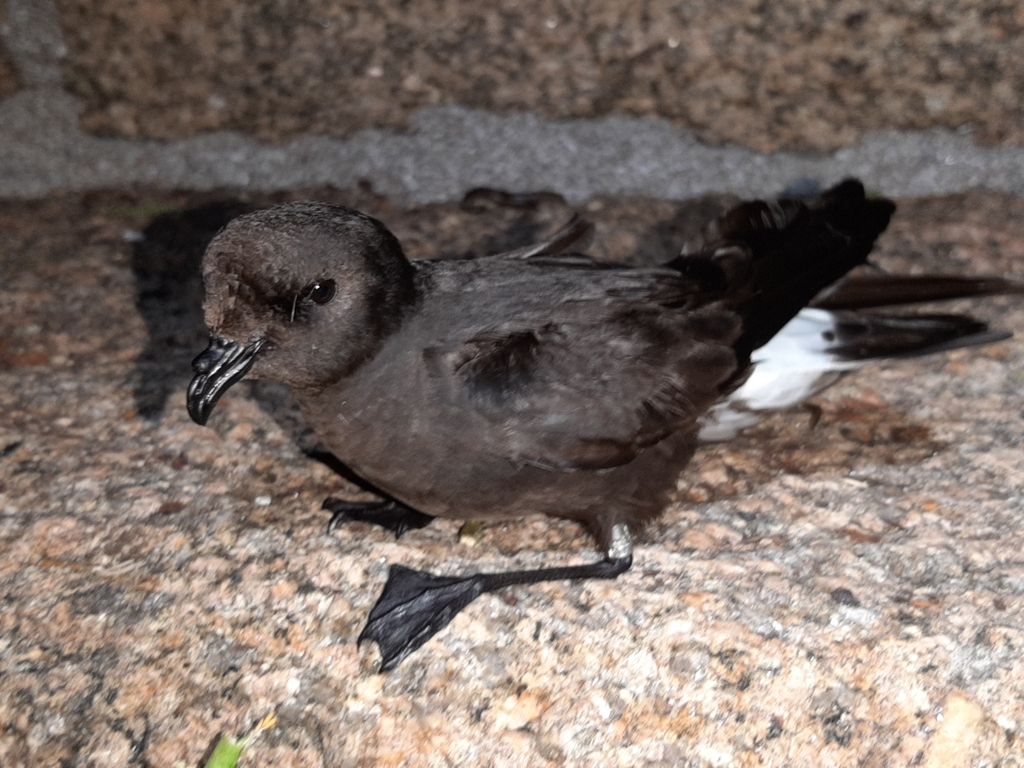
European Storm Petrel
Photo © franciscodocampo
Photo © franciscodocampo — CC BY 4.0 — Source: iNaturalist photo #306135162Identification
The European storm petrel is a tiny seabird, measuring just 14–18 cm in length with a wingspan of 36–39 cm—making it one of the ocean's smallest petrels. Its plumage is entirely black except for a distinctive snow-white rump patch that extends to the sides of the tail base and a broad white band visible on the underwings. The bird has a square tail and a characteristic fluttering, bat-like flight pattern. Juveniles in fresh plumage may also display a narrow white bar on the upper wing, though this fades with wear. The Mediterranean subspecies is slightly larger with longer wings and a heavier bill than its Atlantic counterpart, but neither subspecies can be reliably distinguished at sea.
Range & Habitat
The European storm petrel breeds on islands off the northern coasts of Europe, with the largest populations in the Faroe Islands, United Kingdom, Ireland, and Iceland. A separate Mediterranean subspecies inhabits Filfla Island (Malta), Sicily, and the Balearic Islands. This species is strongly migratory, spending the Northern Hemisphere winter mainly off the coasts of South Africa and Namibia, with some birds stopping in West African waters and a few remaining near their Mediterranean breeding grounds. Outside the breeding season, storm petrels are strictly oceanic, rarely venturing near land except during severe weather.
Behaviour & Diet
Storm petrels nest in crevices and burrows, sometimes sharing spaces with other seabirds or rabbits, and lay a single white egg on bare soil. Both parents share incubation duties and feed the chick, which is not normally brooded after the first week. The bird feeds on small fish, squid, and zooplankton by pattering across the sea's surface—a behaviour reflected in its name. Remarkably, storm petrels possess a keen sense of smell, unusual among birds, which allows them to locate food and their own nests. Usually silent at sea, they produce chattering calls during courtship flights and purring songs from their breeding chambers.
Best Time & Places to See It
To observe European storm petrels, visit their breeding islands during the breeding season. Key locations include the Faroe Islands, coastal regions of the United Kingdom and Ireland, Iceland, and Mediterranean sites such as the Balearic Islands and Sicily. The birds are strictly oceanic outside breeding season, spending winters off South Africa and Namibia, making them difficult to encounter except during migration periods or rough weather when they may be driven closer to shore.
Photography Tips
Storm petrels are challenging photographic subjects due to their small size, oceanic habits, and preference for open water. The best opportunities arise during breeding season at accessible island colonies, where birds may be observed entering or leaving nest sites at dusk. Their distinctive white rump and underwing bands provide good field marks for identification in photographs. Look for their characteristic fluttering, bat-like flight pattern skimming just above the water surface. A telephoto lens is essential, and patience is required, as these small seabirds are often active during low-light conditions.
Kosterhavets National Park
Västra Götalands län, Sweden
+211 birds+9 mammals
Where the west coast of Sweden dissolves into an archipelago of granite skerries and pine-clad islands, Kosterhavets National Park emerges as one of northern Europe's most…
VIEW NATIONAL PARKL’Albufera Natural Park
València, Spain
+321 birds+18 mammals
Where shallow lagoons meet Mediterranean coastal marshland, L'Albufera Nature Park unfolds as one of Spain's most vital wetland complexes. This protected landscape, designated under IUCN Category…
VIEW NATURAL PARKHamburgisches Wattenmeer National Park
Hamburg, Germany
+206 birds+6 mammals
Where the North Sea exhales across the Elbe estuary, the tidal mudflats of Hamburgisches Wattenmeer National Park emerge twice daily in a landscape of extraordinary ecological…
VIEW NATIONAL PARKSchleswig-Holsteinisches Wattenmeer National Park
Germany
+378 birds+49 mammals
Where the North Sea ebbs and flows across a vast expanse of exposed mud and sand, the Schleswig-Holsteinisches Wattenmeer National Park reveals one of Europe's most…
VIEW NATIONAL PARKDoñana National Park
Hinojos, Spain
+300 birds+13 mammals
Where the Guadalquivir River delta spreads into the Atlantic, vast marshes, cork woodlands, and coastal dunes converge to create one of southwestern Europe's most biodiverse wetland…
VIEW NATIONAL PARKPembrokeshire Coast National Park
Pembrokeshire, United Kingdom
+250 birds+41 mammals
Where the Cambrian coastline meets the Celtic Sea, cliff-top moorland and hidden coves define a landscape carved by 300 million years of geological drama. Pembrokeshire Coast…
VIEW NATIONAL PARKSouth Downs National Park
Chichester, United Kingdom
+298 birds+45 mammals
Chalk downland ridges rise and fall across the South Downs, their open grasslands and beech hangers creating a mosaic of habitats that has shaped human settlement…
VIEW NATIONAL PARKCabo de Gata-Níjar Natural Park
San José, Spain
+274 birds+11 mammals
Where volcanic ridges plunge toward the Mediterranean, Cabo de Gata-Níjar Nature Park unfolds across one of Europe's most arid coastlines, a landscape sculpted by tectonic violence…
VIEW NATURAL PARKParcial C Marina de les Medes Nature Reserve
Torroella de Montgrí, Spain
+93 birds
Where the Costa Brava's limestone cliffs plunge into crystalline Mediterranean waters, the Parcial C section of Marina de les Medes Nature Reserve protects one of Catalonia's…
VIEW NATURE RESERVEDelta de l’Ebre Natural Park
Eucaliptus, Spain
+341 birds+18 mammals
Where the Ebro River spreads into a vast labyrinth of shallow lagoons, reed beds, and brackish marshes before surrendering to the Mediterranean, one of southern Europe's…
VIEW NATURAL PARKCap de Creus Natural Park
Roses, Spain
+245 birds+23 mammals
Where the Pyrenees tumble into the Mediterranean, Cap de Creus Nature Park unfolds across 300 square kilometres of one of northeastern Spain's most dramatic coastal wilderness…
VIEW NATURAL PARKEspacio Natural Remolar-Filipinas
El Prat del Llobregat, Spain
+297 birds+7 mammals
Where the Llobregat River delta meets the Mediterranean, a patchwork of salt marshes, reed beds, and shallow lagoons creates one of Catalonia's most dynamic wetland ecosystems.…
VIEW NATURE RESERVEUrdaibai Biosphere Reserve
Txatxarramendi, Spain
+268 birds+8 mammals
Where the Pyrenean foothills surrender to the Bay of Biscay, tidal estuaries carve through Basque limestone, creating one of Europe's most ecologically vital wetland complexes. Salt…
VIEW BIOSPHERE RESERVECamargue Regional Nature Park
Saintes-Maries-de-la-Mer, France
+378 birds+48 mammals
Where the Rhône Delta sprawls into the Mediterranean, a landscape of stark and haunting beauty emerges—vast salt marshes punctuated by shallow lagoons, reed beds, and scrubland…
VIEW NATURAL PARKEstrecho Natural Park
Pedro Valiente, Spain
+281 birds+20 mammals
Where Mediterranean pine forests meet wind-sculpted coastal cliffs, one of Europe's most dynamic ecological crossroads unfolds across the Strait of Gibraltar. Spanning 686 square kilometers of…
VIEW NATURAL PARKLa Maddalena Archipelago National Park
La Maddalena, Italy
+86 birds+1 mammals
Crystalline waters lap against granite islands scattered across the Tyrrhenian Sea, where Dell'Arcipelago di la Maddalena unfolds as a Mediterranean archipelago of raw geological beauty and…
VIEW NATIONAL PARKDorob National Park
Henties Bay, Namibia
+230 birds+13 mammals
Where the Skeleton Coast meets the Namib Desert's inland reaches, Dorob National Park sprawls across 34,021 square kilometres of one of southern Africa's most austere and…
VIEW NATIONAL PARKSkomer Island
Haverfordwest, United Kingdom
+177 birds+5 mammals
Where the Irish Sea crashes against the Welsh coast, wind-scoured cliffs rise dramatically from churning waters, creating one of Britain's most pristine island sanctuaries. Skomer Island's…
VIEW ISLAND & ARCHIPELAGOCabo Peñas
Susacasa, Spain
+303 birds+21 mammals
Where sea cliffs rise sheer from the Bay of Biscay, Susacasa's observation point commands one of Asturias's most dramatic coastal vistas. The landscape here is defined…
VIEW OBSERVATION POINTPort-Cros National Park
Hyères, France
+271 birds+29 mammals
Where Mediterranean granite islands rise from crystalline waters off the Provençal coast, Port-Cros National Park protects one of Europe's most intact marine and terrestrial ecosystems. The…
VIEW NATIONAL PARKRum National Nature Reserve
Isle Of Rum, United Kingdom
+112 birds+8 mammals
Where the Inner Hebrides rise from the Atlantic, Rum's landscape embodies the raw drama of Scotland's northwest. Steep ridges and volcanic plateaus dominate this island nature…
VIEW NATURE RESERVENo community photos yet. Log in to add the first one.
No community observations of this species yet.