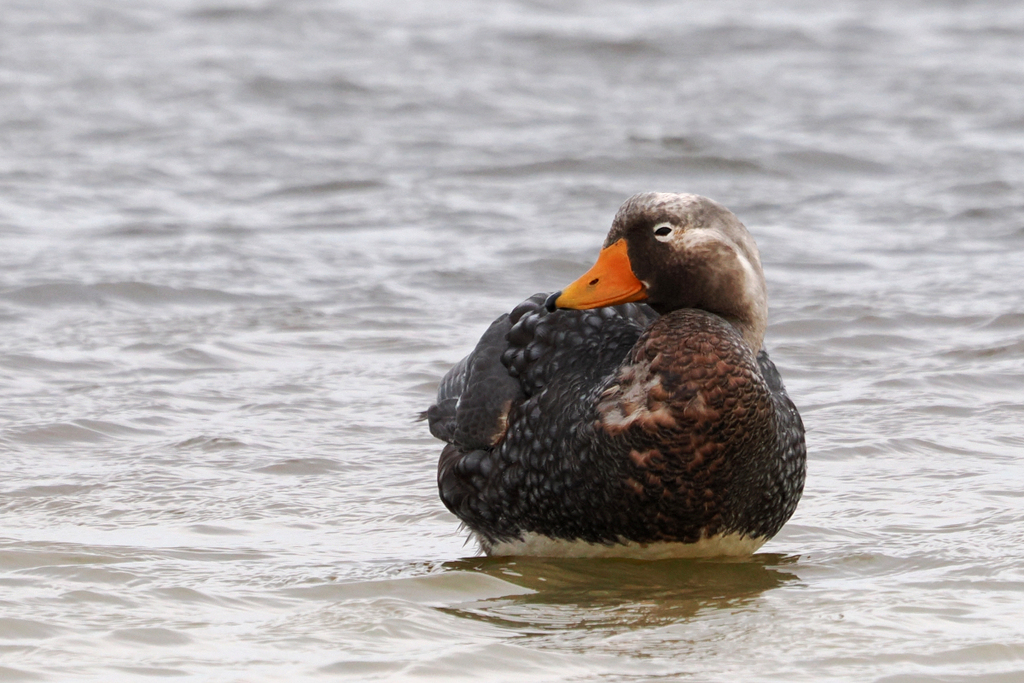
Falkland Steamer Duck
Photo © steve b
Photo © steve b — CC0 1.0 — Source: iNaturalist photo #260322043Identification
The Falkland steamer duck is a fairly large duck, measuring between 61 and 74 cm in length with a wingspan of 84 to 94 cm. Males are distinctive with brown to grey plumage and a contrasting light grey-white head, featuring a characteristic orange bill, white eye-ring, and faint white eye-streak. Females are darker overall, with a brown neck and head, olive green beak, and the same distinctive white eye-ring with a white line behind the eyes. Both sexes display characteristic yellow-orange feet. Juveniles can be distinguished from females by black marks on their paler feet and a lack of or very reduced white line behind the eyes.
In the field, the Falkland steamer duck can be confused with the flying steamer duck, with which it shares its range. However, the Falkland steamer duck has noticeably shorter wings and tail, along with a thicker neck and bill. Most significantly, the Falkland steamer duck is strictly flightless, though this characteristic can be difficult to observe since the flying steamer duck rarely takes to the air and is often seen walking or swimming.
Range & Habitat
The Falkland steamer duck is one of only two bird species endemic to the Falkland Islands in the South Atlantic Ocean, the other being Cobb's wren. This species is part of the genus Tachyeres, which contains four steamer duck species found in South America. The Falkland steamer duck is most closely related to the flying steamer duck, which can also be found in and around the Falkland Islands.
Behaviour & Diet
The steamer ducks derive their name from their unconventional swimming behaviour, in which they flap their wings and feet on the water in a motion reminiscent of an old paddle steamer. According to Charles Darwin's observations from 1833, these birds move very quickly through the water, using their wings partly for swimming and partly for flapping the surface—a motion somewhat resembling how a domestic duck escapes from a pursuing dog. The steamer is able to dive only to a very short distance.
The species feeds entirely on shellfish from kelp and tidal rocks. This diet has shaped their distinctive heavy and strong head and beak, adaptations necessary for breaking open shells. Notably, Darwin recorded that these birds are remarkably tenacious of life. When in the evening, pluming themselves in a flock, they produce an odd mixture of sounds.
Best Time & Places to See It
The Falkland steamer duck's distribution is limited to the Falkland Islands. As an endemic species found nowhere else in the world, a visit to these remote South Atlantic islands is essential for observing this unique duck. Look for them in coastal areas near kelp beds and tidal rocks, which provide their primary food source.
Photography Tips
The distinctive plumage differences between males and females offer rewarding photographic opportunities. Males' contrasting light grey-white heads and orange bills stand out dramatically against their brown-grey bodies, while females' darker colouration provides a different aesthetic challenge. The characteristic white eye-ring and eye-streak visible in both sexes can make for striking close-up portraits. Capture the birds' famous "steaming" behaviour as they flap their wings across the water—a dynamic and visually distinctive activity that defines the species. The yellow-orange feet of both sexes add a splash of colour worth highlighting in your shots.
Sea Lion Island
Sealion Island Settlement, Falkland Islands
+74 birds+3 mammals
Windswept tussock grasslands roll across volcanic terrain where Southern Ocean swells crash against rocky shores, creating one of the Falkland Islands' most dramatic wildlife theatres. This…
VIEW ISLAND & ARCHIPELAGOKidney Island
Stanley, Falkland Islands
+47 birds
Wind-scoured tussock grassland sweeps across this remote South Atlantic outcrop, where peaty soils and exposed rock formations create a landscape as austere as it is vital.…
VIEW ISLAND & ARCHIPELAGOPort Stephens
Port Stephens, Falkland Islands
+29 birds
Windswept moorlands sweep down to pristine beaches where kelp forests fringe the turquoise shallows, their giant fronds swaying in the southern current. Port Stephens, cradled on…
VIEW NATURE RESERVEMurrell Farm
falskland islands, Falkland Islands
+54 birds
Rolling grasslands sweep across windswept plateaux where the South Atlantic exerts its relentless influence on the vegetation, sculpting tussock grassland into a tapestry of browns and…
VIEW NATURE RESERVECape Dolphin
falskland islands, Falkland Islands
+54 birds+1 mammals
Where windswept grasslands meet dramatic coastal cliffs, the Falkland Islands' northern reaches reveal one of the Southern Hemisphere's most compelling seabird sanctuaries. The terrain here is…
VIEW NATURE RESERVEVolunteer Point
Stanley, Falkland Islands
+70 birds+3 mammals
Windswept grasslands meet volcanic black sand beaches where three penguin species converge in the South Atlantic's most theatrical wildlife theatre. This remote peninsula on East Falkland…
VIEW NATURE RESERVEWest Point Island
West Point, Falkland Islands
+67 birds+3 mammals
Windswept cliffs plunge dramatically into the South Atlantic, their rust-coloured rock faces sculpted by millennia of gales and spray. This northwestern outpost of the Falkland Islands…
VIEW ISLAND & ARCHIPELAGONo community photos yet. Log in to add the first one.
No community observations of this species yet.