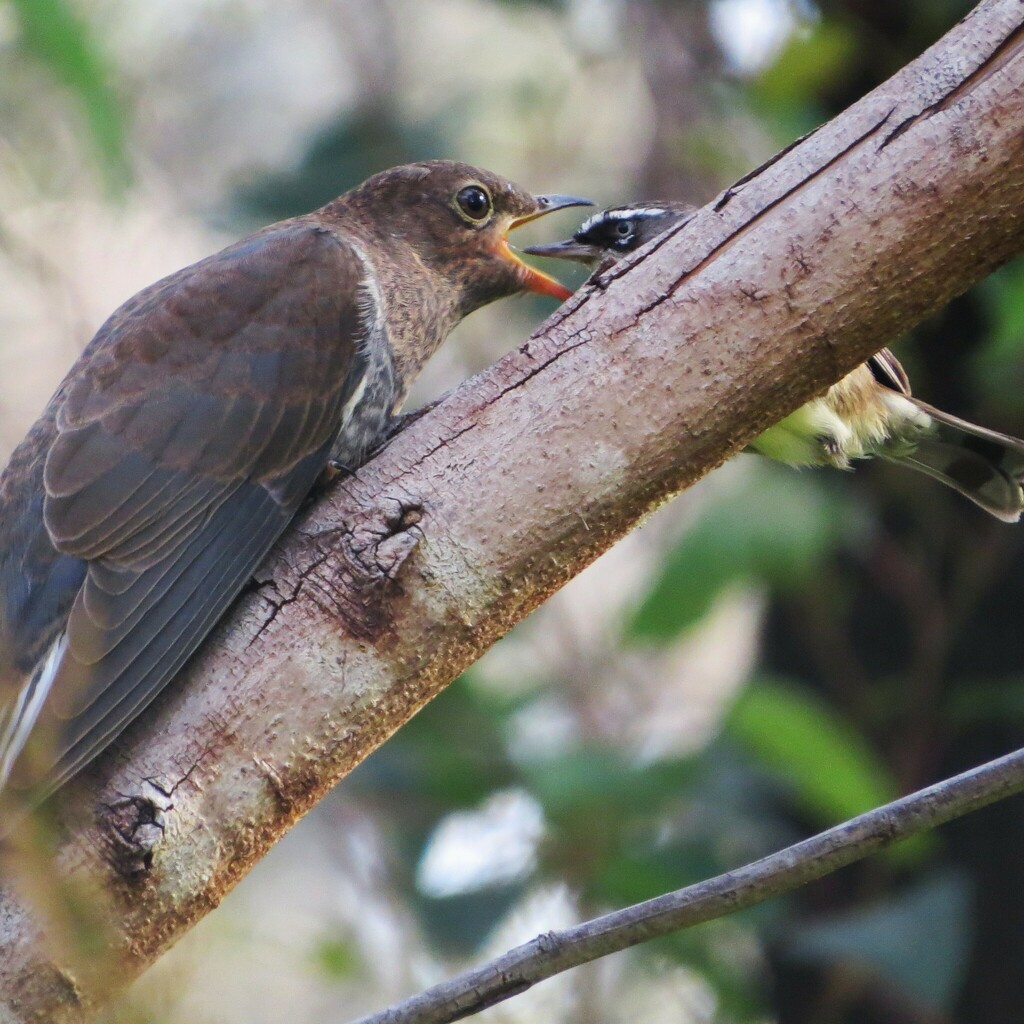
Fan-tailed Cuckoo
Photo © pimelea
Photo © pimelea — CC BY 4.0 — Source: iNaturalist #231179027Identification
The fan-tailed cuckoo is a medium-sized cuckoo measuring 25–27 cm in length. It is readily identified by its slate-grey head, back and wings contrasted with rufous underparts. The most distinctive feature is its barred black and white tail, which gives the species its common name. A bright yellow orbital eye ring is a key identification feature that helps distinguish it from the smaller brush cuckoo and chestnut-breasted cuckoo found in overlapping ranges.
Range & Habitat
This species is distributed across a wide area of the south-western Pacific, occurring in Australia, Fiji, New Caledonia, New Guinea, Solomon Islands, and Vanuatu. Within Australia, its range extends from Cape York in Queensland along the coast southward to Shark Bay in Western Australia, with the western extent rarely exceeding 1000 km inland. The species also inhabits Tasmania and coastal South Australia. Six subspecies are recognised across this range, each adapted to regional conditions.
The fan-tailed cuckoo favours temperate and subtropical forests, tropical mangrove forests, and montane forests, but also readily adapts to human-modified landscapes including paddocks, orchards and gardens.
Behaviour & Diet
As a brood parasite, the fan-tailed cuckoo does not raise its own young. Instead, it lays a single mauve-white egg spotted with red or brown in the nests of other birds, typically selecting domed nests of fairywrens or thornbills. In Australia, breeding occurs from July to January. The species has a distinctive voice described as a descending trill punctuated by grasshopper-like chirps.
The diet is varied and opportunistic, comprising insects and their larvae, fruits and vegetables, small reptiles, mammals and birds—particularly chicks. The cuckoo typically perches in an exposed position to spot prey before pouncing to catch it either in flight or on the ground.
Best Time & Places to See It
The fan-tailed cuckoo is common throughout much of its range, making it a reliable species to encounter in suitable habitat. The breeding season from July to January is an excellent time to locate birds, when they are most active and vocal. Temperate and subtropical forests with open perching spots, as well as gardens and orchards, are productive areas for sightings across eastern and southern Australia.
Photography Tips
The fan-tailed cuckoo's habit of perching in exposed positions to hunt makes it a relatively approachable subject for photographers. The bright yellow eye ring and barred tail pattern are key features to capture. Early morning and late afternoon light will best showcase the slate-grey plumage and rufous underparts. Watch for the characteristic pouncing hunting behaviour, which offers dynamic photo opportunities. Patient observation in gardens or woodland edges during breeding season increases the chances of obtaining action shots.
Alpine National Park
Bald Rock National Park
Barrington Tops National Park
Belair National Park
Ben Boyd National Park
Blue Mountains National Park
Bouddi National Park
Bribie Island National Park
Budawang National Park
Nothing matches these filters.
No community photos yet. Log in to add the first one.
No community observations of this species yet.