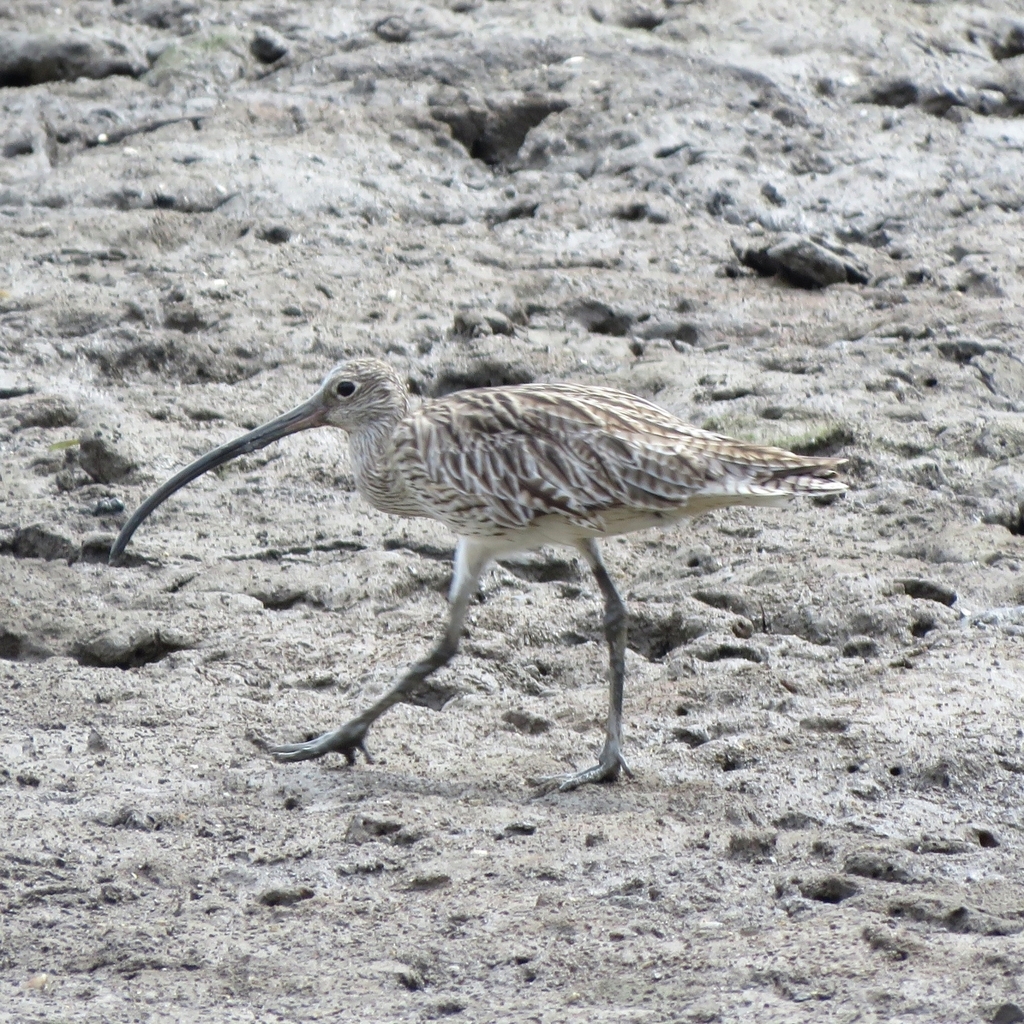
Far Eastern Curlew
Photo © Pirataber
Photo © Pirataber — CC BY 4.0 — Source: iNaturalist #254009972Identification
The Far Eastern curlew is the world's largest sandpiper and probably the largest curlew, measuring 60–66 cm in length with a wingspan of 110 cm. It is most similar in appearance to the long-billed curlew but slightly larger. The plumage is mostly brown, with a distinctive plain, unpatterned brown underwing and brown rump—the latter being the most reliable field mark to distinguish it from the closely related Eurasian curlew, which has a white rump and lower back.
The bird's most striking feature is its extremely long, decurved bill, measuring 12.8–20.1 cm, which rivals the long-billed curlew as the longest bill for any sandpiper. Weight ranges from 390–1,350 g, with females averaging about 100 g heavier than males.
Range & Habitat
The Far Eastern curlew breeds across northeastern Asia, from Siberia and Kamchatka through Mongolia, favouring marshy and swampy wetlands and lakeshores. Most individuals migrate to coastal Australia for the non-breeding season, though some winter in Indonesia, Thailand, the Philippines, New Zealand, southern China, and Taiwan. During migration, birds make stopovers on the mudflats of the Yellow Sea and along Japanese coasts.
In winter, the species occupies estuaries, beaches, and salt marshes. Its breeding habitat consists of wetlands and lakeshores across a vast range of northeastern Asia.
Behaviour & Diet
The Far Eastern curlew uses its long, decurved bill to probe for invertebrates in mud. Although it may feed solitarily, it generally congregates in large flocks for migration and roosting. Its call is a sharp, clear whistle—cuuue-reee—often repeated. On breeding grounds, the species consumes insects including beetle and fly larvae, and amphipods. During migration, it also feeds on berries.
In the non-breeding season, the diet shifts to marine invertebrates, with crabs and small molluscs preferred, though other crustaceans and polychaetes are also taken.
Best Time & Places to See It
For travellers in Australia, the non-breeding season offers the best opportunity to observe this species. Coastal estuaries, beaches, and salt marshes throughout Australia are prime locations. Birdwatchers visiting the Yellow Sea region during migration periods may encounter flocks at mudflats in this critical stopover zone. The species is also present in smaller numbers in Indonesia, Thailand, the Philippines, New Zealand, and parts of China and Taiwan during winter months.
Photography Tips
The Far Eastern curlew's large size and distinctive brown rump make it a rewarding subject for nature photographers. The best light for capturing detail is during early morning or late afternoon. The bird's habit of feeding in flocks and congregating at traditional roosting sites provides opportunities for both individual portraits and flock composition shots. The long, curved bill and overall proportions are distinctive features worth emphasizing in photographs. Coastal locations during the non-breeding season in Australia offer the most reliable viewing and shooting opportunities.
Kakadu National Park
Kakadu, Australia
+273 birds+46 mammals
Kakadu National Park is Australia’s largest national park and one of the world’s most remarkable protected areas, covering nearly 20,000 square kilometres in the tropical north…
VIEW NATIONAL PARKDaintree National Park
Dedin, Australia
+362 birds+37 mammals
Daintree National Park is one of the world’s oldest and most biologically diverse tropical rainforests, protecting an extraordinary landscape where ancient forests meet the Great Barrier…
VIEW NATIONAL PARKSydney Harbour National Park
Sydney, Australia
+203 birds+26 mammals
Where Sydney Harbour's sheltered waters meet the sandstone headlands of New South Wales, a mosaic of coastal heathland, eucalyptus woodland and rocky shores creates one of…
VIEW NATIONAL PARKRoyal National Park
Sydney, Australia
+296 birds+46 mammals
Where sandstone ridges plunge toward the Tasman Sea, Royal National Park unfolds across 343 square kilometres of southeastern Australian coastal wilderness. The park's defining character emerges…
VIEW NATIONAL PARKGheebulum Kunungai National Park
Moreton Island, Australia
+168 birds+7 mammals
Sand dunes rise and fall across Moreton Island's eastern shore, a landscape sculpted by wind and ocean currents into one of Australia's most dynamic coastal ecosystems.…
VIEW NATIONAL PARKAnnan River (Yuku Baja-Muliku) National Park
Australia
+78 birds
Where the Annan River winds through northeastern Queensland's coastal hinterland, a compact national park of roughly 246 square kilometers protects a mosaic of subtropical rainforest, eucalypt…
VIEW NATIONAL PARKEndeavour River National Park
Philadelphia, Australia
+203 birds+1 mammals
Where the Endeavour River winds through northeastern Queensland's tropical lowlands, a compact mosaic of rainforest, open woodland, and riverine corridor creates one of Australia's most ecologically…
VIEW NATIONAL PARKBribie Island National Park
Brisbane, Australia
+284 birds+20 mammals
Across tidal flats and shallow waterways north of Brisbane, Bribie Island National Park spreads across nearly four hundred square kilometres of subtropical coastal wilderness—a patchwork of…
VIEW NATIONAL PARKWilsons Promontory National Park
Australia
+210 birds+21 mammals
Where granite headlands plunge toward Bass Strait, Wilson's Promontory National Park sprawls across nearly 1,300 square kilometers of southeastern Victoria's most rugged coastal wilderness. The park's…
VIEW NATIONAL PARKWhitsunday Islands National Park
Whitsundays, Australia
+163 birds+9 mammals
Crystalline waters lap against seventy-four islands where rainforest canopies tumble down to pristine beaches and coral gardens flourish in the shallows. This archipelago off Queensland's coast…
VIEW NATIONAL PARKSt. Paul Island
Saint Paul, United States
+255 birds+8 mammals
Windswept tundra rolls across this remote Pribilof island, where volcanic basalt cliffs plunge into the Bering Sea and fog rolls in thick enough to erase the…
VIEW PROTECTED LANDSCAPEBako National Park
Kuching, Malaysia
+210 birds+17 mammals
Weathered sandstone cliffs rise dramatically from the South China Sea, their ochre faces sculpted by millennia of wind and tide into a landscape of extraordinary geological…
VIEW NATIONAL PARKKuching Wetlands National Park
Kuching, Malaysia
+103 birds+4 mammals
Where brackish waters meet mangrove stilts and freshwater swamps blend into coastal mudflats, one of Southeast Asia's most dynamic wetland ecosystems unfolds across Sarawak's northwestern coast.…
VIEW NATIONAL PARKWest Bali National Park
Gerokgak, Indonesia
+240 birds+8 mammals
Across West Bali's northwestern reaches, where the Indian Ocean meets volcanic slopes and limestone cliffs plunge toward turquoise shallows, sprawls a protected realm of roughly 325…
VIEW NATIONAL PARKSembilang National Park
Banyuasin, Indonesia
+56 birds+3 mammals
Where tidal mangroves grade into freshwater swamp forest and the Musi River delta spreads across more than 7,000 square kilometres, Sembilang National Park represents one of…
VIEW NATIONAL PARKGreat Sandy National Park
Australia
+306 birds+40 mammals
Where coastal dunes rise inland from the Queensland coastline, Great Sandy National Park encompasses a landscape of remarkable ecological diversity shaped by subtropical humid conditions year-round.…
VIEW NATIONAL PARKNoosa National Park
Marcus Beach, Australia
+216 birds+8 mammals
Subtropical eucalypt woodland and open forest meet coastal heathland along the Noosa Peninsula, where the temperate waters of the Tasman current moderate the Queensland climate into…
VIEW NATIONAL PARKBouddi National Park
Gosford, Australia
+147 birds+17 mammals
Sandstone ridges rise sharply from the Tasman Sea along the central New South Wales coast, their weathered faces etched by millennia of salt spray and storm…
VIEW NATIONAL PARKKu-ring-gai Chase National Park
Sydney, Australia
+216 birds+39 mammals
Where Hawkesbury sandstone cliffs plunge toward sheltered bays and creeks, Ku-ring-gai Chase National Park unfolds across rugged terrain just north of Sydney, a mosaic of eucalyptus…
VIEW NATIONAL PARKBen Boyd National Park
Eden, Australia
+255 birds+47 mammals
Where the temperate forests of the far south coast meet towering sea cliffs, Ben Boyd National Park unveils one of New South Wales' most dramatic coastal…
VIEW NATIONAL PARKCoorong National Park
Australia
+217 birds+15 mammals
Where the Murray River meets the Southern Ocean, a chain of shallow lagoons stretches across the South Australian coast, separated from the sea by a ribbon…
VIEW NATIONAL PARKCape Range National Park
Australia
+159 birds+15 mammals
Where arid limestone ridges plunge toward turquoise waters, Cape Range National Park frames one of Australia's most dramatic desert-ocean interfaces. The park's spine—a stark, weathered range…
VIEW NATIONAL PARKFreycinet National Park
Coles Bay, Australia
+115 birds+9 mammals
Granite peaks rise abruptly from the Tasmanian coast where Coles Bay opens into the Freycinet Peninsula, sculpting one of southeastern Australia's most dramatically vertical national parks.…
VIEW NATIONAL PARKNortheast China Tiger and Leopard National Park
Mu Dan Jiang Shi, China
+202 birds+19 mammals
Across the temperate forests of northeastern China, where winters grip the landscape in subzero silence and summers remain cool and brief, the Mudanjiang region supports a…
VIEW NATIONAL PARKNo community photos yet. Log in to add the first one.
No community observations of this species yet.