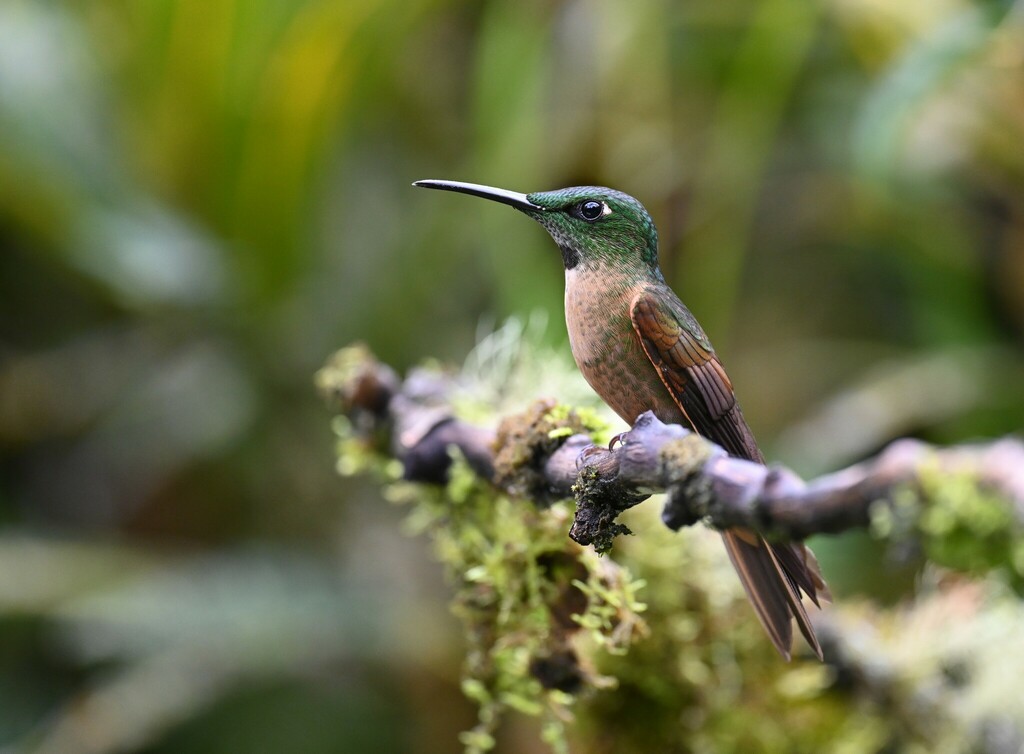
Fawn-breasted Brilliant
Photo © Chrissy McClarren and Andy Reago
Photo © Chrissy McClarren and Andy Reago — CC0 1.0 — Source: iNaturalist photo #258090875The fawn-breasted brilliant (Heliodoxa rubinoides) is a medium-sized species of hummingbird in the family Trochilidae. It is native to South America, where it occurs in Bolivia, Colombia, Ecuador, and Peru. Other common names include lilac-throated brilliant in English and brillante pechigamuza, colibrí de vientre ocre, and diamante pechigamuza in Spanish. == Taxonomy == The fawn-breasted brilliant was originally described as Trochilus rubinoides by French naturalists Jules Bourcier and Étienne Mulsant in 1846, with the type locality given as Colombia. It was later moved to the genus Heliodoxa, which was introduced by John Gould in 1850. The genus name Heliodoxa derives from the Greek words hēlios ("sun") and doxa ("glory"), while the specific epithet rubinoides combines the Latin rubinus ("ruby-red") with the Greek suffix -oidēs ("resembling"), referring to the male's pink throat patch. There are three recognized subspecies: Heliodoxa rubinoides rubinoides (Bourcier & Mulsant, 1846) – Central and Eastern Andes of Colombia. Heliodoxa rubinoides aequatorialis (Gould, 1860) – Western slope of the Andes from western Colombia (Antioquia) south to western Ecuador (Pichincha to El Oro and western Loja). Heliodoxa rubinoides cervinigularis (Salvin, 1892) – Eastern slope of the Andes in eastern Ecuador and Peru; also recorded in northern Cochabamba, central Bolivia.…
Sangay National Park
Cebadas, Ecuador
+320 birds+10 mammals
High in Ecuador's Andean spine, where the Western Cordillera rises to touch perpetual snow, a landscape of volcanic drama and ecological intensity unfolds across Sangay National…
VIEW NATIONAL PARKPodocarpus National Park
Zamora, Ecuador
+496 birds+6 mammals
Where the Andes descend toward the Amazon basin, Podocarpus National Park sprawls across nearly 2,800 square kilometres of the most biodiverse terrain in Ecuador's southern highlands.…
VIEW NATIONAL PARKSumaco Napo-Galeras National Park
Loreto, Ecuador
+563 birds+4 mammals
Where Ecuador's Amazon transitions into cloud forest, a massive shield volcano rises from the emerald lowlands of Orellana Province, anchoring one of the continent's most biodiverse…
VIEW NATIONAL PARKAntisana National Park
Quijos, Ecuador
+432 birds+21 mammals
Where the eastern Andean slopes descend into the Amazon basin, Antisana National Park sprawls across roughly 2,500 square kilometers of some of South America's most dramatic…
VIEW NATIONAL PARKNatural Munchique National Park
El Tambo, Colombia
+194 birds
Where the Western Cordillera rises steeply from the Pacific plains of southwestern Colombia, Natural Munchique National Park sprawls across 1,078 square kilometers of montane forest that…
VIEW NATIONAL PARKNatural Serranía de los Yariguíes National Park
El Carmen de Chucurí, Colombia
+320 birds+3 mammals
Where the northern cordilleras of Colombia rise toward cloud forest, the Serranía de los Yariguíes unfolds across nearly 1,820 square kilometers of some of the most…
VIEW NATIONAL PARKNatural Farallones de Cali National Park
Buenaventura, Colombia
+733 birds+27 mammals
Where the Pacific coastal plain meets the western slopes of the Andes, Farallones de Cali National Park sprawls across nearly 3,500 square kilometers of dramatic topography…
VIEW NATIONAL PARKGuácharos Cave National Natural Park
Acevedo, Colombia
+359 birds
High in the Andean foothills of southern Huila, where mist-laden slopes rise above 1,600 metres, lies a landscape carved by underground rivers and crowned by karst…
VIEW NATIONAL PARKYanachaga–chemillén National Park
Palcazu, Peru
+639 birds+6 mammals
Where the eastern slopes of Peru's central cordillera plunge into cloud forest, Yanachaga–Chemillén National Park protects nearly three thousand square kilometres of montane wilderness that few…
VIEW NATIONAL PARKManu National Park
Manu, Peru
+892 birds+26 mammals
Across the eastern slopes of the Peruvian Andes, tropical rainforest descends into the Amazon basin with a complexity that few terrestrial ecosystems match. Manu National Park…
VIEW NATIONAL PARKNo community photos yet. Log in to add the first one.
No community observations of this species yet.