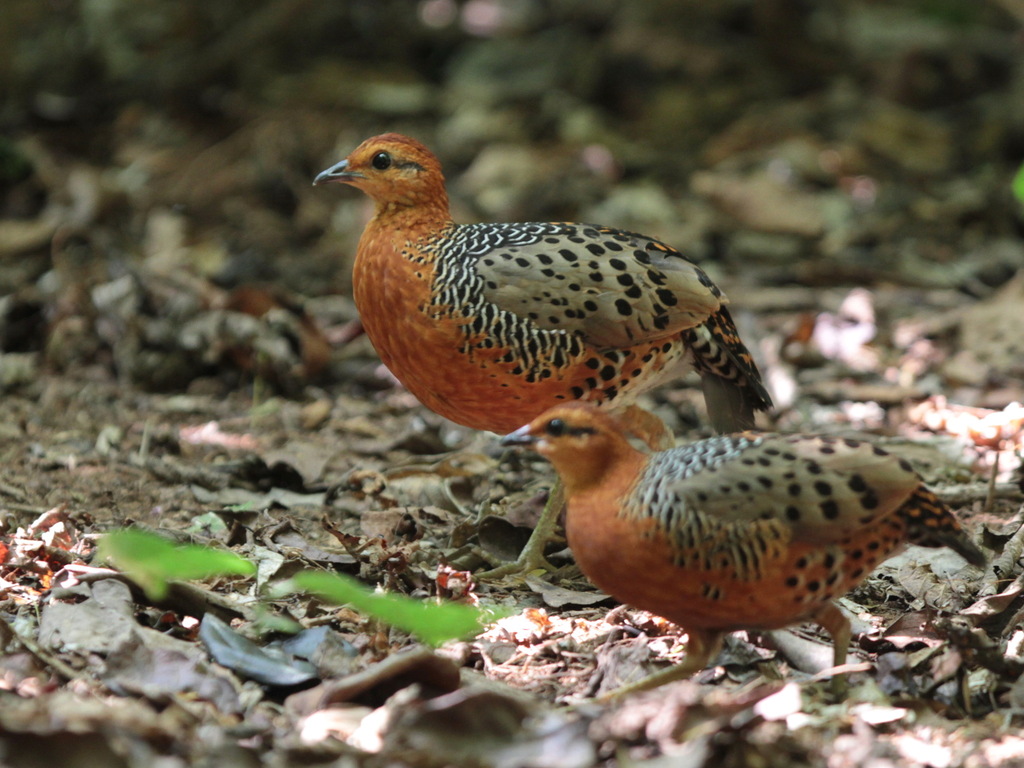
Ferruginous Partridge
Photo © Ian Dugdale
Photo © Ian Dugdale — CC BY 4.0 — Source: iNaturalist #303326546Identification
The ferruginous partridge is a compact gamebird measuring 27 to 32 cm in length, weighing between 191–230 g. Its most distinctive feature is its striking plumage: a rufous head, breast, and belly contrasts sharply with a black upper back scaled with white, and black-scaled rufous on the lower back. The wings are brown with black spotting, while the sides of the breast and flanks show the same black-and-white scaling pattern. The sexes are similar in appearance, though males can be distinguished by the presence of two spurs on their legs, compared to just one on females.
Range & Habitat
The ferruginous partridge is found across Southeast Asia, ranging from southern Myanmar through the Kra Isthmus into the Malay Peninsula, as well as on the islands of Borneo and Sumatra. Three recognized subspecies are distributed throughout this region. The species occupies a variety of forest habitats from sea-level to 1,200 metres, including tropical dry forests and tropical moist lowland forests, as well as secondary scrub and secondary bamboo growth, making it adaptable to both primary and disturbed forest environments.
Behaviour & Diet
The ferruginous partridge is a ground-foraging bird, typically found singly or in small pairs as it searches for seeds, fruits, grasses, and insects among the forest floor. Very little is known about its breeding behaviour, though nesting records indicate that females lay clutches of 8-10 pure white eggs in domed nests, a characteristic nest structure for several partridge species. The bird's preference for foraging in pairs or alone suggests it may be relatively territorial or monogamous, though further research is needed to confirm this.
Best Time & Places to See It
Travellers hoping to encounter the ferruginous partridge should focus on forest habitats in Myanmar, Thailand, Malaysia, Borneo, and Sumatra, particularly in areas with secondary growth and bamboo thickets where the bird forages. Early morning hours are typically the best time to search for ground-dwelling partridges, when they are most active. However, the species can be elusive and difficult to locate, so patience and a good ear for calls will improve your chances of a sighting in suitable lowland forest habitat.
Photography Tips
Photographing the ferruginous partridge presents challenges due to its ground-dwelling habits and preference for dense forest understory. Use a fast shutter speed to capture movement as the bird forages, and consider employing a telephoto lens to maintain distance from this wary species. The bird's distinctive plumage—particularly the contrast between rufous underparts and scaled black-and-white upper parts—photographs well in soft, diffused forest light. Patience is essential; position yourself quietly near suitable habitat at dawn and wait for the bird to emerge into open areas.
No community photos yet. Log in to add the first one.
No community observations of this species yet.