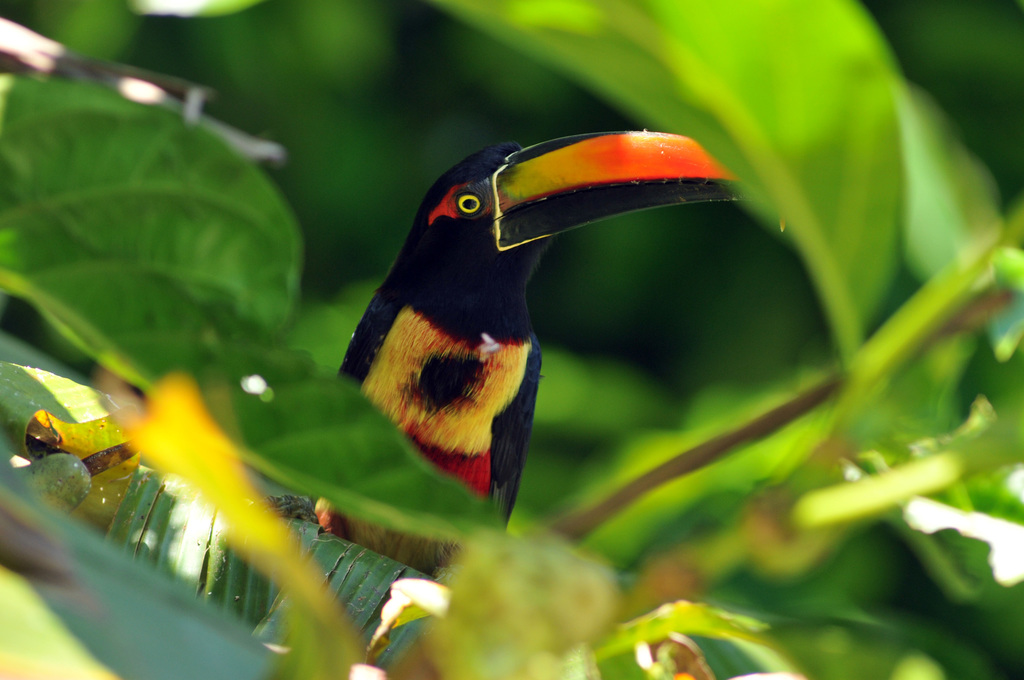
Fiery-billed Aracari
Photo © Tom Kennedy
Photo © Tom Kennedy — CC BY 4.0 — Source: iNaturalist photo #172283820Identification
The fiery-billed aracari is a striking mid-sized toucan, measuring approximately 45 cm (18 in) long and weighing 225 to 280 g. Like all toucans, it boasts a large, boldly patterned bill and vibrant plumage that makes it unmistakable in the field. The most distinctive feature is its bill: the maxilla is predominantly red with a black culmen, yellow tip, and greenish base, while the mandible is black. A vertical ivory line marks the bill's base, earning this species its "fiery-billed" name.
The head, neck, and throat are black, contrasting sharply with a chestnut collar on the nape. Bare red skin encircles the eye, adding to the bird's intense gaze. The back is blue-green, the rump is bright red, and the underparts are striking yellow with a red band across the belly and a black spot on the breast. Females are slightly duller, with a darker chestnut collar and shorter bill, while immatures show less distinct plumage and bill patterns throughout.
Range & Habitat
The fiery-billed aracari is endemic to Central America, found from the Gulf of Nicoya on Costa Rica's Pacific coast southward into Panama's western Chiriquí Province. The species formerly ranged as far east as Panama's Veraguas Province, though it has since contracted in that region. It inhabits the interior and edges of wet primary and secondary forests, ranging primarily from sea level to 1,200 m (3,940 ft) in elevation, though it is occasionally encountered as high as 1,800 m (5,910 ft).
Behaviour & Diet
Fiery-billed aracaris are gregarious birds, typically traveling in flocks of six or more individuals that may include other toucan species. They are year-round residents throughout their range and roost communally, with several birds sometimes sharing a single cavity overnight. Their diet is primarily frugivorous, though they supplement with large insects, eggs and nestlings of other birds, and other small vertebrates. They forage mostly in or just below the canopy, employing acrobatic feeding techniques—stretching, bending, and even hanging upside down to glean fruit from branches.
During breeding season, which runs from January to April in Costa Rica and may extend later in Panama, pairs typically lay two eggs, sometimes more. They nest in woodpecker holes, either abandoned or commandeered from the original occupants, positioned as high as 30 m above the ground. Both parents share incubation and provisioning duties and are often assisted by additional adults, possibly offspring from previous seasons. Young nestlings are fed primarily insects. The species produces high-pitched calls—"pseep" to "sis-sik" in series—similar to those of the collared aracari, along with croaking and soft rattling sounds.
Best Time & Places to See It
The fiery-billed aracari is a year-round resident, making it potentially viewable any time of year, though breeding season (January to April in Costa Rica) offers excellent opportunities to observe family groups and hear vocalizations. The species occurs in at least two protected areas in Costa Rica, which offer reliable viewing opportunities within its range from the Gulf of Nicoya south into western Panama. Look for them in wet forest interiors and along forest edges, where they move through the canopy in characteristic small flocks.
Photography Tips
The fiery-billed aracari's vivid colors and dramatic bill make it a rewarding photographic subject. Position yourself in wet forest habitat during early morning hours when birds are most active and light is optimal for capturing the brilliant reds, yellows, and blue-greens of their plumage. Since they typically forage in or near the canopy, a telephoto lens is essential. Watch for their acrobatic feeding behavior—hanging upside down or stretching awkwardly for fruit—which provides dynamic compositional opportunities. The bright red skin around the eye and the distinctive bi-colored bill are key identifying features worth highlighting in your images.
Corcovado National Park
Puerto Jiménez, Costa Rica
+444 birds+48 mammals
Where the Osa Peninsula juts into the Pacific, rainforest descends almost to the tide line, and Corcovado National Park protects one of Central America's most intact…
VIEW NATIONAL PARKManuel Antonio National Park
Quepos, Costa Rica
+426 birds+22 mammals
Where tropical rainforest descends steeply to a rocky Pacific coastline, Manuel Antonio National Park distills Central American biodiversity into one of Costa Rica's most compressed and…
VIEW NATIONAL PARKChirripó National Park
Rivas, Costa Rica
+274 birds+6 mammals
Where the volcanic spine of Costa Rica's Central Cordillera reaches its apex, Chirripó National Park encompasses a landscape that shifts dramatically with elevation, from montane cloud…
VIEW NATIONAL PARKPiedras Blancas National Park
Golfito, Costa Rica
+386 birds+24 mammals
Where the Golfo Dulce meets the southwestern Pacific coast of Costa Rica, Piedras Blancas National Park protects a dramatic transition zone where lowland rainforest descends toward…
VIEW NATIONAL PARKBaru Volcano National Park
Cerro Punta, Panama
+402 birds+6 mammals
Where the land rises sharply toward the Caribbean's western spine, Baru Volcano National Park sprawls across roughly 220 square kilometres of southwestern Panama, anchored by the…
VIEW NATIONAL PARKParque Internacional la Amistad
Teribe, Panama
+325 birds+11 mammals
Where the continental divide rises between the Caribbean and Pacific watersheds, a wilderness of extraordinary biological richness unfolds across the Talamanca Range and into lowland rainforest—a…
VIEW NATIONAL PARKMarino Golfo de Chiriquí National Park
Boca Chica, Panama
+82 birds+2 mammals
Where mangrove forests meet tropical Pacific waters, Marino Golfo de Chiriquí National Park spans 463 square kilometers of one of Central America's most biodiverse coastal systems.…
VIEW NATIONAL PARKCarara National Park
Tárcoles, Costa Rica
+397 birds+19 mammals
Where the Pacific coastal plain meets transitional forest, Carara National Park straddles one of Central America's most dynamic ecological boundaries. The park's landscape encompasses lowland deciduous…
VIEW NATIONAL PARKTapantí Macizo de la Muerte National Park
Orosi, Costa Rica
+503 birds+18 mammals
Where montane cloud forest rises steeply from the Orosi Valley, Tapantí Macizo de la Muerte National Park enfolds a landscape of perpetual moisture and emerald complexity.…
VIEW NATIONAL PARKLa Amistad International Park
Crorina, Costa Rica
+532 birds+20 mammals
Where the Caribbean slopes of Costa Rica's Talamanca Mountains rise steeply inland from Limón, the boundary between two nations dissolves into an unbroken expanse of rainforest.…
VIEW NATIONAL PARKMarino Ballena National Park
Bahía Ballena, Costa Rica
+336 birds+8 mammals
Where mangrove forests meet coral-fringed shorelines along Costa Rica's southern Pacific coast, Marino Ballena National Park encompasses a marine and terrestrial mosaic that ranks among Central…
VIEW NATIONAL PARKNo community photos yet. Log in to add the first one.
No community observations of this species yet.