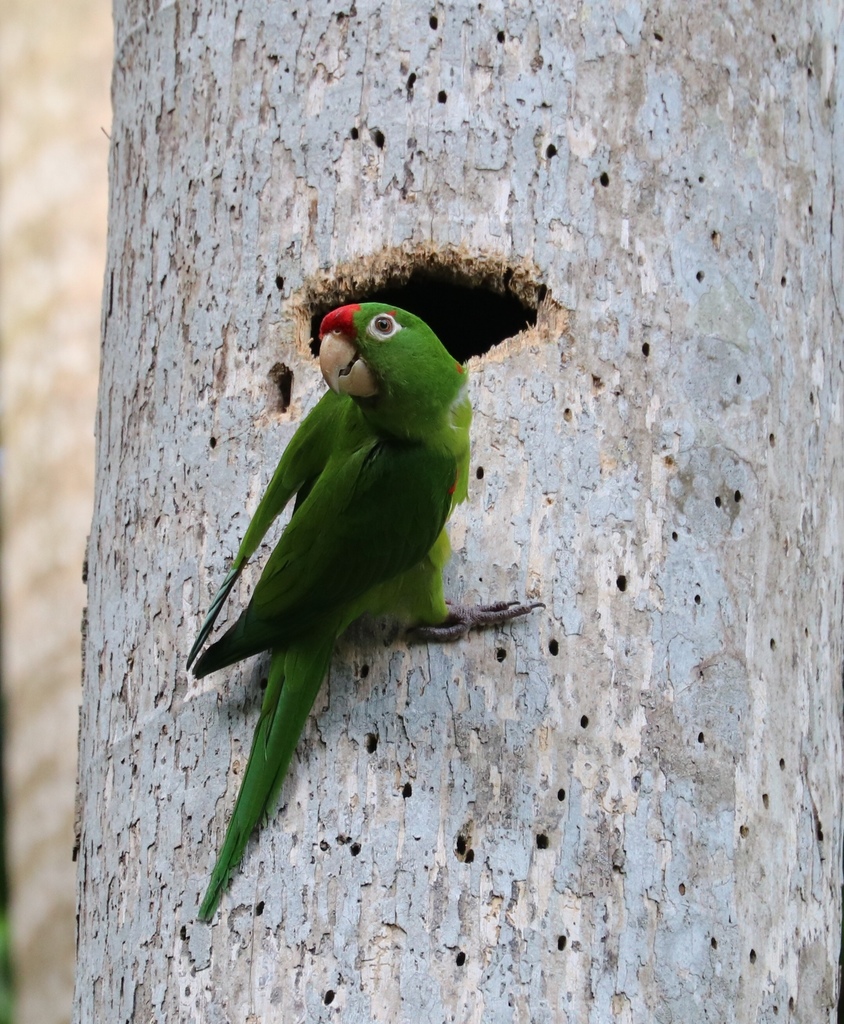
Finsch’s Parakeet
Photo © Aitor
Photo © Aitor — CC BY 4.0 — Source: iNaturalist photo #37101747Identification
Finsch's parakeet is a small parrot, measuring about 28 cm (11 inches) long and weighing between 135 and 175 grams. Adults are predominantly green with yellowish underparts and are most distinctive for their bright red forehead—a field mark that gives them their alternate name, the crimson-fronted parakeet. Additional red plumage appears as flecks elsewhere on the head, along the wing edge, and on the outer underwing coverts, often tinged with orange. The greater underwing coverts are yellow, and the undersides of flight feathers and tail are olive-yellow. Red also typically appears on the thighs. The eye is striking orange, surrounded by bare white skin, and the bill is horn-colored. Males and females are alike in plumage. Juveniles resemble adults but lack the distinctive red forehead and thigh markings, and have gray eyes rather than orange.
Range & Habitat
This parakeet is found from southeastern Nicaragua through both Pacific and Caribbean slopes of Costa Rica and into Panama's Pacific slope, reaching as far east as the Azuero Peninsula. It inhabits a wide variety of semi-open to open landscapes including woodlands, forest edges, secondary forest, ranchlands, and agricultural areas with scattered trees. Coffee plantations and towns also provide suitable habitat. The species ranges in elevation from sea level to 1,800 meters (5,900 feet).
Interestingly, Finsch's parakeet appears to be expanding its range as deforestation creates the more open landscapes it prefers. The species is considered abundant in Nicaragua, common in Costa Rica, and locally common in Panama.
Behaviour & Diet
Finsch's parakeet is highly social, typically gathering in flocks of about 30 individuals, with several hundred sometimes roosting together. The species wanders widely throughout its range, making irregular and seasonal movements that are not fully understood, though increased numbers are present on the Pacific side of Costa Rica during the dry season.
The diet consists primarily of fruits and flowers from a variety of plants and trees, supplemented by maize and sorghum crops. Unusually for parrots, this species has been observed feeding on wood. Breeding occurs during the dry and early wet seasons (December to May) in Costa Rica and apparently in July in Panama. Birds nest in tree cavities, sometimes excavating their own in rotten wood, and may nest semi-colonially. Clutch size is typically three to four eggs, though details of incubation and fledging periods remain undocumented.
Best Time & Places to See It
Finsch's parakeet is vocal and often conspicuous, making it relatively straightforward to locate with patience. Costa Rica offers the best opportunities, where the species is common throughout both lowland and middle elevations. The dry season (December to May) may offer increased sightings on the Pacific slope. Look for them in open woodlands, at the edges of forests, in agricultural areas with scattered trees, and around coffee plantations. Early morning and late afternoon are typically the most active feeding periods. Nicaragua also offers good viewing opportunities where the species is abundant, while Panama provides locally common sightings.
Photography Tips
The species' vibrant red forehead, orange eye, and green plumage create striking photographic subjects, especially in natural light. Early morning light will best emphasize these colors. Photograph birds in flight to capture the diagnostic red wing edge and orange-tinged coverts. Because Finsch's parakeets are very vocal and often travel in small flocks, listen for their distinctive "klee-klee-chee-chee" call and sharp squeaky notes to locate them. Semi-open habitats and woodland edges provide clearer sightlines and better photographic opportunities than dense forest. Patience during feeding sessions in flowering or fruiting trees will reward photographers with active, engaged subjects.
Corcovado National Park
Puerto Jiménez, Costa Rica
+444 birds+48 mammals
Where the Osa Peninsula juts into the Pacific, rainforest descends almost to the tide line, and Corcovado National Park protects one of Central America's most intact…
VIEW NATIONAL PARKManuel Antonio National Park
Quepos, Costa Rica
+426 birds+22 mammals
Where tropical rainforest descends steeply to a rocky Pacific coastline, Manuel Antonio National Park distills Central American biodiversity into one of Costa Rica's most compressed and…
VIEW NATIONAL PARKArenal Volcano National Park
Peñas Blancas, Costa Rica
+551 birds+21 mammals
Straddling the border between Alajuela and Guanacaste in northwestern Costa Rica, this national park rises dramatically around one of Central America's most active volcanic systems. The…
VIEW NATIONAL PARKTortuguero National Park
Roxana, Costa Rica
+420 birds+23 mammals
Canals and lagoons thread through a labyrinth of lowland rainforest where the Caribbean coast of Costa Rica meets the wetland frontier. This is terrain shaped by…
VIEW NATIONAL PARKChirripó National Park
Rivas, Costa Rica
+274 birds+6 mammals
Where the volcanic spine of Costa Rica's Central Cordillera reaches its apex, Chirripó National Park encompasses a landscape that shifts dramatically with elevation, from montane cloud…
VIEW NATIONAL PARKBraulio Carrillo National Park
Las Horquetas, Costa Rica
+547 birds+18 mammals
Where the Caribbean slope descends from the central volcanic cordillera toward the humid lowlands of Heredia, Braulio Carrillo National Park preserves one of Costa Rica's most…
VIEW NATIONAL PARKPiedras Blancas National Park
Golfito, Costa Rica
+386 birds+24 mammals
Where the Golfo Dulce meets the southwestern Pacific coast of Costa Rica, Piedras Blancas National Park protects a dramatic transition zone where lowland rainforest descends toward…
VIEW NATIONAL PARKSanta Rosa National Park
Santa Elena, Costa Rica
+359 birds+30 mammals
Where Pacific-facing slopes descend from volcanic uplands toward the Guanacaste lowlands, Santa Rosa National Park unfolds across a mosaic of tropical dry forest, gallery woodland, and…
VIEW NATIONAL PARKGuanacaste National Park
Santa Elena, Costa Rica
+461 birds+17 mammals
Where the Pacific slopes of northwestern Costa Rica rise toward the Continental Divide, dry tropical forest gives way to cloud-laden peaks and misty ridges—a landscape that…
VIEW NATIONAL PARKVolcán Poás National Park
Toro Amarillo, Costa Rica
+237 birds+4 mammals
Where volcanic slopes rise sharply from the Central Valley floor, Volcán Poás National Park protects one of Costa Rica's most active and accessible volcanic systems. The…
VIEW NATIONAL PARKBaru Volcano National Park
Cerro Punta, Panama
+402 birds+6 mammals
Where the land rises sharply toward the Caribbean's western spine, Baru Volcano National Park sprawls across roughly 220 square kilometres of southwestern Panama, anchored by the…
VIEW NATIONAL PARKParque Internacional la Amistad
Teribe, Panama
+325 birds+11 mammals
Where the continental divide rises between the Caribbean and Pacific watersheds, a wilderness of extraordinary biological richness unfolds across the Talamanca Range and into lowland rainforest—a…
VIEW NATIONAL PARKCarara National Park
Tárcoles, Costa Rica
+397 birds+19 mammals
Where the Pacific coastal plain meets transitional forest, Carara National Park straddles one of Central America's most dynamic ecological boundaries. The park's landscape encompasses lowland deciduous…
VIEW NATIONAL PARKLos Quetzales National Park
Copey, Costa Rica
+232 birds+3 mammals
Cloud forest sweeps across the upper slopes of the Central Valley watershed, where elevation and persistent moisture forge an ecosystem unlike any other in Costa Rica.…
VIEW NATIONAL PARKCahuita National Park
Talamanca, Costa Rica
+359 birds+15 mammals
Where the Caribbean shoreline dissolves into mangrove creeks and coral gardens, Cahuita's mosaic of habitats unfolds across the Limón coast. The park's signature feature—a living coral…
VIEW NATIONAL PARKRincón de la Vieja National Park
Liberia, Costa Rica
+451 birds+30 mammals
Where volcanic slopes rise abruptly from the Guanacaste lowlands, Rincón de la Vieja National Park sprawls across a landscape shaped by geothermal drama and seasonal extremes.…
VIEW NATIONAL PARKTapantí Macizo de la Muerte National Park
Orosi, Costa Rica
+503 birds+18 mammals
Where montane cloud forest rises steeply from the Orosi Valley, Tapantí Macizo de la Muerte National Park enfolds a landscape of perpetual moisture and emerald complexity.…
VIEW NATIONAL PARKLa Amistad International Park
Crorina, Costa Rica
+532 birds+20 mammals
Where the Caribbean slopes of Costa Rica's Talamanca Mountains rise steeply inland from Limón, the boundary between two nations dissolves into an unbroken expanse of rainforest.…
VIEW NATIONAL PARKBarbilla National Park
Chirripó, Costa Rica
+226 birds
Where the Caribbean slope of Costa Rica's eastern cordillera plunges into perpetual moisture, Barbilla National Park rises as one of Central America's most water-rich ecosystems. Fed…
VIEW NATIONAL PARKVolcán Tenorio National Park
Guatuso, Costa Rica
+480 birds+12 mammals
Where volcanic slopes rise through Costa Rica's northwestern borderlands, Volcán Tenorio National Park sprawls across terrain shaped by ancient lava flows and mineral-rich springs. The park's…
VIEW NATIONAL PARKMarino Ballena National Park
Bahía Ballena, Costa Rica
+336 birds+8 mammals
Where mangrove forests meet coral-fringed shorelines along Costa Rica's southern Pacific coast, Marino Ballena National Park encompasses a marine and terrestrial mosaic that ranks among Central…
VIEW NATIONAL PARKCaño Negro National Wildlife Refuge
Caño Negro District, Costa Rica
+486 birds+16 mammals
Where the San Juan River's seasonal floodplain opens into expansive wetlands, Caño Negro Wildlife Sanctuary sprawls across one of Central America's most productive freshwater ecosystems. This…
VIEW WILDLIFE SANCTUARYGandoca-Manzanillo National Wildlife Refuge
Manzanillo, Costa Rica
+394 birds+18 mammals
Where the Caribbean coastal plain surrenders to water-logged forest and mangrove tangles, Gandoca-Manzanillo Wildlife Sanctuary shelters one of Costa Rica's most biodiverse lowland wetland ecosystems. The…
VIEW WILDLIFE SANCTUARYBarra del Colorado National Wildlife Refuge
Tortuguero, Costa Rica
+462 birds+36 mammals
Where the Caribbean's restless waters meet the Limón Province coastline, Barra del Colorado National Wildlife Sanctuary unfolds across a landscape of extraordinary ecological complexity. This equatorial…
VIEW WILDLIFE SANCTUARYNo community photos yet. Log in to add the first one.
No community observations of this species yet.