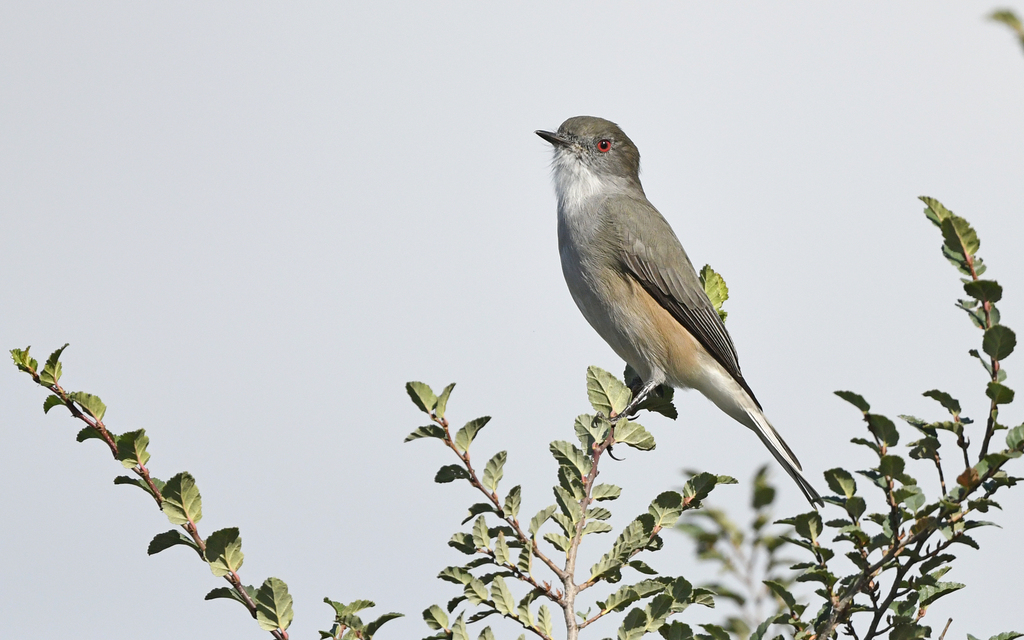
Fire-eyed Diucon
Photo © Christoph Moning
Photo © Christoph Moning — CC BY 4.0 — Source: iNaturalist photo #378530635Identification
The fire-eyed diucon is a small tyrant flycatcher, measuring 18.5 to 21.5 cm in length and weighing 31 to 50 g. Both sexes are identical in plumage. The nominate subspecies displays a dark gray crown, face, and upperparts, with black primary coverts and remiges edged in pale gray on the inner feathers. The tail is dark gray with paler outer feathers and tips. The throat is very pale ashy gray with faint darker streaks, the breast darker ashy gray, the belly grayish white, and the vent white. The southern subspecies P. p. fortis is larger and darker overall. The species' most distinctive feature is its brilliant bright red iris, which gives it its English name—a striking field mark visible even at distance. The bill is black, as are the legs and feet. Juveniles are duller and retain a brown iris until maturity.
Range & Habitat
This species is found in southern South America, with the nominate subspecies ranging from Chile's central Coquimbo Region and west-central Argentina's Neuquén Province south to Cape Horn. Subspecies P. p. fortis is endemic to Chile's Chiloé Island. The nominate subspecies occasionally appears as a vagrant to the Falkland Islands. Fire-eyed diucons inhabit open landscapes including the margins of Nothofagus forest, open woodlands, agricultural lands, gardens, and the shrubby transition zones between forest and steppe. They occur mostly up to 2,000 m elevation but may range as high as 3,050 m.
Behaviour & Diet
The mainland population is entirely migratory, breeding in Argentina and Chile from the Atacama Region south to Cape Horn before withdrawing northward in austral winter to Chile's Atacama and Coquimbo regions. The Chiloé subspecies' migratory status remains debated among researchers. Fire-eyed diucons forage singly or in pairs, dropping from perches to capture prey on the ground or sallying into the air to hawk insects in flight. Their diet consists primarily of insects, supplemented in winter by wild berries and grapes. Breeding begins in October in the north and as late as December or January in the south. Males perform a distinctive high flight display with slow wing beats and no vocalization. Pairs construct open cup nests woven from sticks and grass, lined with lichen, moss, or wool, typically placed in shrubs or trees up to 5 m high, often in streamside vegetation. Clutches contain two to four eggs (most commonly three), which are creamy white with red spots. Shiny cowbirds are known nest parasites.
Best Time & Places to See It
Fire-eyed diucons are fairly common and considered to have no current significant human threats. They are found in open habitats and have adapted well to urbanized areas throughout their range. To observe them during breeding season, visit Argentina or Chile from October through January, when they actively forage and display. The species' widespread distribution and abundance mean good opportunities exist in suitable open habitat across their range, from the Coquimbo Region northward through Chilean valleys down to Cape Horn. Their preference for open woodlands and gardens makes them accessible to travellers exploring both natural and semi-cultivated landscapes.
Photography Tips
The fire-eyed diucon's brilliant red iris is its most photogenic feature and should be your primary compositional focus. Seek birds in good light to capture the striking eye color that defines the species. Since they often forage from exposed perches before dropping to ground prey, positioning yourself downwind and remaining still will increase your chances of close approaches. The males' slow-winged, high flight display in breeding season offers dynamic photographic opportunities—scout open areas on calm mornings when displays are most frequent. The species' habit of foraging in open, well-lit habitats, combined with its relatively approachable behavior in urbanized areas, makes it one of the more accessible small flycatchers for photography in southern Chile and Argentina.
Alerce Costero National Park
Cabo de Hornos National Park
Cerro Castillo National Park
Chiloé National Park
Corcovado National Park
Lago Puelo National Park
Laja National Park Lagoon
Lanín National Park
Los Alerces National Park
Nothing matches these filters.
No community photos yet. Log in to add the first one.
No community observations of this species yet.