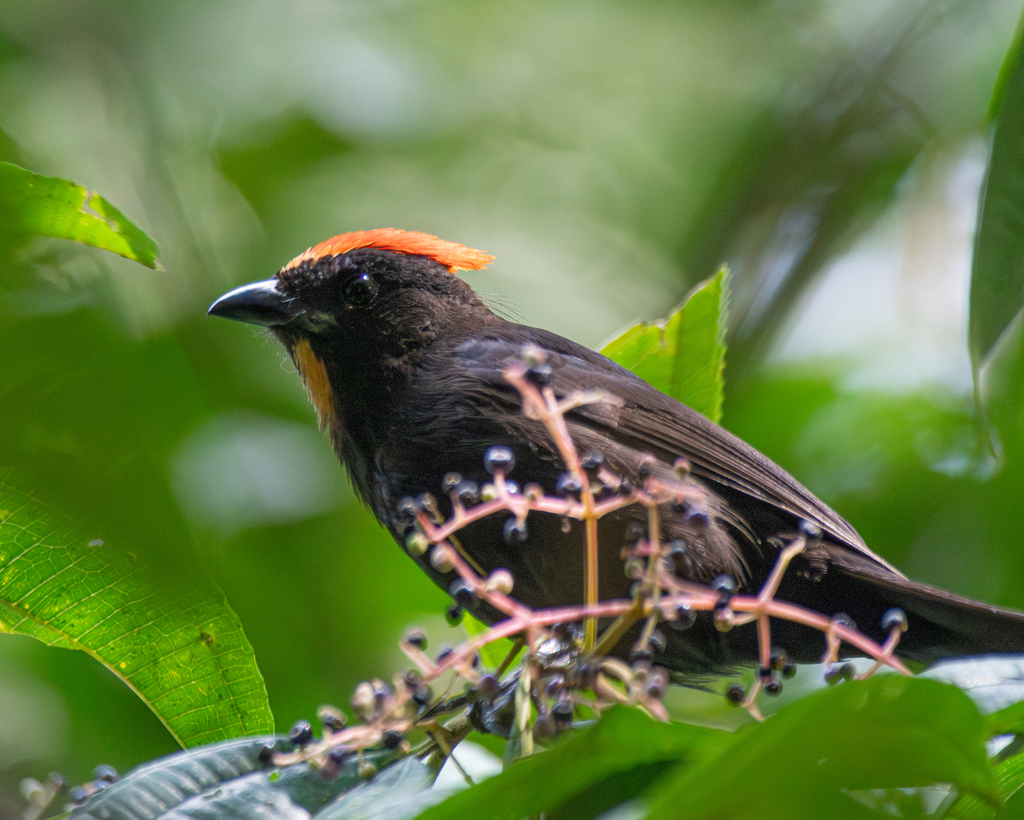
Flame-crested Tanager
Photo © Henrique Bitencourt
Photo © Henrique Bitencourt — CC BY-SA 4.0 — Source: iNaturalist photo #556039773Identification
The flame-crested tanager is a compact bird, measuring about 15 cm in length and weighing around 20 g. Males are strikingly patterned with a black head, distinctive moderate-sized orangish crest, and a small orangeish-red bib. The upper parts are slatey-black with a golden-buff rump and a large white patch on the upper wing-coverts, while the underparts are dark brownish-black. Females are more subdued, appearing browner above with buff-ochre underparts, making them potentially confusable with the white-winged shrike-tanager at first glance, though closer inspection reveals their distinctly warmer tones.
Range & Habitat
This tanager inhabits lowland forests across the northern half of South America, with a discontinuous range. The main population occupies most of the Amazon Basin, including parts of Brazil, Venezuela, Guyana, Suriname, French Guiana, Colombia, Ecuador, Peru, and Bolivia. A separate subspecies population (L. c. brunneus) occupies a coastal strip of Brazil extending from Recife to Curitiba. The species favours subtropical or tropical moist lowland forests and subtropical or tropical dry shrubland, typically remaining in humid lowland regions.
Behaviour & Diet
Though detailed behavioural information is limited, the flame-crested tanager belongs to the diverse tanager family, known for their activity in forest canopies and mid-storey levels. Like most tanagers, this species likely forages for fruits and insects, playing a valuable role in seed dispersal within its forest habitat. Ten subspecies are currently recognized across its range, reflecting geographical variation throughout its extensive distribution.
Best Time & Places to See It
The flame-crested tanager is a fairly common species across its wide range, making it accessible to patient birdwatchers. The larger Amazonian population offers the best opportunities for observation, particularly in protected lowland forests throughout the Amazon Basin. The separate Atlantic Forest population in southeastern Brazil provides an alternative location, though the species shows no marked seasonal movements, suggesting year-round residency throughout its range.
Photography Tips
The male's bold black and orange plumage makes it highly photogenic, particularly when the crest is raised. Look for males perched in mid-storey vegetation where their white wing patches become visible. Early morning provides optimal lighting for capturing the subtle golden-buff rump and the intensity of the orangish-red bib. Females require more patience to locate and photograph due to their plainer coloration, but they offer excellent opportunities for studying regional subspecific variation. A longer lens (300–500 mm) is recommended for capturing detail in forest settings where these birds typically remain partially obscured by canopy foliage.
Amacayacu National Park
Amazônia National Park
Anavilhanas National Park
Campos Amazónicos National Park
Cantão State Park
Carlos Botelho State Park
Chapada dos Guimarães National Park
Ilha do Cardoso State Park
Intervales State Park
Nothing matches these filters.
No community photos yet. Log in to add the first one.
No community observations of this species yet.