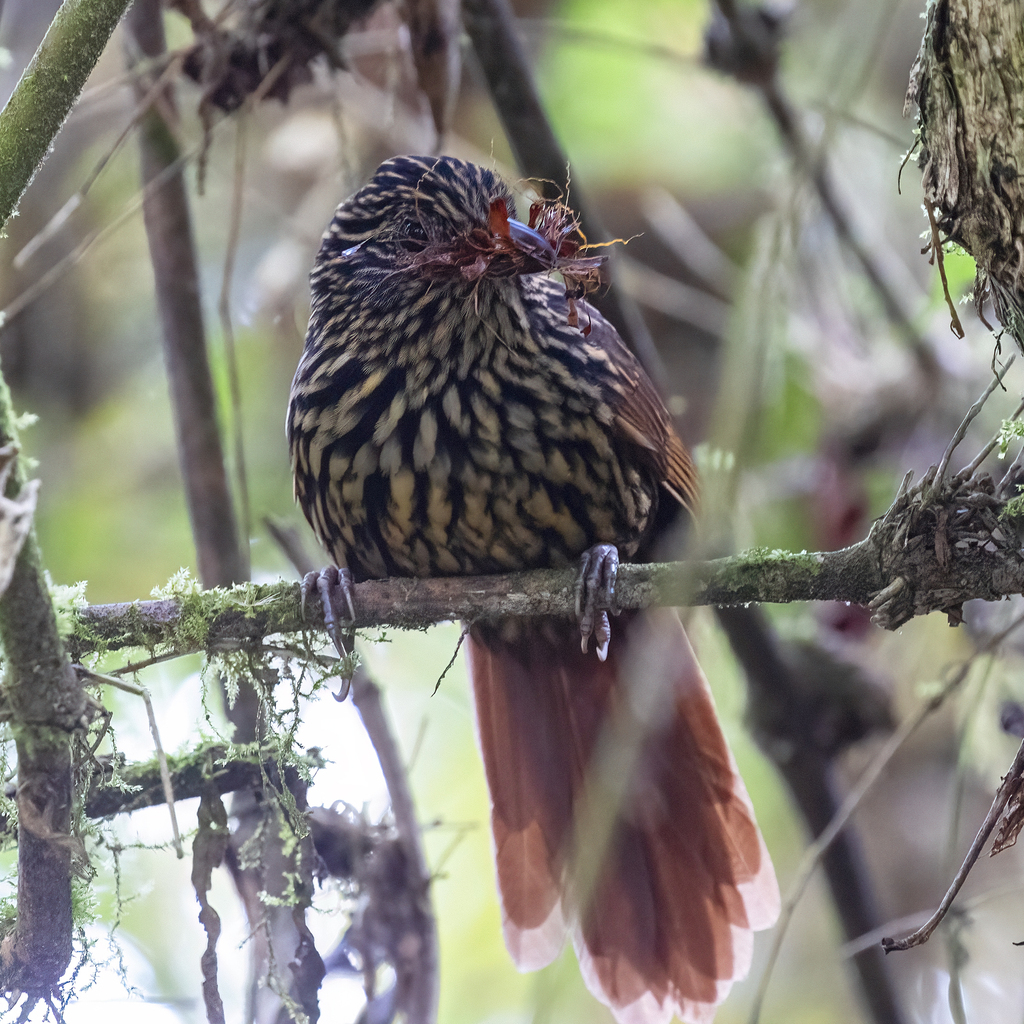
Flammulated Treehunter
Photo © Dan Vickers
Photo © Dan Vickers — CC BY 4.0 — Source: iNaturalist #259389906Identification
The flammulated treehunter is 24–25 cm long and weighs 50–62 g, making it the largest and most strikingly patterned member of its genus. Both sexes share identical plumage. Adults display a distinctive blackish face and crown with sharp tawny-buff streaks that appear golden on the crown, while their lores are speckled with blackish and buff tones. The back is browner than the head with blackish along feather shafts, blending to a rich medium-brown rump and dark reddish-brown uppertail coverts. The wing coverts are more rufescent with narrower streaks, flight feathers dark rufescent-brown, and the tail dull chestnut-brown. Underparts are streaked with blackish and golden buff on the throat and breast, fading to rich brown on the lower belly and flanks. The iris is brown to dark brown, the bill black, and legs gray-brown to blackish. Juveniles are less distinctly streaked than adults.
Range & Habitat
This species has a disjunct distribution across the Andes of northwestern South America. The nominate subspecies ranges from southwestern Venezuela through Colombia's Sierra Nevada de Santa Marta and all three Colombian Andes ranges, continuing more or less continuously through Ecuador's Andes into extreme northern Peru. Subspecies T. f. bricenoi occurs in western Venezuela's Mérida state. The flammulated treehunter inhabits montane and temperate evergreen forests, showing a strong preference for dense thickets of Chusquea bamboo. It typically occurs between 2,200 and 3,500 m elevation, though it locally descends to 700 m in western Colombia.
Behaviour & Diet
A year-round resident throughout its range, the flammulated treehunter feeds primarily on arthropods and is suspected to consume small vertebrates. It forages singly or rarely joins mixed-species feeding flocks, working methodically through dense undergrowth where it gleans prey from branches, moss, and debris. The breeding season spans at least June to October, during which pairs excavate tunnels in earthen banks and construct nests from rootlets, bamboo fibers, and other plant material. Known clutches contained two eggs, and both parents provision the nestlings, though incubation and fledging periods remain undocumented. The species' song is a distinctive series of grating notes that begins as a stutter, accelerates, and grows louder; its contact call is an emphatic sharp 'check'.
Best Time & Places to See It
As a year-round resident, the flammulated treehunter can be encountered throughout the year within its range, though it is generally uncommon. The species occurs in at least two protected areas in Ecuador, which offer reliable access. Locating this bird requires patience and knowledge of its preferred habitat—search in dense bamboo thickets and montane forest undergrowth between 2,200 and 3,500 m, listening for its distinctive grating song. The best strategy is to position yourself in suitable habitat and wait for the bird to betray its presence through vocalizations.
Photography Tips
The flammulated treehunter's preference for dense undergrowth presents significant photographic challenges. Position yourself with a clear sightline through bamboo thickets and use a telephoto lens (at least 300–400 mm) to capture frame-filling images from a distance. Early morning hours offer the best light and increased activity. Use a fast shutter speed to freeze movement through dense vegetation. The bird's cryptic yet intricate plumage—with its striking streaking and rufescent tones—demands careful exposure metering to preserve detail in both dark facial markings and buff highlights. Patience and familiarity with its vocalizations will increase your chances of positioning yourself for that decisive moment.
Antisana National Park
Cajas National Park
Natural Farallones de Cali National Park
Podocarpus National Park
Puracé National Natural Park
Sumaco Napo-Galeras National Park
Nothing matches these filters.
No community photos yet. Log in to add the first one.
No community observations of this species yet.