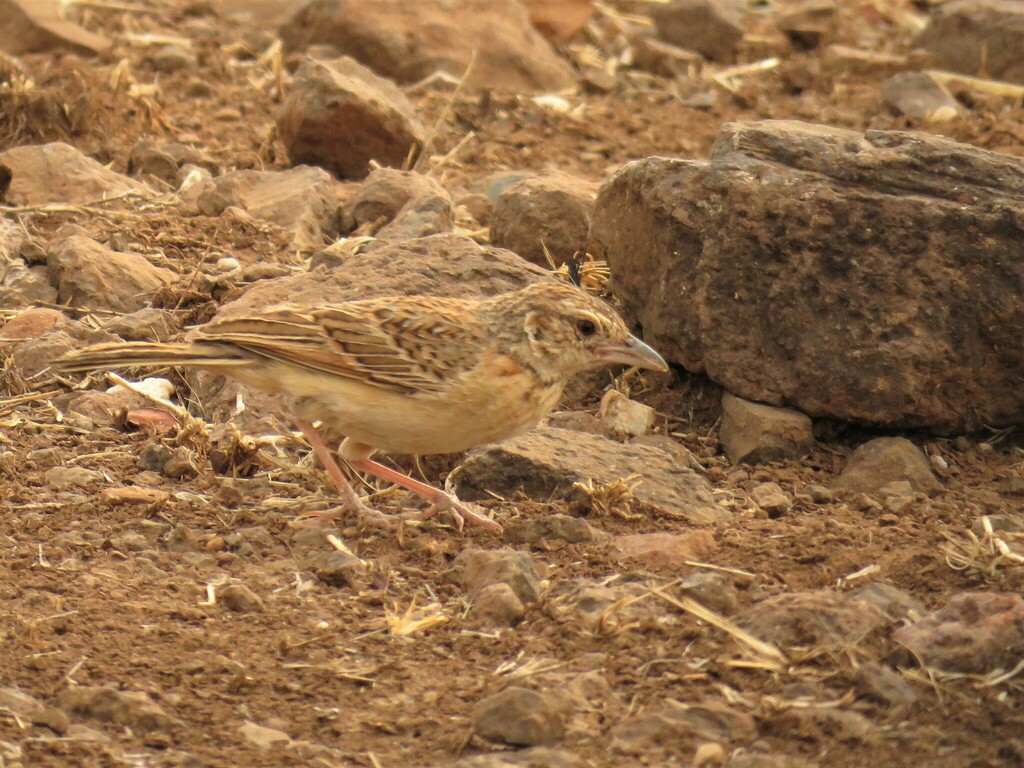
Flappet Lark
Photo © Christiaan Viljoen
Photo © Christiaan Viljoen — CC BY 4.0 — Source: iNaturalist #35940535Identification
The Flappet Lark is a species of lark in the family Alaudidae, widespread across Sub-Saharan Africa. It is a member of a superspecies group that includes the Cape clapper lark and the Eastern clapper lark. The bird's name derives from its most distinctive feature: the characteristic wing-flapping sound it produces during the breeding season, a behavioural display that makes it readily identifiable in the field.
Recent taxonomic revision has placed this species in the genus Amirafra, following molecular genetic analysis published in 2023. Fifteen subspecies are currently recognized across the African continent, reflecting variation in plumage and size across its vast range.
Range & Habitat
The Flappet Lark occupies an enormous range across Sub-Saharan Africa, with a global extent of occurrence estimated at 10 million square kilometres. Its distribution encompasses most of the African continent, with fifteen recognized subspecies reflecting regional populations from Mauritania and Senegal in the west through the Sahel, East Africa, and southern Africa.
The species inhabits dry savannah, moist savannah, and subtropical or tropical dry lowland grassland. This breadth of habitat preference allows the Flappet Lark to thrive across diverse ecological zones, from arid regions to more productive grasslands.
Behaviour & Diet
The Flappet Lark is most notable for its distinctive breeding display, characterized by the vigorous wing-flapping sound that gives the species its English name. This acoustic display is a key component of male territorial and courtship behaviour during the breeding season, and serves as an excellent field marker for identification and locating birds.
As a member of the lark family, the Flappet Lark is adapted to grassland and savannah foraging, though detailed dietary information specific to this species is limited. Like most larks, it likely feeds on insects and seeds, gleaning food from the ground and lower vegetation.
Best Time & Places to See It
The Flappet Lark's extensive range means it can be encountered across much of Sub-Saharan Africa, particularly in savannah and grassland habitats. The breeding season offers the best opportunity for observation, as the male's distinctive wing-flapping display makes them highly conspicuous and audible during this period.
Birders and nature travellers exploring grassland and savannah habitats throughout the continent—from West Africa through the Sahel, East Africa, and southern Africa—should listen for and watch for this characteristic breeding display behaviour, which will greatly aid in locating and confirming the presence of this widespread lark.
Photography Tips
To photograph the Flappet Lark effectively, focus your efforts during the breeding season when males are most active and conspicuous. Position yourself in open grassland and savannah habitats at dawn, when larks are typically most vocal and active. The bird's distinctive wing-flapping display provides excellent opportunities for capturing behavioural photography.
Given the species' preference for open grassland and savannah, wide-angle perspectives that capture the bird in its habitat context can be as rewarding as close-up portraits. Listen carefully for the characteristic wing-flapping sound to locate displaying males, and use this acoustic cue to anticipate and frame your shots. The open nature of grassland habitats generally provides good lighting conditions for photography, particularly in early morning and late afternoon.
Murchison Falls National Park
Queen Elizabeth National Park
Kidepo Valley National Park
Tarangire National Park
Zimanga Private Game Reserve
Nothing matches these filters.
No community photos yet. Log in to add the first one.
No community observations of this species yet.