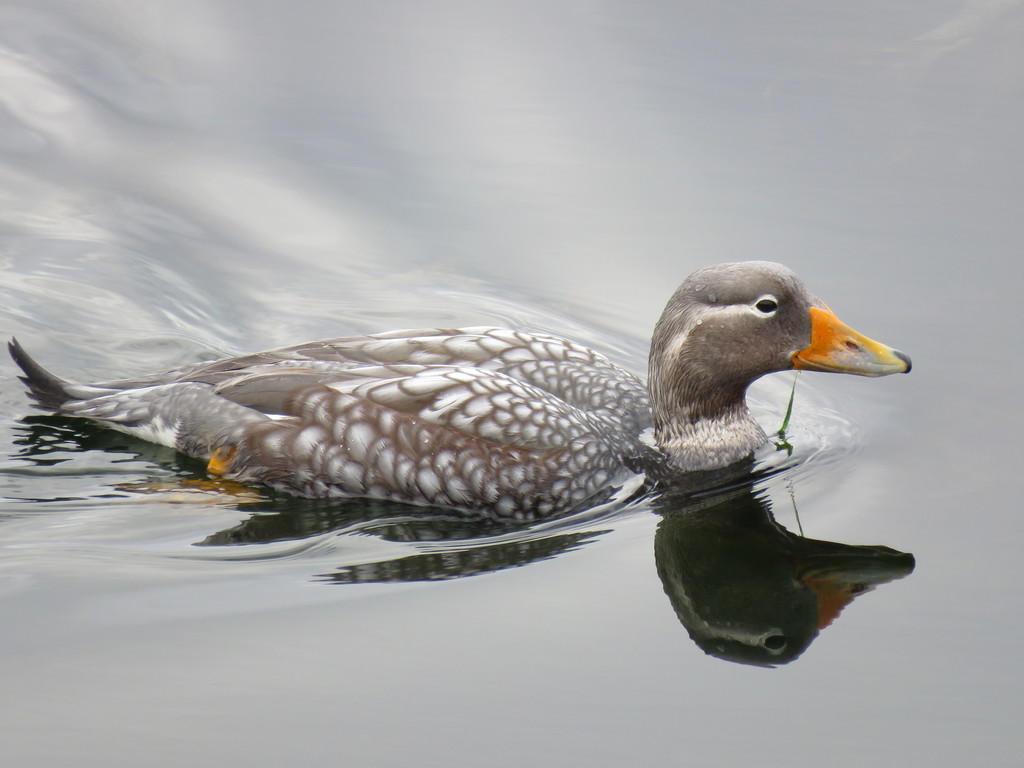
Flying Steamer Duck
Photo © Nicolas Olejnik
Photo © Nicolas Olejnik — CC BY 4.0 — Source: iNaturalist photo #27170322Identification
The flying steamer duck is the smallest of four steamer duck species, distinguished by distinctive plumage featuring a brown head and neck with white stripes running from the eyes to the napes. Their bodies display brown-gray gradient feathers, while their underbellies are predominantly white and their feet are bright orange. Both sexes possess cornified orange carpal knobs on their wings, which they use in displays and combat.
Sexual dimorphism is pronounced in this species. Males are heavier but have smaller heads and wingspans than females. Bills differ between sexes: females have smaller, orange bills with black tips, while males display darker gray bills with slight yellow accents. Their vocalizations are distinctive grunts; females produce lower-pitched calls in rapid succession, while males produce three different grunt types described as whistle-like, including rasping, ticking, and sibilant variants.
Range & Habitat
Flying steamer ducks inhabit the southern tip of South America, occurring in Chile, Argentina, Tierra del Fuego, and the Falkland Islands. Genetic evidence suggests Falkland Island populations diverged from continental populations between 2.2 and 2.6 million years ago, possibly via an ancient land bridge. Unlike their flightless relatives, flying steamer ducks are widely distributed across their range due to their flying capability.
This species is unique among steamer ducks in utilizing both freshwater and marine environments. They are found in diverse aquatic habitats throughout their range, demonstrating greater ecological flexibility than other steamer duck species, which are restricted to coastal or specialized environments.
Behaviour & Diet
Flying steamer ducks are highly social and territorial birds, spending much of their time in pairs and are thought to be mostly monogamous. Their mating ritual is highly ritualized: pairs begin by dipping their bills into water at increasingly rapid paces, followed by the female nearly submerging while being mounted by the male, after which both raise their bills high and grunt audibly. They forage almost exclusively in pairs, diving around deep-water kelp beds or shallow water zones to feed on mollusks, crustaceans, and other marine invertebrates.
These ducks are notoriously aggressive and territorial, often displaying unnecessary hostility toward other species. Males attack opponents by grabbing their necks and striking them with their carpal wing knobs. Flying steamer ducks have been observed attacking entire flocks of grebes and killing Red shovelers apparently without provocation, suggesting their aggression extends beyond resource competition.
Best Time & Places to See It
Flying steamer ducks can be encountered throughout Chile, Argentina, and the Falkland Islands in both freshwater and marine habitats. Their presence in inland freshwater systems—unique among steamer ducks—expands viewing opportunities beyond coastal areas. Look for them in pairs on lakes, rivers, and coastal waters across their South American range.
Photography Tips
The striking orange feet and distinctive head markings make flying steamer ducks visually compelling subjects. Photograph them in pairs to capture their characteristic behavior, and try to capture their ritualized diving and mating displays. The contrast between their brown plumage and white underparts photographs well in both overcast and bright conditions. Their aggressive territorial behavior provides opportunities to photograph combat sequences, though approach cautiously given their pugnacious nature.
Sea Lion Island
Sealion Island Settlement, Falkland Islands
+74 birds+3 mammals
Windswept tussock grasslands roll across volcanic terrain where Southern Ocean swells crash against rocky shores, creating one of the Falkland Islands' most dramatic wildlife theatres. This…
VIEW ISLAND & ARCHIPELAGOKidney Island
Stanley, Falkland Islands
+47 birds
Wind-scoured tussock grassland sweeps across this remote South Atlantic outcrop, where peaty soils and exposed rock formations create a landscape as austere as it is vital.…
VIEW ISLAND & ARCHIPELAGOVolunteer Point
Stanley, Falkland Islands
+70 birds+3 mammals
Windswept grasslands meet volcanic black sand beaches where three penguin species converge in the South Atlantic's most theatrical wildlife theatre. This remote peninsula on East Falkland…
VIEW NATURE RESERVEWest Point Island
West Point, Falkland Islands
+67 birds+3 mammals
Windswept cliffs plunge dramatically into the South Atlantic, their rust-coloured rock faces sculpted by millennia of gales and spray. This northwestern outpost of the Falkland Islands…
VIEW ISLAND & ARCHIPELAGOCabo de Hornos National Park
Cape Horn, Chile
+88 birds+9 mammals
Where the Andes plunge into the Southern Ocean and the Drake Passage churns between two continents, Cabo de Hornos National Park sprawls across one of Earth's…
VIEW NATIONAL PARKTorres del Paine National Park
Torres del Paine, Chile
+143 birds+10 mammals
Where granite spires pierce the Patagonian sky, Torres del Paine commands one of South America's most dramatic landscapes. Across 4,106 square kilometres of southern Chile, jagged…
VIEW NATIONAL PARKLaja National Park Lagoon
Antuco, Chile
+123 birds+1 mammals
Where the Andes descend into the Biobío Region's temperate forests, a vast lagoon fills the caldera of the extinct Antuco volcano, cradled by steep native woodland…
VIEW NATIONAL PARKPuyehue National Park
Puyehue, Chile
+110 birds+4 mammals
Across the volcanic spine of the Los Lagos Region, where the Andes descend toward temperate rainforest, Puyehue National Park encompasses nearly 2,600 square kilometers of one…
VIEW NATIONAL PARKVicente Pérez Rosales National Park
Puerto Varas, Chile
+109 birds+8 mammals
Where the Andes descend toward the temperate rainforests of Chile's Lake District, nearly 4,641 square kilometers of pristine wilderness unfolds across Vicente Pérez Rosales National Park.…
VIEW NATIONAL PARKCerro Castillo National Park
Coyhaique, Chile
+89 birds+3 mammals
Granite peaks and windswept steppe converge across this vast Patagonian landscape, where the Andes' eastern flank drops into terrain sculpted by ice age glaciers and relentless…
VIEW NATIONAL PARKPatagonia National Park
Cochrane, Chile
+133 birds+8 mammals
Where the Andes meet the Patagonian steppe, vast grasslands and shrublands sweep across rolling terrain carved by ancient glaciation, their contours softened by distance and dramatic…
VIEW NATIONAL PARKReserva Nacional Magallanes
Punta Arenas, Chile
+78 birds+2 mammals
Where windswept steppe meets sub-Antarctic forest near the southern tip of continental South America, Reserva Nacional Magallanes unfolds across roughly 352 square kilometres of profound ecological…
VIEW NATIONAL PARKParque Provincial Península de Magallanes
Argentina
+125 birds+4 mammals
Granite peaks and windswept steppe converge across this 415-square-kilometre peninsula jutting into the cold Atlantic waters of southern Patagonia, where the Magallanes landscape embodies the raw,…
VIEW NATIONAL PARKParque Municipal Llao Llao
San Carlos de Bariloche, Argentina
+73 birds+1 mammals
Where the Andes meet the Patagonian lakes, granite peaks rise above temperate rainforest in a landscape of startling contrasts. Parque Municipal Llao Llao, sprawling across 23…
VIEW NATIONAL PARKMonte León National Park
Argentina
+100 birds+4 mammals
Where the Patagonian steppe meets the Atlantic, Monte León National Park protects a landscape of windswept coastal cliffs, rocky outcrops, and semi-arid grassland spanning over 1,200…
VIEW NATIONAL PARKLos Glaciares National Park
Argentina
+121 birds+3 mammals
Where granite peaks and sprawling ice fields dominate the landscape, Los Glaciares National Park encompasses over ten thousand square kilometres of Patagonian wilderness in southern Argentina.…
VIEW NATIONAL PARKPerito Moreno National Park
Argentina
+78 birds
Where the Patagonian steppe descends into a landscape carved by ancient ice, Perito Moreno National Park sprawls across nearly 1,590 square kilometres of some of South…
VIEW NATIONAL PARKNahuel Huapi National Park
Argentina
+124 birds+11 mammals
Where the Andes descend toward Patagonia, vast glacial lakes cut through a landscape of southern beech forest and granite peaks, creating one of South America's most…
VIEW NATIONAL PARKLanín National Park
Argentina
+128 birds+7 mammals
Where the volcanic spine of the Andes plunges into Patagonian steppe, Lanín National Park sprawls across nearly 4,700 square kilometers of one of Argentina's most visually…
VIEW NATIONAL PARKLago Puelo National Park
Argentina
+109 birds+1 mammals
Where temperate forests descend to crystalline waters in the foothills of the Andes, Lago Puelo National Park sprawls across nearly 300 square kilometers of pristine wilderness…
VIEW NATIONAL PARKLos Alerces National Park
Argentina
+84 birds+3 mammals
Where the temperate rainforests of southern Patagonia sweep down towards crystalline lakes, Los Alerces National Park unfolds across nearly 3,000 square kilometres of one of South…
VIEW NATIONAL PARKNo community photos yet. Log in to add the first one.
No community observations of this species yet.