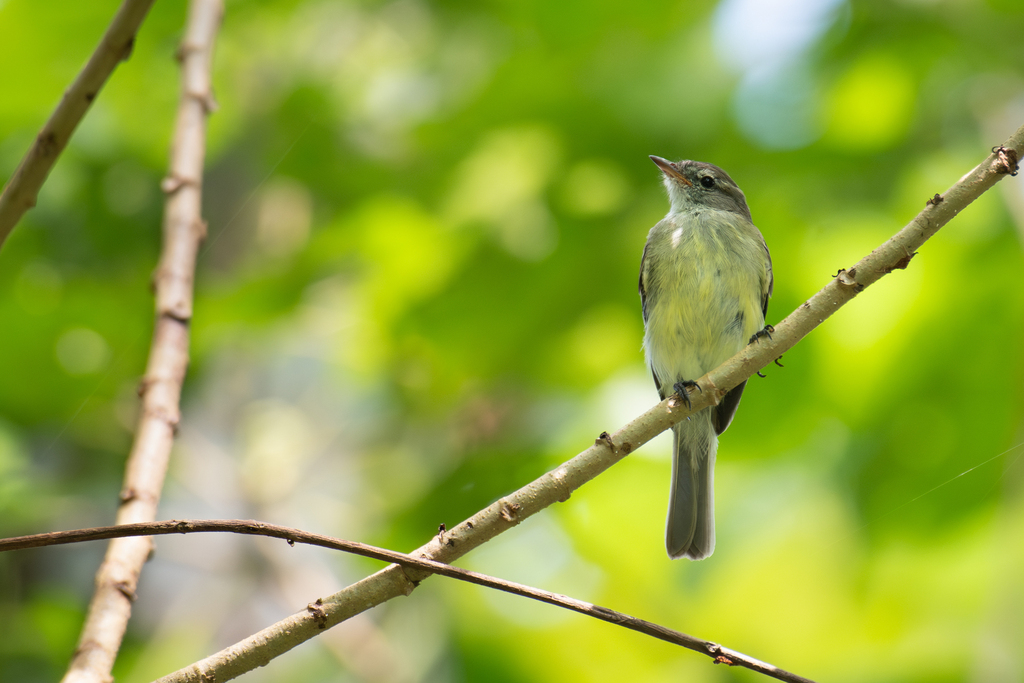
Forest Elaenia
Photo © Rajan Rao
Photo © Rajan Rao — CC BY 4.0 — Source: iNaturalist photo #424661410Identification
The forest elaenia is a diminutive tyrant flycatcher measuring just 12.7 cm in length and weighing a mere 12.2 grams. Despite its small size, it possesses several distinctive field marks that aid identification. The head is particularly characteristic, featuring a blackish crown with a partly concealed white or pale yellow central stripe running down the middle—a feature that becomes visible when the bird is alert. A weak whitish supercilium and prominent white eyering complete the facial pattern. The upperparts are olive-green, while the brown wings are distinguished by yellow feather edging and two conspicuous yellow wing bars. The throat is whitish, transitioning through a greenish-yellow breast to bright yellow on the belly. The long, narrow bill is notably bicoloured, being black on the upper mandible and pink-based below. Males and females are similar in plumage, making sexing difficult in the field.
The Trinidad subspecies, M. g. trinitatis, differs from mainland populations by being larger and displaying duller upper parts, which may aid identification for travellers visiting that island.
Range & Habitat
The forest elaenia has a wide distribution across northern South America, breeding from Panama through Colombia, Venezuela, and the Guianas to Bolivia and Brazil. The species also occurs on the island of Trinidad. This extensive range makes it a likely species encounter across much of tropical South America for well-travelled naturalists.
The species frequents forests and the edges of mangrove swamps, showing a preference for these humid, vegetated habitats. Birds typically nest in trees, constructing shallow cups from roots, bark, and grass. The typical clutch consists of two cream-coloured eggs distinctively marked with rufous and lavender spots.
Behaviour & Diet
Forest elaenias are generally solitary or encountered in pairs, though they are not particularly gregarious birds. They typically perch inconspicuously within the foliage, often in the higher levels of trees, making them somewhat challenging to observe. Like other tyrant flycatchers, they are adept insectivores, sallying out to catch insects and spiders in flight or gleaning them from vegetation.
The species is notably omnivorous, frequently supplementing its diet with berries—a behaviour that may make them more visible to observers during fruiting seasons. They produce a sharp, high-pitched "weep" call that may be the most reliable way to detect their presence in dense foliage.
Best Time & Places to See It
The forest elaenia's breeding range extends across most of northern South America, making it potentially accessible across numerous birding destinations from Panama southward through the Amazon basin. The species' preference for forest and mangrove-edge habitats means that dedicated forest exploration will provide the best opportunities for sightings. Listen for the characteristic sharp "weep" call, which may alert you to the bird's presence before you spot it visually.
Visits during fruiting seasons may increase the likelihood of observing these birds as they become more active when foraging for berries. Trinidad represents an accessible island destination where the endemic larger subspecies may be encountered.
Photography Tips
The forest elaenia's small size, inconspicuous perching habits, and preference for higher foliage levels present challenges for photographers. Position yourself to observe likely perches in forest canopies and wait patiently for the bird to reveal itself. The partly concealed crown stripe and yellow wing bars are diagnostic features worth attempting to capture, as these help distinguish it from similar small flycatchers.
Early morning light filtering through the forest canopy will help illuminate the olive-green upperparts and yellow underparts. Patience is essential; positioning yourself near productive fruit-bearing trees during fruiting seasons may reward you with more active, accessible subjects as they feed.
Emas National Park
Brazil
+333 birds+23 mammals
Across the high plateaux of central Brazil, where the cerrado grasslands roll toward distant horizons under an immense sky, Emas National Park anchors one of South…
VIEW NATIONAL PARKYasuní National Park
Aguarico, Ecuador
+601 birds+43 mammals
Where the western Amazon basin converges with Ecuador's Orellana Province, lowland rainforest reaches toward the horizon in an unbroken canopy of staggering botanical density. Yasuní National…
VIEW NATIONAL PARKNatural Sierra de Chiribiquete National Park
Solano, Colombia
+359 birds+27 mammals
Massive table-top mountains rise abruptly from the lowland rainforest of southeastern Colombia, their sheer sandstone cliffs and isolated summits creating some of the most dramatic topography…
VIEW NATIONAL PARKNatural la Paya National Park
Puerto Leguízamo, Colombia
+262 birds+4 mammals
Where the Amazon's western reaches fold into the Andes foothills, La Paya National Park sprawls across more than 8,500 square kilometers of pristine Amazonian rainforest in…
VIEW NATIONAL PARKNatural el Cocuy National Park
Güicán, Colombia
+313 birds+3 mammals
Where the Andes rise to their highest peaks in Colombia's eastern cordillera, El Cocuy National Park sprawls across more than 6,600 square kilometers of some of…
VIEW NATIONAL PARKMorrocoy National Park
Municipio Silva
+290 birds
Where the Caribbean coast of northwestern Venezuela meets protected coastal waters, a mosaic of mangrove forests, sandy beaches, and coral reef systems defines Morrocoy National Park.…
VIEW NATIONAL PARKEl Tamá National Park
Toledo, Colombia
+435 birds
Where the Andes descend toward the Caribbean coastal lowlands of northern Colombia, El Tamá National Park sprawls across nearly 3,800 square kilometres of montane forest, cloud…
VIEW NATIONAL PARKNatural Sierra de la Macarena National Park
Vista Hermosa, Colombia
+566 birds+15 mammals
Across nearly 20,000 square kilometres of Colombia's Meta Department, the terrain rises from lowland savanna into Andean foothills through a mosaic of gallery forests, palm-fringed wetlands,…
VIEW NATIONAL PARKAmacayacu National Park
Leticia, Colombia
+567 birds+25 mammals
Where the Rio Amazonas curves through the tri-border region where Colombia, Peru, and Brazil converge, Amacayacu National Park sprawls across more than 5,250 square kilometres of…
VIEW NATIONAL PARKViruá National Park
Brazil
+389 birds+6 mammals
Across the northern frontier of Roraima, where the forest canopy rises from ancient Amazonian lowlands, Viruá National Park protects nearly 3,700 square kilometres of terra firme…
VIEW NATIONAL PARKSerra do Pardo National Park
Brazil
+153 birds
Vast upland forests and weathered plateaus define this 7,129-square-kilometre protected expanse in the heart of Pará's remote interior, where ancient bedrock and swollen rivers have carved…
VIEW NATIONAL PARKMonte Roraima National Park
Brazil
+226 birds+1 mammals
Where the tepuis rise from the Amazon basin like islands in a sea of forest, Monte Roraima National Park sprawls across 3,714 square kilometres of one…
VIEW NATIONAL PARKChapada dos Guimarães National Park
Brazil
+450 birds+1 mammals
Where weathered sandstone plateaus rise above the cerrado grasslands of central Brazil, Chapada dos Guimarães National Park protects 624 square kilometres of ecological transition zone that…
VIEW NATIONAL PARKChapada dos Veadeiros National Park
Brazil
+324 birds+6 mammals
Where granite plateaus rise above the cerrado savanna in central Brazil, Chapada dos Veadeiros National Park unfolds across 6,665 square kilometres of some of the world's…
VIEW NATIONAL PARKPantanal Matogrossense National Park
Brazil
+322 birds+17 mammals
Where the flooded forests of central Brazil meet vast seasonally inundated grasslands, Pantanal Matogrossense National Park sprawls across nearly 2,900 square kilometers of one of the…
VIEW NATIONAL PARKBrasília National Park
Plano Piloto, Brazil
+338 birds+15 mammals
Cerrado grassland and scattered woodland sweep across the central Brazilian plateau where this national park sprawls across more than a thousand square kilometres of the Federal…
VIEW NATIONAL PARKAmazônia National Park
Brazil
+439 birds+6 mammals
Where the Rio Amazonas and its tributaries weave through the heart of Pará state, a vast tapestry of rainforest stretches across 23,611 square kilometers of unbroken…
VIEW NATIONAL PARKMapinguari National Park
Brazil
+354 birds
Vast tracts of western Amazonian rainforest blanket the remote terrain of this 56,827 square kilometre national park in Amazonas state, where seasonal rivers wind through dense…
VIEW NATIONAL PARKJaú National Park
Brazil
+354 birds+3 mammals
Vast floodplain forests and blackwater rivers define this remote corner of western Amazonas, where the Rio Negro and its tributaries have carved an intricate mosaic of…
VIEW NATIONAL PARKPacaás Novos National Park
Brazil
+279 birds+1 mammals
Across the border between Rondônia and Amazonas, vast tracts of humid tropical forest rise and fall in gentle undulations, carved by clear-flowing rivers that feed into…
VIEW NATIONAL PARKAnavilhanas National Park
Brazil
+468 birds+8 mammals
Across the Rio Negro in central Amazonas, an archipelago of over a thousand islands rises from the world's largest rainforest river system, creating a labyrinth of…
VIEW NATIONAL PARKCampos Amazónicos National Park
Amazonas, Brazil
+434 birds+7 mammals
Sprawling across the southwestern Amazon basin in Amazonas state, this 27,263-square-kilometre national park encompasses some of the region's most pristine lowland rainforest, where terra firme forest…
VIEW NATIONAL PARKSerra do Divisor National Park
Brazil
+448 birds+10 mammals
Where the western Amazon meets the Andes foothills, Serra do Divisor National Park sprawls across one of South America's most biodiverse and least accessible frontiers. Spanning…
VIEW NATIONAL PARKPico da Neblina National Park
Brazil
+103 birds
Where the Amazon's western rampart rises into perpetual mist, Pico da Neblina National Park sprawls across more than 33,000 square kilometres of some of Earth's least…
VIEW NATIONAL PARKYanachaga–chemillén National Park
Palcazu, Peru
+639 birds+6 mammals
Where the eastern slopes of Peru's central cordillera plunge into cloud forest, Yanachaga–Chemillén National Park protects nearly three thousand square kilometres of montane wilderness that few…
VIEW NATIONAL PARKManu National Park
Manu, Peru
+892 birds+26 mammals
Across the eastern slopes of the Peruvian Andes, tropical rainforest descends into the Amazon basin with a complexity that few terrestrial ecosystems match. Manu National Park…
VIEW NATIONAL PARKSierra del Divisor National Park
Alto Tapiche, Peru
+298 birds+2 mammals
Where the western Amazon meets the Andes foothills, nearly 41,000 square kilometres of pristine rainforest rise across Peru's Alto Tapiche region in a landscape of extraordinary…
VIEW NATIONAL PARKBahuaja Sonene National Park
San Pedro de Putina Punco, Peru
+602 birds+8 mammals
Where the Madre de Dios and Heath rivers converge in southeastern Peru rises one of South America's most biodiverse wilderness regions: a vast protected realm of…
VIEW NATIONAL PARKIchigkat Muja – Cordillera del Cóndor National Park
Río Santiago, Peru
+101 birds
Where the Andes descend into the western Amazon, the Río Santiago carves through a landscape of profound biological complexity. Ichigkat Muja – Cordillera del Cóndor National…
VIEW NATIONAL PARKTingo Maria National Park
Mariano Dámaso Beraún, Peru
+423 birds
Where the eastern slopes of the Peruvian Andes descend toward the Amazon basin, the landscape fractures into a maze of limestone ridges, humid gorges, and cloud-wrapped…
VIEW NATIONAL PARKSoberanía National Park
Cristóbal, Panama
+495 birds+34 mammals
Rainforest and riverine woodland blanket the rolling terrain of this 714-square-kilometre national park in Colón Province, where the Caribbean watershed feeds a maze of streams and…
VIEW NATIONAL PARKChagres National Park
Caimitillo, Panama
+486 birds+19 mammals
Where the Chagres River carves through the humid tropics of central Panama, a vast montane and lowland forest sprawls across more than 2,300 square kilometers, anchoring…
VIEW NATIONAL PARKDarién National Park
Tucutí, Panama
+534 birds+13 mammals
Where the spine of Central America crumbles into wetland and rainforest, Darién National Park sprawls across more than 20,000 square kilometres of some of the tropics'…
VIEW NATIONAL PARKPortobelo National Park
Portobelo, Panama
+366 birds+9 mammals
Where the Caribbean's turquoise waters meet the Darién's verdant shore, Portobelo National Park sprawls across 570 square kilometers of coastal forest, mangrove wetland, and coral-fringed islands…
VIEW NATIONAL PARKNo community photos yet. Log in to add the first one.
No community observations of this species yet.