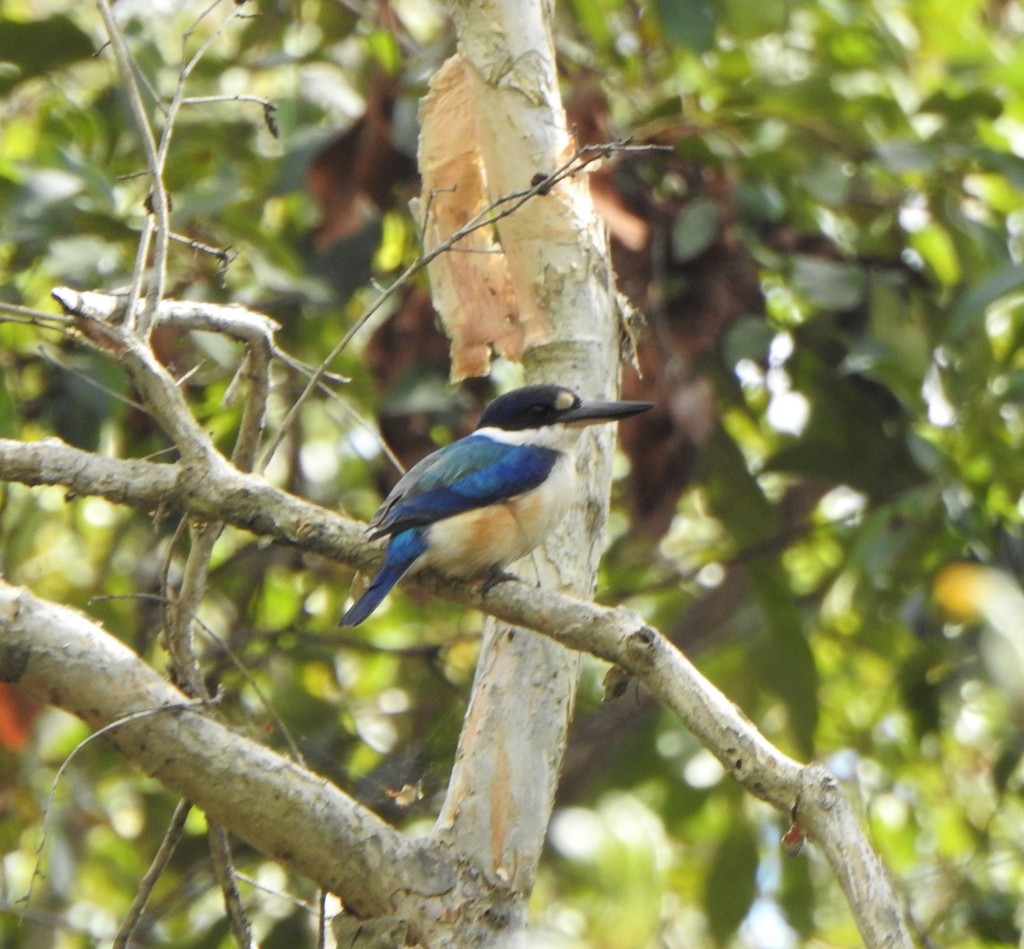
Forest Kingfisher
Photo © Greg Tasney
Photo © Greg Tasney — CC BY-SA 4.0 — Source: iNaturalist #80077938Identification
The Forest Kingfisher is a striking small kingfisher, measuring 21.5–25.5 cm in length. It is predominantly blue and white, with bright blue wings, head and tail contrasting sharply against a white breast, abdomen and nape. A distinctive black band stretches from the bill through the eyes to the ear coverts, with a white patch visible in front of the eyes. In flight, a white patch on the wings is conspicuous. The female can be distinguished from the male by her blue nape rather than white. Immature birds are duller overall with a blackish crown. The dark brown iris, dark grey legs and feet complete the plumage. Its shrill, repeated call—a sharp t-reek—is most often heard in the early morning.
Range & Habitat
The Forest Kingfisher is found across Indonesia, Papua New Guinea, the Solomon Islands, and Australia. In Australia, it inhabits the coastline from Port Stephens in New South Wales northwards to Cape York and westwards across the Top End. It is a summer visitor in southern New South Wales and southern Queensland, but resident year-round elsewhere. Three subspecies are recognised: the nominate T. m. macleayi in Australia's Top End and Gulf of Carpentaria region; T. m. incinctus along Australia's east coast, slightly larger with a greener back tinge; and T. m. elisabeth in eastern New Guinea. The species favours subtropical and tropical dry forests, moist lowland forests, mangrove forests, and Melaleuca swampland.
Behaviour & Diet
This kingfisher is an active hunter, watching from high perches before diving to seize prey from the ground or water in a characteristic sally-pounce, then returning directly to its perch. It often kills prey by striking it against a branch. Its diet is varied, including invertebrates such as bugs, beetles, grasshoppers, spiders, dragonflies, cicadas, ants, and butterflies, as well as worms, small fish, tadpoles, frogs, lizards, and snakes.
Breeding occurs from August to February in Australia, often producing two broods per season. The Forest Kingfisher nests in short burrows within arboreal termite nests, typically 4–12 m above the ground. Clutches of three to six eggs (usually four or five) are incubated by both parents for 18–21 days, with fledglings remaining in the nest for 27–31 days and requiring parental feeding for approximately one month after fledging.
Best Time & Places to See It
Early morning is prime time for encountering Forest Kingfishers, when their shrill calls are most vocal. The species is present year-round in most of its range, though it is a seasonal visitor to southern parts of New South Wales and Queensland. Coastal regions from Port Stephens to Cape York, particularly in mangrove and lowland forest habitats, offer the best opportunities. In Australia's Top End, residents enjoy year-round presence.
Photography Tips
The Forest Kingfisher's vibrant blue and white plumage photographs beautifully in natural light. Position yourself near termite nests in mangrove or forest edges where birds perch prominently while hunting. Early morning light is ideal for capturing the contrast between blue and white plumage and the distinctive black facial band. Watch for the characteristic sally-pounce behaviour, which provides dynamic photo opportunities. Patient observation of high perches overlooking open ground or water will reward attentive photographers with excellent shots of this stunning kingfisher.
Kroombit Tops National Park
Valentine Plains, Australia
+152 birds+6 mammals
Where eucalypt woodlands rise into sandstone plateaus, Kroombit Tops unfolds across nearly 906 square kilometres of northeastern Queensland's most biodiverse terrain. The park's defining feature is…
VIEW NATIONAL PARKCania Gorge National Park
Australia
+131 birds+7 mammals
Where sandstone ridges rise above the Queensland inland plains, Cania Gorge National Park carves a compelling landscape across 51 square kilometres of dry eucalypt woodland and…
VIEW NATIONAL PARKCarnarvon National Park
Philadelphia, Australia
+179 birds+17 mammals
Across 15,000 square kilometres of inland Queensland, rugged sandstone plateaus rise above eucalypt woodlands and open grasslands, carved by creeks that have worn deep gorges into…
VIEW NATIONAL PARKMount Coolum National Park
Sunshine Coast, Australia
+124 birds+3 mammals
Rising abruptly from the hinterland plateau of Queensland's Sunshine Coast, Mount Coolum commands attention as a distinctive volcanic remnant clothed in open eucalypt woodland and heathland…
VIEW NATIONAL PARKNerang National Park
Gold Coast, Australia
+126 birds+13 mammals
Steep subtropical rainforest clads the hinterland ridges of southeast Queensland's Gold Coast, where Nerang National Park sprawls across 34 square kilometres of protected bushland between the…
VIEW NATIONAL PARKHerberton Range National Park
Australia
+115 birds+10 mammals
Rainforest-clad ridges and rocky outcrops define this 324-square-kilometre reserve in far north Queensland, where the mountainous terrain of the Herberton Range rises through layered eucalypt woodland…
VIEW NATIONAL PARKKakadu National Park
Kakadu, Australia
+273 birds+46 mammals
Kakadu National Park is Australia’s largest national park and one of the world’s most remarkable protected areas, covering nearly 20,000 square kilometres in the tropical north…
VIEW NATIONAL PARKDaintree National Park
Dedin, Australia
+362 birds+37 mammals
Daintree National Park is one of the world’s oldest and most biologically diverse tropical rainforests, protecting an extraordinary landscape where ancient forests meet the Great Barrier…
VIEW NATIONAL PARKSpringbrook National Park
Australia
+195 birds+25 mammals
Subtropical rainforest meets open eucalypt woodland across a mountainous terrain where the McPherson Range rises sharply from the Queensland coast, creating a patchwork of microclimates and…
VIEW NATIONAL PARKLamington National Park
Australia
+227 birds+24 mammals
Where subtropical rainforest rises steeply from the Queensland coast, Lamington National Park spreads across 541 square kilometres of one of Australia's most biodiverse mountain landscapes. The…
VIEW NATIONAL PARKSundown National Park
Australia
+211 birds+9 mammals
Granite ridges and eucalypt woodlands define this 305-square-kilometre expanse of southeastern Queensland, where the landscape descends from sandstone plateaus into open forests and grassy clearings that…
VIEW NATIONAL PARKGheebulum Kunungai National Park
Moreton Island, Australia
+168 birds+7 mammals
Sand dunes rise and fall across Moreton Island's eastern shore, a landscape sculpted by wind and ocean currents into one of Australia's most dynamic coastal ecosystems.…
VIEW NATIONAL PARKAnnan River (Yuku Baja-Muliku) National Park
Australia
+78 birds
Where the Annan River winds through northeastern Queensland's coastal hinterland, a compact national park of roughly 246 square kilometers protects a mosaic of subtropical rainforest, eucalypt…
VIEW NATIONAL PARKEndeavour River National Park
Philadelphia, Australia
+203 birds+1 mammals
Where the Endeavour River winds through northeastern Queensland's tropical lowlands, a compact mosaic of rainforest, open woodland, and riverine corridor creates one of Australia's most ecologically…
VIEW NATIONAL PARKRinyirru National Park
Lakefield, Australia
+258 birds+7 mammals
Where the savanna grasslands of far north Queensland meet seasonal wetlands and eucalypt woodlands, Rinyirru National Park sprawls across more than 12,500 square kilometres of rugged,…
VIEW NATIONAL PARKGirraween National Park
Australia
+193 birds+21 mammals
Granite boulders rise like the bones of the earth across these 278 square kilometres of southeastern Queensland, where the Great Dividing Range descends towards the coastal…
VIEW NATIONAL PARKMorton National Park
Australia
+253 birds+57 mammals
Across nearly 4,800 square kilometers of New South Wales's Southern Tablelands, rugged sandstone plateaus rise above sheltered valleys where cool-climate eucalypt woodland meets grassy heath and…
VIEW NATIONAL PARKGlass House Mountains National Park
Australia
+151 birds+8 mammals
Conical peaks of volcanic origin rise dramatically from the coastal lowlands of southeastern Queensland, their weathered slopes cloaked in eucalyptus woodland and open sclerophyll forest that…
VIEW NATIONAL PARKBribie Island National Park
Brisbane, Australia
+284 birds+20 mammals
Across tidal flats and shallow waterways north of Brisbane, Bribie Island National Park spreads across nearly four hundred square kilometres of subtropical coastal wilderness—a patchwork of…
VIEW NATIONAL PARKWhitsunday Islands National Park
Whitsundays, Australia
+163 birds+9 mammals
Crystalline waters lap against seventy-four islands where rainforest canopies tumble down to pristine beaches and coral gardens flourish in the shallows. This archipelago off Queensland's coast…
VIEW NATIONAL PARKLitchfield National Park
Australia
+175 birds+15 mammals
Where weathered sandstone plateaus rise above the savanna woodlands of Australia's Top End, Litchfield National Park unfolds as a landscape of dramatic contrasts shaped by a…
VIEW NATIONAL PARKNitmiluk National Park
Australia
+186 birds+27 mammals
Dramatic sandstone gorges carved by the Katherine River slice through the tropical savanna of Australia's Top End, creating a landscape where escarpments tower above crystalline pools…
VIEW NATIONAL PARKGreat Sandy National Park
Australia
+306 birds+40 mammals
Where coastal dunes rise inland from the Queensland coastline, Great Sandy National Park encompasses a landscape of remarkable ecological diversity shaped by subtropical humid conditions year-round.…
VIEW NATIONAL PARKGirringun National Park
Australia
+231 birds+10 mammals
Where granite gorges cleave through subtropical woodland in North Queensland, Girringun National Park unfolds across rugged terrain shaped by millions of years of weathering and erosion.…
VIEW NATIONAL PARKWooroonooran National Park
Australia
+240 birds+28 mammals
Where the Great Dividing Range rises sharply inland from Queensland's tropical coast, Wooroonooran National Park encompasses a landscape of steep, forested gorges and cascading waterways carved…
VIEW NATIONAL PARKNoosa National Park
Marcus Beach, Australia
+216 birds+8 mammals
Subtropical eucalypt woodland and open forest meet coastal heathland along the Noosa Peninsula, where the temperate waters of the Tasman current moderate the Queensland climate into…
VIEW NATIONAL PARKKosciuszko National Park
Australia
+211 birds+52 mammals
Where the Great Dividing Range reaches its highest peaks in southeastern Australia, Kosciuszko National Park encompasses a landscape of windswept plateaus, rocky ridges, and deep river…
VIEW NATIONAL PARKDorrigo National Park
Gleniffer, Australia
+172 birds+17 mammals
Where subtropical rainforest transitions into cool temperate woodland, Dorrigo National Park rises across the volcanic tablelands of far northern New South Wales, cloaked in the perpetually…
VIEW NATIONAL PARKNo community photos yet. Log in to add the first one.
No community observations of this species yet.