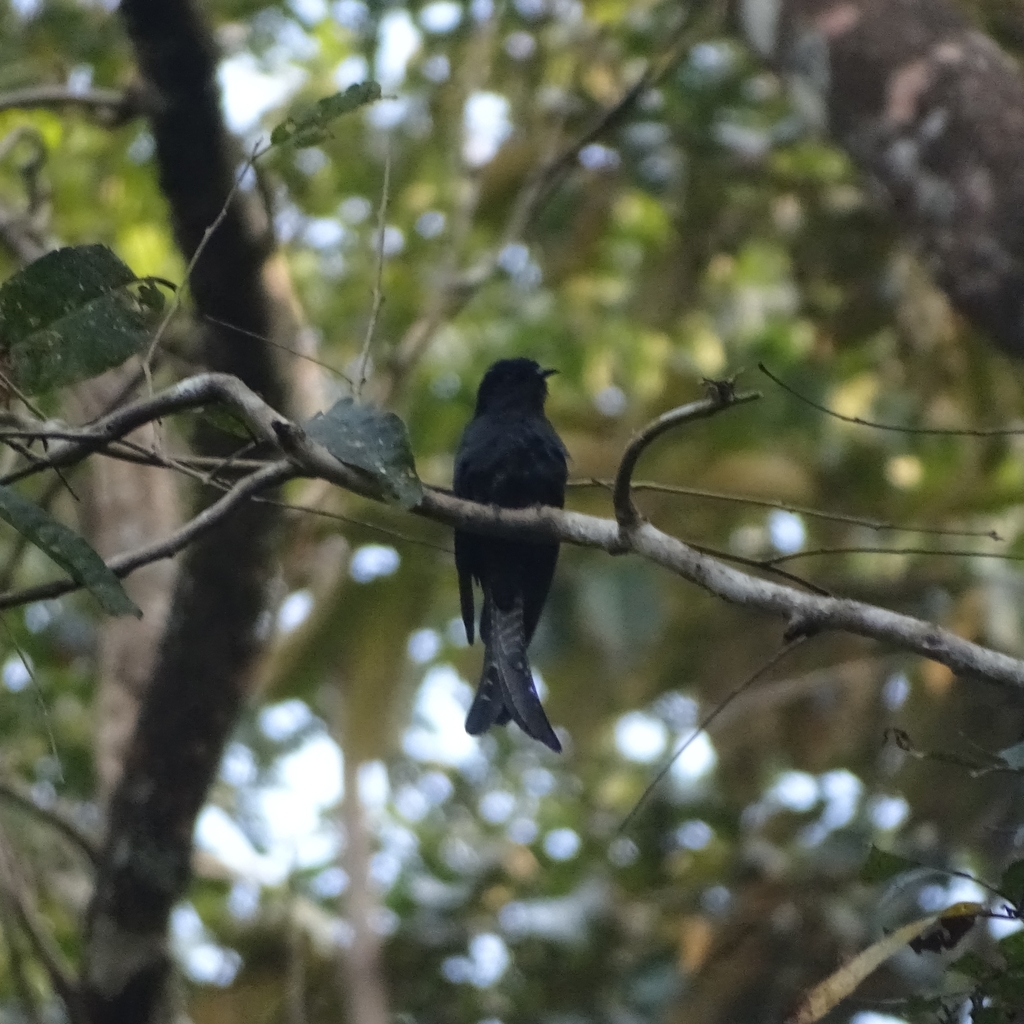
Fork-tailed Drongo-Cuckoo
Photo © renjus box
Photo © renjus box — CC BY 4.0 — Source: iNaturalist #47237142Identification
The Fork-tailed Drongo-Cuckoo is a small, glossy black cuckoo measuring 24.5–26 cm in length. Its most distinctive features are its metallic blue to purple or greenish-black plumage, deeply forked tail with narrow white bars, straight-to-slightly-curved bill, and a characteristic white spot on the back of the head. Look for a thin horizontal white stripe in the underwing, visible only in flight. The bill is black with an orange mouth lining, while tarsi and toes are black, bluish-grey, or pinkish. Juveniles are readily distinguished by white spots scattered across the head, wings, and breast, plus scattered brown feathers.
The species closely resembles the Black Drongo, but differs in its characteristic forked tail shape and smoother, more direct flight pattern—Black Drongos perform more acrobatic, swooping maneuvers. It is sometimes confused with the similar Square-tailed Drongo-Cuckoo, though the Fork-tailed species has a more forked tail and different call frequencies. Both subspecies lack sexual dimorphism.
Range & Habitat
The Fork-tailed Drongo-Cuckoo is mainly found in peninsular India and Sri Lanka, though some specimens occur in the Himalayan foothills. In Sri Lanka, birds are largely resident with possible local migrations. In India, the species exhibits both resident and migratory populations, with some individuals year-round in Kerala and Goa, while others migrate seasonally—moving south to Kerala and Karnataka in winter and north to central India, Maharashtra, Rajasthan, and the Eastern Ghats in summer. The species has also been recorded as a migrant in Nepal, East Pakistan, southern China, Tenasserim, Thailand, and Sumatra.
The species inhabits a variety of habitats including woodland and scrub jungle, though it shows a marked preference for hill forests where it is most commonly encountered.
Behaviour & Diet
The Fork-tailed Drongo-Cuckoo is a brood parasite, laying its eggs in the nests of small babblers rather than raising its own young. Its resemblance to the Black Drongo is suspected to aid in this parasitic strategy, similar to how hawk-cuckoos mimic hawks to facilitate their breeding success, though the exact mechanism remains unclear.
Vocally, the species is distinctive. Its song consists of a series of 5–6 whistling "pip-pip-pip-pip-pip-" notes that rise in pitch with each call. In flight, it produces drongo-like "quip" calls, and delivers "wheep-wheep" calls with a characteristically higher second note. In Sri Lanka, it also mimics calls similar to the Sri Lanka Drongo.
Best Time & Places to See It
The Fork-tailed Drongo-Cuckoo is best observed in hill forests of peninsular India and Sri Lanka. In India, seasonal migrants are most readily found in their preferred regions during their respective seasons—southern areas like Kerala and Karnataka in winter, and central India, Maharashtra, Rajasthan, and the Eastern Ghats in summer. In Sri Lanka, the species is present year-round as a resident.
As a brood parasite of small babblers in forested habitats, patience and careful listening to its distinctive vocalizations are essential for locating this species. Early morning hours typically offer the best viewing opportunities when the bird is most vocal.
Photography Tips
Photographing the Fork-tailed Drongo-Cuckoo presents a moderate challenge given its preference for forest habitats and somewhat elusive nature. The bird's glossy black plumage requires careful exposure metering to avoid blown highlights; underexpose slightly to retain detail in the metallic sheen. The forked tail is a key identifying feature, so aim for shots that clearly show the tail's distinctive fork shape and any visible white bars.
The thin horizontal white stripe in the underwing is only visible in flight, making action shots particularly valuable. Use a fast shutter speed to freeze its direct, smooth flight pattern. The white spot on the back of the head and white barring on the vent are also diagnostic—try to capture these details when the bird is perched. Early morning light in hill forests will help illuminate the metallic quality of the plumage and make identification features more apparent.
Lunugamvehera National Park
Sri Lanka
+204 birds+14 mammals
Dry scrubland and shallow wetlands converge in Sri Lanka's southeastern lowlands, where Lunugamvehera National Park anchors one of the island's most ecologically vital landscapes. The park's…
VIEW NATIONAL PARKWasgamuwa National Park
Sri Lanka
+156 birds+8 mammals
Dry deciduous forest and open grassland sweep across the North Central lowlands where Wasgamuwa National Park protects one of Sri Lanka's largest remaining tracts of this…
VIEW NATIONAL PARKMaduru Oya National Park
Sri Lanka
+74 birds+1 mammals
Granite ridges rise abruptly from the humid lowlands of Sri Lanka's Uva Province, their weathered slopes clothed in dry monsoon forest and scattered woodland where deciduous…
VIEW NATIONAL PARKRanthambhore National Park
Sawai Madhopur, India
+294 birds+20 mammals
Granite ridges and ravines carved through the Aravalli Range frame this protected landscape in eastern Rajasthan, where deciduous forest mingles with open scrubland and seasonal water…
VIEW NATIONAL PARKKanha Tiger Reserve
Kanha Kisli F.V., India
+321 birds+23 mammals
Where sal forests give way to emerald meadows and crystalline streams carve through ancient valleys, one of India's finest wilderness reserves unfolds across the Maikal Range.…
VIEW NATIONAL PARKTadoba National Park
Palasgaon Singru, India
+270 birds+20 mammals
Where sal forests meet open grasslands and rocky outcrops rise from red laterite soil, central India's landscape unfolds in raw, untamed beauty. Ancient teak woodlands and…
VIEW NATIONAL PARKBandhavgarh National Park
Garhpuri, India
+285 birds+17 mammals
Where granite ridges rise dramatically above sal and bamboo forests, one of India's most pristine tiger reserves unfolds across the Vindhyan plateau. Ancient rock formations tower…
VIEW NATIONAL PARKPeriyar National Park
Mlappara, India
+232 birds+4 mammals
Dawn breaks over mist-shrouded ridges where the Western Ghats tumble toward Kerala's spice-scented lowlands. Here, ancient tropical forests envelope a glittering artificial lake, creating a mosaic…
VIEW NATIONAL PARKPampadum Shola National Park
Vattavada, India
+258 birds+14 mammals
Where misty shola forests cling to the high plateaus of the Nilgiri Mountains, ancient evergreen remnants create a world apart. This 2,316-hectare reserve protects one of…
VIEW NATIONAL PARKBandipur National Park
Hirehalli, India
+302 birds+19 mammals
Where the Western Ghats descend into the Deccan plateau, ancient deciduous forests blanket a landscape carved by the Nugu River. Bandipur unfolds across 880 square kilometres…
VIEW NATIONAL PARKNagarahole Tiger Reserve
Nalkeri Forest, India
+323 birds+23 mammals
Where granite escarpments rise above dense deciduous forests and the Kabini River carves through pristine wilderness, one of India's most biodiverse landscapes unfolds across the Western…
VIEW NATIONAL PARKNo community photos yet. Log in to add the first one.
No community observations of this species yet.