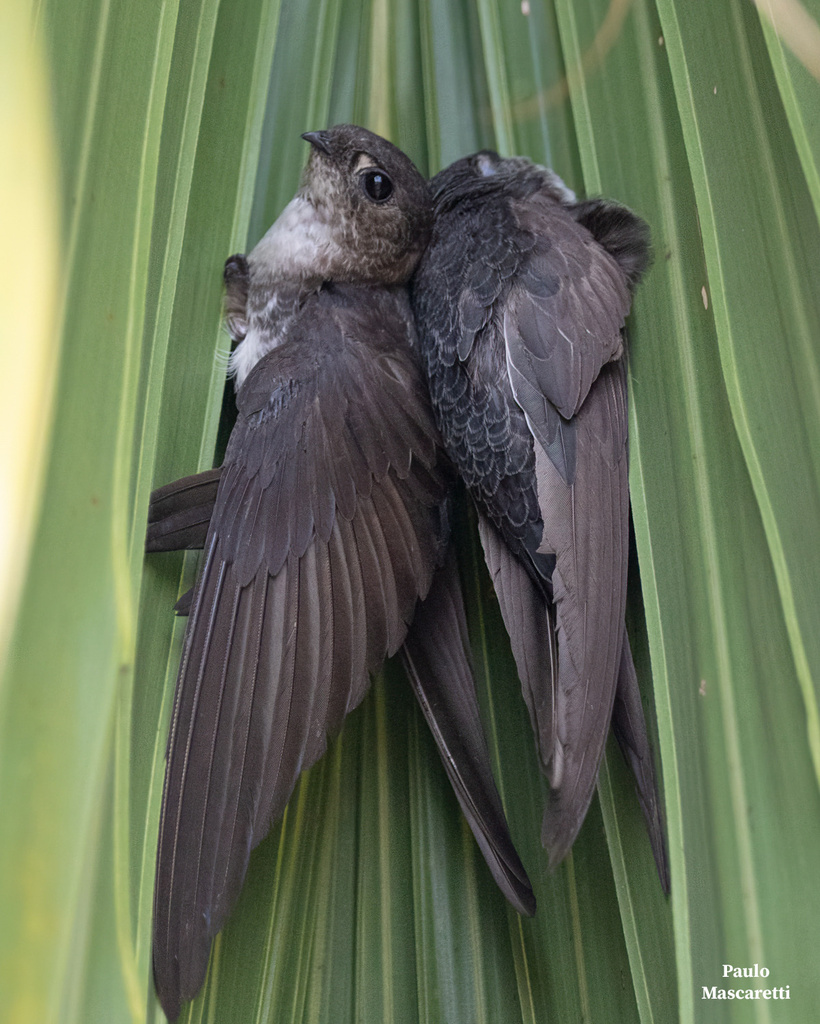
Fork-tailed Palm Swift
Photo © Paulo Mascaretti
Photo © Paulo Mascaretti — CC0 1.0 — Source: iNaturalist photo #336191112Identification
The fork-tailed palm swift is a tiny swift, measuring just 13 cm in length and weighing only 9 to 13.6 grams. Its most distinctive feature is its long, deeply forked tail, which is immediately recognizable in flight. The bird has characteristically long, narrow wings typical of swifts built for sustained aerial hunting. Males and females look identical, displaying blackish-brown upperparts with a slight greenish gloss and pale gray feather edges, while the rump is slightly paler. The cheeks are grayish-brown, and the throat is very pale brownish-white with dusky mottling. Underparts are pale with light brown mottling that is sparsest on the belly. The darker subspecies, T. s. semota, found in Trinidad, Tobago, the Guianas, and parts of Brazil, has blacker upperparts and darker underparts with less pale edging.
Juveniles resemble adults but show a buff tinge to the head and buffy edges on their feathers. The species belongs to the swift family Apodidae and should not be confused with the Old World palm swifts of the genus Cypsiurus found in Africa, Madagascar, and Asia.
Range & Habitat
The fork-tailed palm swift is found across most of northern South America and on the Caribbean islands of Trinidad and Tobago. The nominate subspecies T. s. squamata ranges throughout the Amazon Basin from northern Bolivia, eastern Peru, and eastern Ecuador through eastern Colombia and northwestern Brazil into southern and eastern Venezuela. The darker subspecies T. s. semota occurs on Trinidad, Tobago, in the Guianas, and in north-central, northeastern, and eastern Brazil.
This is a lowland species that occurs at elevations up to approximately 1,000 meters. It favors landscapes with abundant palm trees, particularly moriche palms, including moist and wet savannas, palm swamps, riparian forests, and urban areas. Remarkably adaptable, the species has benefited from the planting of decorative palms in human settlements, which provide additional nesting sites.
Behaviour & Diet
The fork-tailed palm swift is a year-round resident throughout its range and is strictly aerial, feeding on insects caught in flight like all swifts. These birds forage in small flocks of up to 10 individuals and have a highly varied diet encompassing insects from at least nine different orders. However, geographic and seasonal variation appears significant; in some areas, ants and termites comprise almost the entire diet, suggesting dietary flexibility based on local conditions.
Breeding seasons vary geographically, occurring from April to June on Trinidad and September to November in central Brazil. The swift nests exclusively in palm trees, most frequently in Mauritia flexuosa but also in other species including introduced ornamental palms. Its remarkable nest is a disorderly, elongated clump of feathers bound together with saliva, suspended from a dangling dead palm frond with a bottom entrance. Feathers are collected by plucking them from birds in flight, particularly pigeons and parrots, though birds from at least 21 families have been targeted. Clutches contain three eggs and are incubated for approximately 21 days.
Best Time & Places to See It
The fork-tailed palm swift is a permanent resident wherever it occurs, so it can be encountered year-round throughout its range. However, breeding seasons vary by location—visit Trinidad and Tobago between April and June, or central Brazil from September to November to observe nesting behavior. Look for these birds in palm-rich habitats including savannas, palm swamps, riparian forests, and even parks and gardens with palm plantings in towns and cities. Small flocks are often active in early morning hours and again in the late afternoon.
Photography Tips
Photographing this tiny, fast-moving swift presents a genuine challenge. Its small size, rapid flight, and forked tail make it demanding but rewarding to capture. Position yourself near palm groves or urban areas with palm trees, particularly moriche palms, where birds are likely to forage. Early morning and late afternoon sessions will reward patient photographers with more activity. Listen for the birds' distinctive flight calls—described as trilling "trrrrreeeee," buzzy "d-z-z-z-z-z," or thin buzzing sounds—to locate flocks. Fast shutter speeds and continuous autofocus are essential for tracking these agile insectivores in flight. The bird's long forked tail and narrow wings are key identifying features to capture in images.
Emas National Park
Brazil
+333 birds+23 mammals
Across the high plateaux of central Brazil, where the cerrado grasslands roll toward distant horizons under an immense sky, Emas National Park anchors one of South…
VIEW NATIONAL PARKYasuní National Park
Aguarico, Ecuador
+601 birds+43 mammals
Where the western Amazon basin converges with Ecuador's Orellana Province, lowland rainforest reaches toward the horizon in an unbroken canopy of staggering botanical density. Yasuní National…
VIEW NATIONAL PARKNatural Sierra de Chiribiquete National Park
Solano, Colombia
+359 birds+27 mammals
Massive table-top mountains rise abruptly from the lowland rainforest of southeastern Colombia, their sheer sandstone cliffs and isolated summits creating some of the most dramatic topography…
VIEW NATIONAL PARKNatural la Paya National Park
Puerto Leguízamo, Colombia
+262 birds+4 mammals
Where the Amazon's western reaches fold into the Andes foothills, La Paya National Park sprawls across more than 8,500 square kilometers of pristine Amazonian rainforest in…
VIEW NATIONAL PARKMorrocoy National Park
Municipio Silva
+290 birds
Where the Caribbean coast of northwestern Venezuela meets protected coastal waters, a mosaic of mangrove forests, sandy beaches, and coral reef systems defines Morrocoy National Park.…
VIEW NATIONAL PARKNatural Sierra de la Macarena National Park
Vista Hermosa, Colombia
+566 birds+15 mammals
Across nearly 20,000 square kilometres of Colombia's Meta Department, the terrain rises from lowland savanna into Andean foothills through a mosaic of gallery forests, palm-fringed wetlands,…
VIEW NATIONAL PARKAmacayacu National Park
Leticia, Colombia
+567 birds+25 mammals
Where the Rio Amazonas curves through the tri-border region where Colombia, Peru, and Brazil converge, Amacayacu National Park sprawls across more than 5,250 square kilometres of…
VIEW NATIONAL PARKUbajara National Park
Brazil
+122 birds+1 mammals
Granite peaks rise sharply from the humid tropical forests of northeastern Brazil, where Ubajara's 234 square kilometres straddle the transition between Atlantic rainforest and drier cerrado…
VIEW NATIONAL PARKViruá National Park
Brazil
+389 birds+6 mammals
Across the northern frontier of Roraima, where the forest canopy rises from ancient Amazonian lowlands, Viruá National Park protects nearly 3,700 square kilometres of terra firme…
VIEW NATIONAL PARKSerra do Teixeira National Park
Brazil
+160 birds+5 mammals
Rugged plateaus and deep escarpments define this 3,112-square-kilometre sweep of the Brazilian Northeast, where the crystalline bedrock of the Borborema Plateau rises abruptly from the surrounding…
VIEW NATIONAL PARKSete Cidades National Park
Brazil
+125 birds+1 mammals
Sete Cidades sprawls across 113 square kilometres of northeastern Brazil's interior plateau, where weathered sandstone formations rise dramatically from the cerrado landscape. The park's geology tells…
VIEW NATIONAL PARKChapada dos Guimarães National Park
Brazil
+450 birds+1 mammals
Where weathered sandstone plateaus rise above the cerrado grasslands of central Brazil, Chapada dos Guimarães National Park protects 624 square kilometres of ecological transition zone that…
VIEW NATIONAL PARKChapada dos Veadeiros National Park
Brazil
+324 birds+6 mammals
Where granite plateaus rise above the cerrado savanna in central Brazil, Chapada dos Veadeiros National Park unfolds across 6,665 square kilometres of some of the world's…
VIEW NATIONAL PARKLençóis Maranhenses National Park
Brazil
+98 birds+2 mammals
Where white sand dunes rise in dramatic ridges across a coastal lowland, Lençóis Maranhenses National Park reveals one of Brazil's most otherworldly landscapes. Spanning 3,670 square…
VIEW NATIONAL PARKChapada Diamantina National Park
Brazil
+346 birds+5 mammals
Where granite peaks and sandstone cliffs rise abruptly from the Brazilian interior, Chapada Diamantina National Park sprawls across 4,215 square kilometers of some of Brazil's most…
VIEW NATIONAL PARKCatimbau National Park
Brazil
+118 birds+6 mammals
Where sandstone plateaus rise from the semi-arid scrublands of northeastern Brazil, Catimbau National Park unfolds across more than 1,000 square kilometres of geological drama and surprising…
VIEW NATIONAL PARKBrasília National Park
Plano Piloto, Brazil
+338 birds+15 mammals
Cerrado grassland and scattered woodland sweep across the central Brazilian plateau where this national park sprawls across more than a thousand square kilometres of the Federal…
VIEW NATIONAL PARKAmazônia National Park
Brazil
+439 birds+6 mammals
Where the Rio Amazonas and its tributaries weave through the heart of Pará state, a vast tapestry of rainforest stretches across 23,611 square kilometers of unbroken…
VIEW NATIONAL PARKMapinguari National Park
Brazil
+354 birds
Vast tracts of western Amazonian rainforest blanket the remote terrain of this 56,827 square kilometre national park in Amazonas state, where seasonal rivers wind through dense…
VIEW NATIONAL PARKJaú National Park
Brazil
+354 birds+3 mammals
Vast floodplain forests and blackwater rivers define this remote corner of western Amazonas, where the Rio Negro and its tributaries have carved an intricate mosaic of…
VIEW NATIONAL PARKAnavilhanas National Park
Brazil
+468 birds+8 mammals
Across the Rio Negro in central Amazonas, an archipelago of over a thousand islands rises from the world's largest rainforest river system, creating a labyrinth of…
VIEW NATIONAL PARKSerra do Divisor National Park
Brazil
+448 birds+10 mammals
Where the western Amazon meets the Andes foothills, Serra do Divisor National Park sprawls across one of South America's most biodiverse and least accessible frontiers. Spanning…
VIEW NATIONAL PARKYanachaga–chemillén National Park
Palcazu, Peru
+639 birds+6 mammals
Where the eastern slopes of Peru's central cordillera plunge into cloud forest, Yanachaga–Chemillén National Park protects nearly three thousand square kilometres of montane wilderness that few…
VIEW NATIONAL PARKManu National Park
Manu, Peru
+892 birds+26 mammals
Across the eastern slopes of the Peruvian Andes, tropical rainforest descends into the Amazon basin with a complexity that few terrestrial ecosystems match. Manu National Park…
VIEW NATIONAL PARKSierra del Divisor National Park
Alto Tapiche, Peru
+298 birds+2 mammals
Where the western Amazon meets the Andes foothills, nearly 41,000 square kilometres of pristine rainforest rise across Peru's Alto Tapiche region in a landscape of extraordinary…
VIEW NATIONAL PARKBahuaja Sonene National Park
San Pedro de Putina Punco, Peru
+602 birds+8 mammals
Where the Madre de Dios and Heath rivers converge in southeastern Peru rises one of South America's most biodiverse wilderness regions: a vast protected realm of…
VIEW NATIONAL PARKIchigkat Muja – Cordillera del Cóndor National Park
Río Santiago, Peru
+101 birds
Where the Andes descend into the western Amazon, the Río Santiago carves through a landscape of profound biological complexity. Ichigkat Muja – Cordillera del Cóndor National…
VIEW NATIONAL PARKTingo Maria National Park
Mariano Dámaso Beraún, Peru
+423 birds
Where the eastern slopes of the Peruvian Andes descend toward the Amazon basin, the landscape fractures into a maze of limestone ridges, humid gorges, and cloud-wrapped…
VIEW NATIONAL PARKCordillera Azul National Park
Pampa Hermosa, Peru
+322 birds+1 mammals
Where the eastern Andes descend into the western Amazon basin, Cordillera Azul National Park sprawls across nearly 38,000 square kilometres of some of Peru's most pristine…
VIEW NATIONAL PARKNo community photos yet. Log in to add the first one.
No community observations of this species yet.