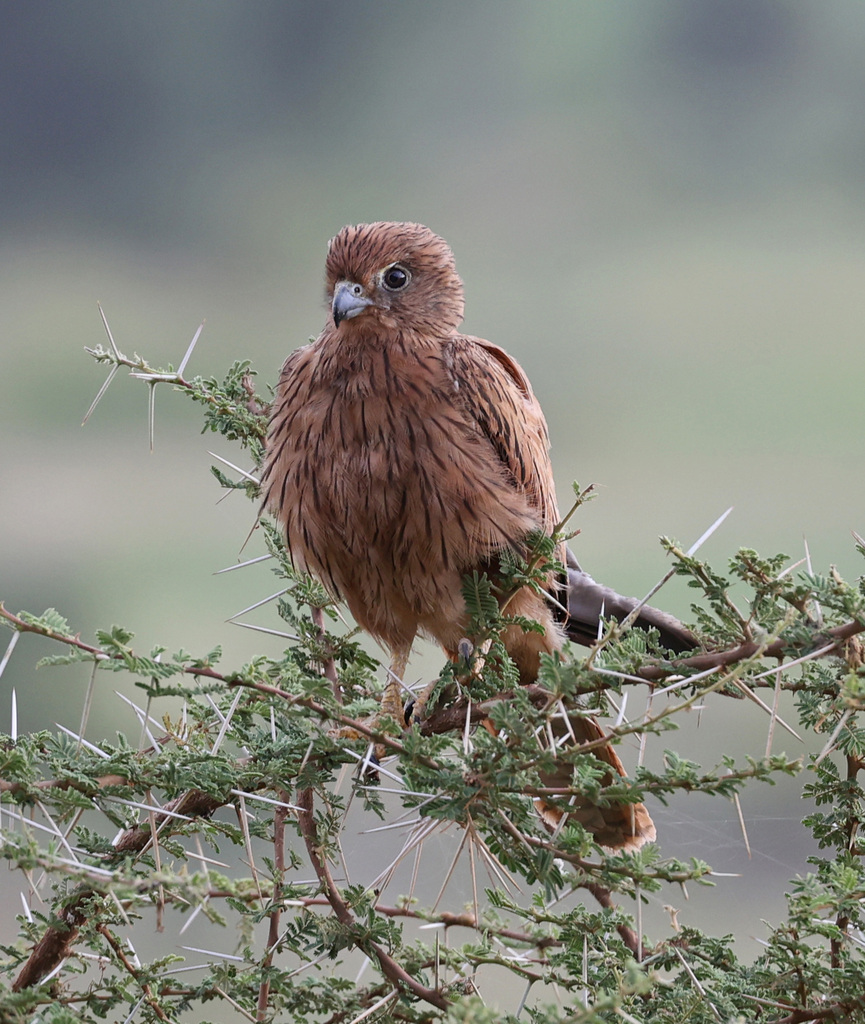
Fox Kestrel
Photo © alanbedfordshaw
Photo © alanbedfordshaw — CC BY-SA 4.0 — Source: iNaturalist #343150133The fox kestrel (Falco alopex) is a bird of prey belonging to the falcon family Falconidae. It is found in arid, open country in the northern part of Sub-Saharan Africa. == Description == It is a large, slender kestrel with long, narrow wings and tail. It is 32–38 cm (13–15 in) long with a wingspan of 76–88 cm (30–35 in) and a weight of 250–300 g (8.8–10.6 oz). The female is 3% larger than the male. The plumage is dark rufous above and below with black streaks. The tail is narrowly barred with black while the flight feathers of the wing are dark and unbarred. The underwings are pale, contrasting with the darker body. The eye is yellow-brown unlike the similar greater kestrel which has whitish eyes as well as paler plumage, barred flight feathers and grey on the tail. Juvenile fox kestrels have heavier streaking than the adults and clearer barring on the tail. The species has a high, screeching call, but is usually silent outside the breeding season. == Habitat and range == It breeds in the savanna region south of the Sahara from Mali eastwards as far as Ethiopia and north-west Kenya. It occasionally wanders west to…
Kidepo Valley National Park
Uganda
+478 birds+24 mammals
Where the Narus and Kidepo rivers carve through northeastern Uganda's semi-arid lowlands, a landscape of sparse acacia woodland, grassland, and riverine thickets creates one of East…
VIEW NATIONAL PARKAwash National Park
Didiga, Ethiopia
+473 birds+23 mammals
Where the Ethiopian Rift Valley carves through volcanic plateaus, a ribbon of riverine forest winds through acacia scrubland and grassland, creating a mosaic of habitats that…
VIEW NATURAL PARKLake Nakuru National Park
Nakuru West, Kenya
+494 birds+32 mammals
Alkaline waters ringed by acacia woodland and grassland create one of East Africa's most distinctive wetland ecosystems, where the interplay of geology and climate sustains a…
VIEW NATIONAL PARKNo community photos yet. Log in to add the first one.
No community observations of this species yet.