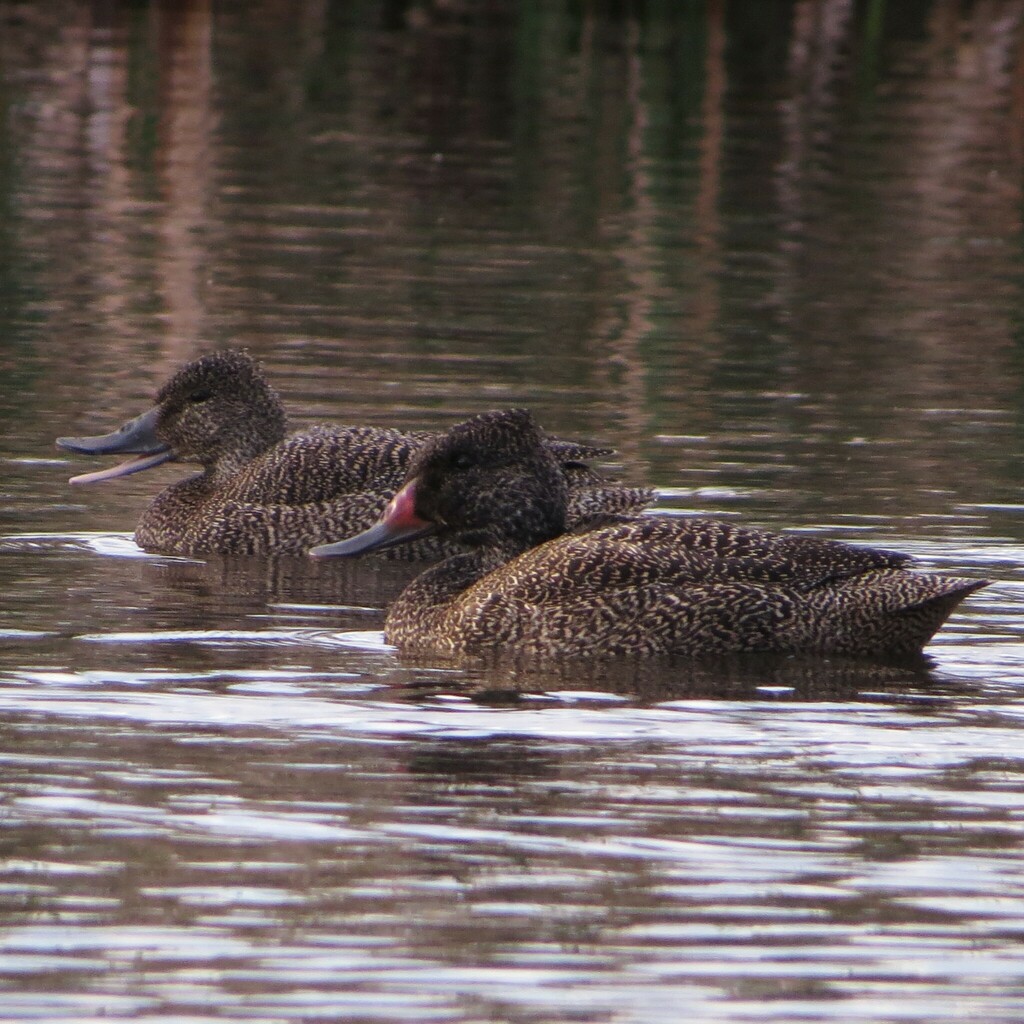
Freckled Duck
Photo © pimelea
Photo © pimelea — CC BY 4.0 — Source: iNaturalist #190312234Identification
The freckled duck is a distinctive waterfowl with a striking appearance. Adults are characterised by dark grey to black plumage densely covered with small white flecks, giving them their distinctive 'freckled' look. Both males and females share slate grey feet, legs, and bills. Adults measure 50–60 cm in length, with males slightly heavier on average (700–1200 g) than females (600–1200 g). During breeding season, males develop red colouration at the base of their bill (culmen), with deeply red males indicating prime reproductive condition and dominance status.
Young freckled ducks look quite different from adults, bearing uniform light grey plumage as hatchlings and juveniles. They retain this pale colouration until around their 32nd week, when they undergo a full body moult to acquire the speckled adult plumage. This dramatic change in appearance is an important clue for identifying birds of different ages in the field.
Range & Habitat
The freckled duck is endemic to Australia, found mainly throughout inland regions of the Eastern section of the country, including New South Wales, Victoria, and Queensland, with populations also present in South Australia and Western Australia. Distribution closely follows water availability, with major populations located within the Paroo-Warrego catchment (Currawinya Lakes), Eyre-Georgine-Mulligan catchment (Lake Torquinie), Cooper's Creek catchment, and Lake Gregory in central north Western Australia.
The species exhibits distinct habitat preferences depending on the season. For breeding, freckled ducks favour large bodies of fresh water with thick vegetation, particularly recently flooded wetland systems and swamps. After breeding, they disperse to more coastal areas with permanent bodies of water such as lakes, reservoirs, and ponds that are typically more exposed with minimal vegetation. The freckled duck does not follow a distinct migratory pathway but sometimes travels considerable distances to locate suitable breeding habitat.
Behaviour & Diet
Freckled ducks are highly gregarious birds, forming flocks ranging from 10 to 100 individuals, particularly outside the breeding season. During breeding, these large flocks break into smaller sub-units scattered throughout wetland systems. Despite their social nature, they display little demonstrative behaviour towards one another, communicating through cryptic gestures and few visible interactions. Quarrelsome interactions are the rare exception to their generally peaceful demeanour.
As specialist filter feeders, freckled ducks consume a versatile diet of aquatic vegetation, insects, algae, larvae, and crustaceans. They prefer feeding in shallow water, using their bills to strain food particles from mud and sand. Water bodies are essential for their natural behaviours including feeding, mating, and bathing. These ducks are polygamous, forming short-term seasonal monogamous pairs in the wild. Males defend receptive females and help construct and defend nest sites during the pre-egg laying stage but depart before eggs are laid and take no role in rearing offspring.
Best Time & Places to See It
The freckled duck's visibility varies seasonally and geographically. These birds are usually present in mainland Australian inland regions but disperse to coastal and subcoastal wetlands during the dry period. During dispersal times, freckled duck populations often congregate in flocks in particular areas, giving the impression they are more common than they actually are—making these congregation periods ideal for observation.
Prime locations include Currawinya Lakes, Lake Torquinie, Cooper's Creek catchment, the Barkley Tablelands, the Bulloo River catchment, and Lake Gregory in Western Australia. However, habitat destruction and droughts have significantly impacted populations, making sightings less predictable than in the past. Several wildlife institutions including Hunter Wetlands Centre Australia, Melbourne Zoo, Healesville Sanctuary, and Tidbinbilla Nature Reserve maintain breeding programs and may offer captive viewing opportunities.
Photography Tips
The freckled duck's distinctive dark plumage with white flecking creates excellent contrast for photography, particularly in good light. The cryptic nature of these birds and their preference for vegetated wetlands can make photography challenging—approach slowly and quietly to avoid dispersing flocks. Males in breeding condition display vibrant red colouration at the bill base, which can provide striking detail shots during the breeding season.
Patience is essential when photographing freckled ducks, as they demonstrate minimal demonstrative behaviour and tend to be relatively unobtrusive. Look for congregations during dry periods in coastal wetlands, where concentrated populations provide better photographic opportunities. Early morning light will best highlight the white flecking against their dark plumage, while detail shots of breeding males' red culmen require careful positioning to capture the subtle colouration accurately.
Uluru-Kata Tjuta National Park
Petermann, Australia
+146 birds+10 mammals
Uluru-Kata Tjuta National Park is one of Australia’s most iconic protected areas, renowned for its breathtaking desert landscapes, extraordinary geological formations, and deep cultural significance. Located…
VIEW NATIONAL PARKKakadu National Park
Kakadu, Australia
+273 birds+46 mammals
Kakadu National Park is Australia’s largest national park and one of the world’s most remarkable protected areas, covering nearly 20,000 square kilometres in the tropical north…
VIEW NATIONAL PARKDaintree National Park
Dedin, Australia
+362 birds+37 mammals
Daintree National Park is one of the world’s oldest and most biologically diverse tropical rainforests, protecting an extraordinary landscape where ancient forests meet the Great Barrier…
VIEW NATIONAL PARKChiltern-Mt Pilot National Park
Australia
+229 birds+12 mammals
Granite ridges and eucalyptus woodlands define this 869-square-kilometre park straddling the border between Victoria and New South Wales, where rugged terrain rises sharply from gentler foothill…
VIEW NATIONAL PARKBelair National Park
Adelaide, Australia
+126 birds+18 mammals
Eucalyptus woodland and native shrubland cloak the low hills of this Adelaide park, where ancient quartzite ridges rise above the plains of South Australia's densest metropolitan…
VIEW NATIONAL PARKLockyer National Park
Australia
+130 birds+5 mammals
Steep ridges and weathered escarpments rise from the Brisbane Valley in southeastern Queensland, where Lockyer National Park sprawls across 267 square kilometres of eucalypt woodland and…
VIEW NATIONAL PARKMorton National Park
Australia
+253 birds+57 mammals
Across nearly 4,800 square kilometers of New South Wales's Southern Tablelands, rugged sandstone plateaus rise above sheltered valleys where cool-climate eucalypt woodland meets grassy heath and…
VIEW NATIONAL PARKBribie Island National Park
Brisbane, Australia
+284 birds+20 mammals
Across tidal flats and shallow waterways north of Brisbane, Bribie Island National Park spreads across nearly four hundred square kilometres of subtropical coastal wilderness—a patchwork of…
VIEW NATIONAL PARKFlinders Chase National Park
Australia
+142 birds+14 mammals
Granite ridges and windswept mallee scrubland define this 1,630-square-kilometre expanse on Kangaroo Island, where ancient rock formations rise abruptly from coastal heathland and woodland mosaics. The…
VIEW NATIONAL PARKGrampians National Park
Australia
+214 birds+18 mammals
Where sandstone ridges rise above the Western District of Victoria, Grampians National Park unfolds across rolling terrain sculpted by ancient geology and sustained by a temperate…
VIEW NATIONAL PARKGreat Otway National Park
Australia
+255 birds+42 mammals
Temperate rainforest and wet eucalyptus woodland cloak the ridges and gullies of Victoria's Great Otway National Park, where persistent moisture and mild year-round temperatures sustain a…
VIEW NATIONAL PARKMurray-Sunset National Park
Australia
+205 birds+2 mammals
Across the semi-arid borderlands of northwestern Victoria, where the Murray River defines the state's edge, sprawls a landscape of remarkable resilience and subtle beauty. Murray-Sunset National…
VIEW NATIONAL PARKCoorong National Park
Australia
+217 birds+15 mammals
Where the Murray River meets the Southern Ocean, a chain of shallow lagoons stretches across the South Australian coast, separated from the sea by a ribbon…
VIEW NATIONAL PARKStirling Range National Park
Australia
+149 birds+7 mammals
Where ancient quartzite ranges rise abruptly from the southwestern Australian plateau, Stirling Range National Park unfolds as a realm of dramatic escarpments, deep valleys, and surprising…
VIEW NATIONAL PARKNo community photos yet. Log in to add the first one.
No community observations of this species yet.