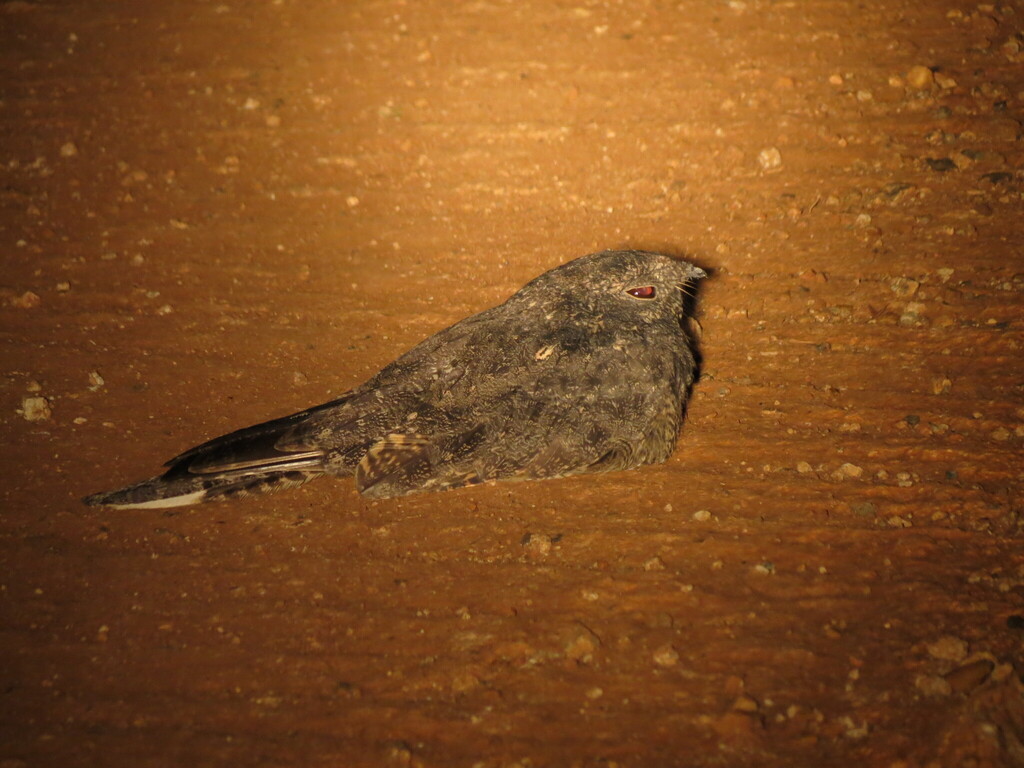
Freckled Nightjar
Photo © alanbedfordshaw
Photo © alanbedfordshaw — CC BY-SA 4.0 — Source: iNaturalist #302166568Identification
The Freckled Nightjar is a large, powerfully-built nightjar with long wings and a relatively short tail. From a distance, it appears dark gray or nearly black, but closer inspection reveals distinctive white, cinnamon, and pale buff freckling across the upperparts. The underparts are dark brown with whitish and cinnamon barring—plumage that provides excellent camouflage against rocky surfaces where it spends its days.
Sexual dimorphism is visible in flight: males display small white spots on the four outer primary feathers and white tips on their two outer tail feathers, while females show 3–4 smaller white spots on the primaries with no white on the tail. When perched with wings folded, these diagnostic marks are hidden, making resting birds challenging to identify.
Range & Habitat
This species has a wide but patchy distribution throughout sub-Saharan Africa, from West Africa to the east and south. It is scarce in western regions but becomes increasingly common toward the east. In southern Africa, it is a year-round resident of colder, drier areas, most frequently encountered in Zimbabwe, northern and eastern Botswana, western Mozambique, and eastern South Africa.
The Freckled Nightjar roosts during the day on bare or lichen-covered rock surfaces, whether in open ground or vegetated areas, and can tolerate surface temperatures up to 60°C. At night, it forages in nearby woodlands and open areas, often perching in the middle of roadways.
Behaviour & Diet
Crepuscular and nocturnal, this species is highly adapted to its rocky environment. Remarkably, it has the capacity to enter torpor during the coldest, driest seasons when food becomes scarce. Its diet consists primarily of flying insects including moths, termites, and chafers, supplemented by beetles, butterflies, cockroaches, mantids, lacewings, antlions, grasshoppers, bees, wasps, and ants. Its notably large gape—larger than any other nightjar—allows it to swallow whole insects up to 3.5 cm long.
Freckled Nightjars are monogamous with long-lasting pair-bonds, exhibiting strong site fidelity and often reusing the same nesting sites year after year. They are rupicolous breeders, laying clutches of two eggs in barren natural hollows within rock formations. Females incubate during the day while males share night duties. Chicks are highly mobile within 24 hours of hatching and fledge at 19–20 days old, well-camouflaged by the surrounding rocks.
Best Time & Places to See It
The breeding season varies by region: in eastern Africa, egg-laying occurs from September to November or May to June; in southern Africa, from August to December with peaks in September–November; and in Nigeria, from January to May. Early morning and evening are the best times to locate this species by its distinctive calls, particularly during breeding season.
Seek this nightjar in its stronghold regions of Zimbabwe, Botswana, and South Africa, where it is relatively common. Rocky outcrops and areas with suitable roosting boulders in open or semi-vegetated landscapes offer the best opportunities. Roadside vigils at night may reward patient observers, as the species frequently perches on road surfaces.
Photography Tips
Photographing Freckled Nightjars requires patience and specialized night-vision equipment or infrared lighting, as they are strictly nocturnal. During daylight, locate roosting birds on rocky substrates; their camouflage is excellent, so scan lichen-covered boulders and rock faces carefully. A headlamp with a red filter will minimize disturbance during night searches.
In flight, use fast shutter speeds to capture the diagnostic white spots on the primaries and tail feathers of males. Early morning and late evening offer better natural light than deep night. Avoid sudden movements when approaching roosting birds, as they may flush easily. Patience near suitable habitat at dusk or dawn, combined with knowledge of their calls, yields the best photographic opportunities.
Serengeti National Park
Tanzania
+558 birds+57 mammals
Across Tanzania's northern plateau, where volcanic soils meet acacia woodland and open grassland, unfolds one of Earth's most dynamic ecosystems. The Serengeti National Park sprawls across…
VIEW NATIONAL PARKMapungubwe National Park
Musina Local Municipality, South Africa
+358 birds+29 mammals
Where the Limpopo River cuts through sandstone ridges at the convergence of South Africa, Botswana, and Zimbabwe, Mapungubwe National Park preserves a landscape of profound ecological…
VIEW NATIONAL PARKChobe National Park
Botswana
+446 birds+45 mammals
Where the Chobe River cuts a sinuous path through northern Botswana, the landscape transforms into one of Africa's most dynamic wetland-savanna mosaics. This national park encompasses…
VIEW NATIONAL PARKKhaudum National Park
Botswana
+213 birds+13 mammals
Where the Okavango's northern tributaries meander through miombo woodland and riverine forest, Khaudum National Park unfolds across a landscape of profound ecological richness and isolation. This…
VIEW NATIONAL PARKKidepo Valley National Park
Uganda
+478 birds+24 mammals
Where the Narus and Kidepo rivers carve through northeastern Uganda's semi-arid lowlands, a landscape of sparse acacia woodland, grassland, and riverine thickets creates one of East…
VIEW NATIONAL PARKMurchison Falls National Park
Uganda
+608 birds+33 mammals
Where the Victoria Nile compresses through a narrow gorge and explodes across a 45-meter precipice, the landscape speaks in thunder. Murchison Falls National Park sprawls across…
VIEW NATIONAL PARKLake Mburo National Park
Uganda
+505 birds+24 mammals
Rolling acacia woodland and scattered lakes define this intimate savanna preserve in southwestern Uganda, where the rift valley's geological drama shapes every water source and grassland.…
VIEW NATIONAL PARKTsavo East National Park
Athi ward, Kenya
+468 birds+50 mammals
Across the semi-arid lowlands of southeastern Kenya, where acacia woodland fragments into scrubland and the landscape rolls toward the Indian Ocean horizon, lies one of Africa's…
VIEW NATIONAL PARKTsavo West National Park
Mwatate, Kenya
+513 birds+49 mammals
Where volcanic ridges and weathered lava flows meet the semi-arid lowlands of south-central Kenya, Tsavo West National Park unfolds across a landscape sculpted by fire and…
VIEW NATIONAL PARKTarangire National Park
Tanzania
+527 birds+50 mammals
Acacia woodland and grassland sweep across the Manyara Region where the Tarangire River carves through low hills and volcanic soils, creating one of East Africa's most…
VIEW NATIONAL PARKNgorongoro Conservation Area
Tanzania
+626 birds+55 mammals
Volcanic calderas and open grassland dominate this high plateau in northern Tanzania, where the landscape rises above 2,000 metres and ancient geological forces have shaped both…
VIEW WILDLIFE MANAGEMENT AREAQueen Elizabeth National Park
Uganda
+672 birds+30 mammals
Across the southwestern escarpment of Uganda, where the Western Rift Valley descends through ancient volcanic terrain, Queen Elizabeth National Park sprawls across more than 8,300 square…
VIEW NATIONAL PARKCederberg Wilderness Area
Cederberg Local Municipality, South Africa
+136 birds+12 mammals
Where ancient sandstone ridges rise dramatically from the semi-arid lowlands of Western Cape, the Cederberg Wilderness Area spreads across nearly 1,700 square kilometres of some of…
VIEW NATIONAL PARKKruger National Park
Ba-Phalaborwa Local Municipality, South Africa
+540 birds+91 mammals
Across the low-lying savanna of northeastern South Africa unfolds one of Africa's largest and most ecologically intact protected areas, where acacia woodlands merge into mopane scrub…
VIEW NATIONAL PARKTankwa-Karoo National Park
Hantam Local Municipality, South Africa
+201 birds+20 mammals
Across the semi-arid heartland of the Northern Cape, where winter rains carve ephemeral watercourses through endless ochre plains, Tankwa-Karoo National Park sprawls across more than 3,100…
VIEW NATIONAL PARKAugrabies Falls National Park
Kai !Garib Local Municipality, South Africa
+176 birds+20 mammals
Where the Orange River cuts a dramatic scar through the Northern Cape's arid interior, Augrabies Falls National Park sprawls across nearly 1,200 square kilometers of raw,…
VIEW NATIONAL PARKIthala Game Reserve
uPhongolo Local Municipality, South Africa
+328 birds+26 mammals
Rolling thornbush savanna and acacia woodland dominate the landscape of this 494-square-kilometre national park in KwaZulu-Natal's uPhongolo Local Municipality, where granite outcrops punctuate grassland plateaus and…
VIEW NATIONAL PARKMarakele National Park
Modimolle Local Municipality, South Africa
+341 birds+36 mammals
Granite ridges and sprawling grasslands dominate this 1,176-square-kilometre reserve in Limpopo's heartland, where bushveld transitions between rocky outcrops and open savanna. The park's rugged topography creates…
VIEW NATIONAL PARKKhaudum National Park
Namibia
+221 birds+13 mammals
Where the Kavango River flows through northeastern Namibia, vast miombo woodlands and riverine forests create one of southern Africa's most remote and biodiverse wilderness corridors. Khaudum…
VIEW NATIONAL PARKSperrgebiet National Park
Barcelona, Namibia
+181 birds+18 mammals
Where the Namib's ancient gravel plains meet the Atlantic coast, one of Africa's most remote and geologically austere landscapes unfolds across more than 56,000 square kilometres.…
VIEW NATIONAL PARKDorob National Park
Henties Bay, Namibia
+230 birds+13 mammals
Where the Skeleton Coast meets the Namib Desert's inland reaches, Dorob National Park sprawls across 34,021 square kilometres of one of southern Africa's most austere and…
VIEW NATIONAL PARKNamib-Naukluft National Park
Namibia
+217 birds+33 mammals
Across nearly 94,000 square kilometers of southwestern Namibia, a landscape of extremes unfolds where towering sand dunes meet rugged mountain ranges, and ancient riverbeds carve through…
VIEW NATIONAL PARKEtosha National Park
Namibia
+356 birds+58 mammals
Across northern Namibia's stark semi-arid plateau, a vast shallow depression transforms seasonally into one of Africa's most dramatic wildlife theaters. Etosha National Park, encompassing more than…
VIEW NATIONAL PARKWaterberg Plateau National Park
Okambukonde, Namibia
+198 birds+27 mammals
Where ancient sandstone cliffs rise 200 metres above the surrounding bushveld, a fortress of geology creates one of southern Africa's most compelling ecosystems. The plateau's steep…
VIEW NATIONAL PARKAbijata-Shalla Lakes National Park
Ethiopia
+438 birds+7 mammals
Two crater lakes of contrasting chemistry define this remote corner of Ethiopia's Rift Valley, where soda lakes and freshwater basins create a mosaic of distinct aquatic…
VIEW NATIONAL PARKNairobi National Park
Nairobi, Kenya
+515 birds+35 mammals
Just minutes from Kenya's capital, where the Nairobi River winds through acacia woodland and open grassland, lies one of Africa's most paradoxical wildlife sanctuaries. The park's…
VIEW NATIONAL PARKLake Nakuru National Park
Nakuru West, Kenya
+494 birds+32 mammals
Alkaline waters ringed by acacia woodland and grassland create one of East Africa's most distinctive wetland ecosystems, where the interplay of geology and climate sustains a…
VIEW NATIONAL PARKMeru National Park
Igembe Central, Kenya
+408 birds+38 mammals
Granite outcrops and acacia woodland rise across the northern reaches of Meru, where semi-arid savanna transitions into drier scrubland under the fierce equatorial sun. The park's…
VIEW NATIONAL PARKSamburu National Reserve
Samburu, Kenya
+430 birds+42 mammals
Across the arid plains of northern Kenya, where scattered acacia woodland gives way to rocky outcrops and dry riverbeds, Samburu National Park unfolds as one of…
VIEW NATURE RESERVEHell’s Gate National Park
Olkaria ward, Kenya
+388 birds+18 mammals
Volcanic scarps and geothermal vents dominate the floor of Hell's Gate, where the East African Rift has carved a dramatic gorge through crystalline rock formations. The…
VIEW NATIONAL PARKNo community photos yet. Log in to add the first one.
No community observations of this species yet.