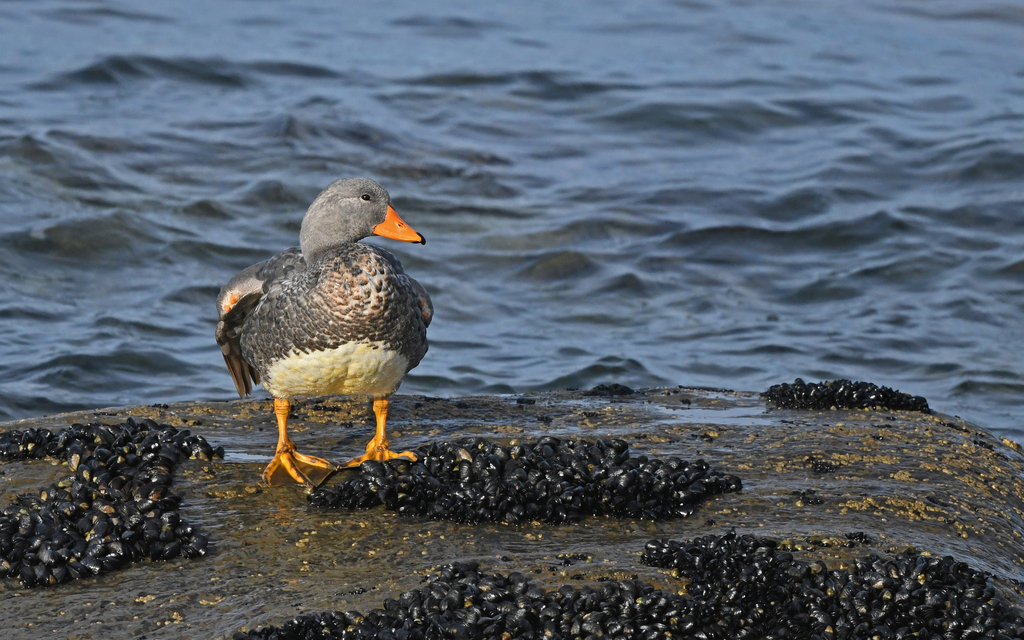
Fuegian Steamer Duck
Photo © Christoph Moning
Photo © Christoph Moning — CC BY 4.0 — Source: iNaturalist photo #376751853Identification
The Fuegian Steamer Duck is the largest of the steamer duck species and one of the heaviest wild ducks in the world, weighing 3.5–7 kg and measuring 65–84 cm in length. Males are noticeably larger than females, averaging 5.34 kg compared to females' 4.2 kg. Despite their impressive size, these ducks are flightless; their wings, spanning only 85–110 cm, are too small for flight and instead function as paddles to propel them rapidly across the water's surface.
Males display distinctive plumage with a blue-gray head and neck, a paler crown and forehead, and a narrow white eye-ring that extends backward as a stripe. Their throat is reddish-brown, while the abdomen, ventral area, and undertail coverts are white, with a grey tail. Females are darker, with a grey-brown head and dark reddish throat, and may show brown or wine-colored feathering on their bodies. Juveniles resemble females but with slightly duller coloration.
Range & Habitat
This species is native to South America, inhabiting the rocky coasts and coastal islands from southern Chile and Chiloé to Tierra del Fuego. During breeding season, they move to adjacent sheltered bays and lakes further inland, before returning to coastal areas outside the breeding period.
Behaviour & Diet
Fuegian Steamer Ducks live principally on saltwater molluscs, crustaceans, and small fish. During breeding season, they and their young consume small snails, insect larvae, amphipods, and isopods. These birds nest between September and December, either in dense shrubby vegetation near water or in abandoned penguin nest burrows. Females typically lay clutches averaging 9 eggs (ranging from 4 to 11), with incubation lasting 28 to 40 days. Young fledge at 120–130 days and become sexually mature at 2 to 3 years old.
Adult males are locally infamous for their extreme aggression during mating season, attacking not only their own species but also other waterfowl with their powerful, spurred wings. However, these same males may peacefully join mixed-species winter flocks. While eggs and young face predation from foxes, caracaras, gulls, skuas, and giant petrels—and occasionally marine otters—healthy adults have no known natural predators.
Best Time & Places to See It
The breeding season from September through December is an excellent time to observe these birds, as they move to sheltered bays and inland lakes. The rocky coasts and coastal islands from southern Chile and Chiloé through Tierra del Fuego offer reliable viewing opportunities year-round, with birds returning to coastal areas outside the breeding season.
Photography Tips
The Fuegian Steamer Duck's striking size and bold coloration make it a rewarding photographic subject. Look for the distinctive male plumage—the blue-gray head contrasting with the reddish-brown throat and white underparts. Capturing their characteristic behavior of skimming rapidly across water using their wings as paddles offers dynamic action shots. The contrast between males and females provides compositional variety. Exercise caution when photographing during breeding season, as males are notoriously aggressive.
Chiloé National Park
Dalcahue, Chile
+122 birds+6 mammals
Temperate rainforest cloaks the Chiloé archipelago's northwestern reaches, where granite ridges thrust through dense, moisture-laden canopy and freshwater streams carve ravines toward the Pacific. Across approximately…
VIEW NATIONAL PARKCabo de Hornos National Park
Cape Horn, Chile
+88 birds+9 mammals
Where the Andes plunge into the Southern Ocean and the Drake Passage churns between two continents, Cabo de Hornos National Park sprawls across one of Earth's…
VIEW NATIONAL PARKReserva Nacional Magallanes
Punta Arenas, Chile
+78 birds+2 mammals
Where windswept steppe meets sub-Antarctic forest near the southern tip of continental South America, Reserva Nacional Magallanes unfolds across roughly 352 square kilometres of profound ecological…
VIEW NATIONAL PARKNo community photos yet. Log in to add the first one.
No community observations of this species yet.