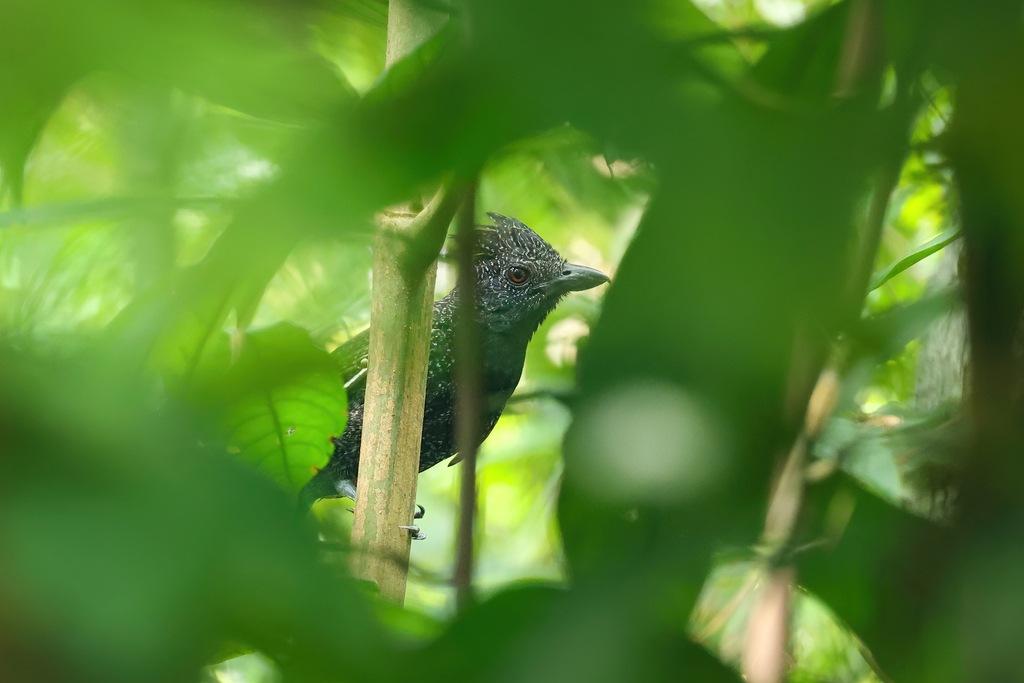
Fulvous Antshrike
Photo © Thibaud Aronson
Photo © Thibaud Aronson — CC BY-SA 4.0 — Source: iNaturalist #198768137The fulvous antshrike (Frederickena fulva) is a species of bird in subfamily Thamnophilinae of family Thamnophilidae, the "typical antbirds". It is found in Colombia, Ecuador, and Peru. == Taxonomy == The fulvous antshrike's taxonomy is unresolved. The South American Classification Committee of the American Ornithological Society (SACC), the International Ornithological Committee, and the Clements taxonomy treat it as a full species. BirdLife International's Handbook of the Birds of the World (HBW) treats the taxon as a subspecies of the undulated antshrike (F. unduliger). The fulvous antshrike is monotypic. == Description == The fulvous antshrike is a large dark antbird, 22 to 25 cm (8.7 to 9.8 in) long and weighing 75 to 85 g (2.6 to 3.0 oz). The species exhibits significant sexual dimorphism, though both sexes have a crest, a brown to orange-yellow iris, a heavy black bill with a hook at the end like true shrikes, and black or dark gray legs and feet. Adult males are mostly black with irregular thin white bars everywhere but the throat. The bars on the face and crest are broken and appear as small spots. Adult females are mostly rich cinnamon with wavy black bars; their forehead and crest are darker…
Yasuní National Park
Aguarico, Ecuador
+601 birds+43 mammals
Where the western Amazon basin converges with Ecuador's Orellana Province, lowland rainforest reaches toward the horizon in an unbroken canopy of staggering botanical density. Yasuní National…
VIEW NATIONAL PARKSumaco Napo-Galeras National Park
Loreto, Ecuador
+563 birds+4 mammals
Where Ecuador's Amazon transitions into cloud forest, a massive shield volcano rises from the emerald lowlands of Orellana Province, anchoring one of the continent's most biodiverse…
VIEW NATIONAL PARKAmacayacu National Park
Leticia, Colombia
+567 birds+25 mammals
Where the Rio Amazonas curves through the tri-border region where Colombia, Peru, and Brazil converge, Amacayacu National Park sprawls across more than 5,250 square kilometres of…
VIEW NATIONAL PARKNo community photos yet. Log in to add the first one.
No community observations of this species yet.